hand hold with slower speeds

>>If your shutter speed is slower than the reciprocal of the focal length of your lens, you must use a tripod.<<

I'll admit it's a good rule of thumb. But the essence of RF photography is having a small, discrete camera with you when unexpected shots present themselves. Alfred Eisenstaedt shot primarily the Leitz Elmar 35/3.5 and said he had trained himself to use it reliably down to 1/4th of a second. Walls, posts and elbows on tables can all become makeshift tripods or monopods. Just a few days ago I set my camera on a napkin holder at a cafe and used the self timer to eliminate camera shake.
 
Carry a monopod, strap it to walk around bag, disguise as umbrella if sensitive, use in self defence if attached and outnumbered.

Shoot immediately using best hand held technique, then shoot again braced, pillars & walls seats etc. are your friends at 1/30 and below with normal (focal length) lens. If the pillar is slim wrap an arm around brace camera to pillar. Checklist focus, aparture and speed somewhere in sequence... shots remaining if you are near to 36...

Then set up monopod if you have time. You need to practice both with monopod and/or without one.

Go for shot at risk if you need to, buy a 1.4 in your focal length, be prepared to push whole reel for a winner - two bath etc.

If it is a night shoot and static you need a heavy tripod, a pad with velvet, for auto suppression etc.

Vince is right, unless you have a view camera

Noel
 
Xmas said:
Carry a monopod, strap it to walk around bag, disguise as umbrella if sensitive, use in self defence if attached and outnumbered.

Ha... this reminds me of an experience I had photographing in Knareborough Yorkshire many years ago. I was shooting the castle with a TLR and monopod. The monopod seems to have been an object of interest trhoughout the UK. I found that odd... but I digress. On this day the sky was perfect and there were a pair of the most handsome older women Iv'e ever seen sitting on the bench in the foreground of my shot. As I was composing, a child,about 12 years old, stood next to me and shouted to one of the women "Mum, what is this man doing?" She shouted back "he's a photographer, dear; he's photographing the castle." He returned the shout "what is that odd appliance he is using?" She replied "I don't know, but I wouldn't stand too close to him." All the time she maintained an extrordinary pose for me. The photos are magnificent. At the end I nodded and we exchanged distant pleasantries.

Prior to that, however, when entering the ocuntry at Heathrow... the cops gave me the "third degree"... "what is this?; Is it an aerial?; Is it electrical?; Is it a weapon?; If it only has one leg, how does it hold up a camera?
 
If I'm not tired or just finished exerting myself, 1/8th is generally the slowest speed I can manage while truly handholding (i.e., standing up w/no support whatsoever). I can get down to 1/4th or so if I'm sitting down, leaning against something, etc. & even slower if I rest my elbows on a table or use "found tripods" (like Vince's napkin holders--I like beverage glasses myself) but @ that point subject movement is really the biggest problem. I use the same techniques I was taught for shooting firearms (controlling breathing, stabilizing the body, etc.), but most of it is just practice, practice, practice. You might want to try "dry firing" your camera w/no film in it @ slow shutter speeds. The advantage of doing this w/an RF is that you can see what's happening @ the moment of exposure.

Also, I've read that Cartier-Bresson actually did exercises to strengthen his arms (Leica curls?), & I have to say that my handholding abilities were better when I worked out regularly.

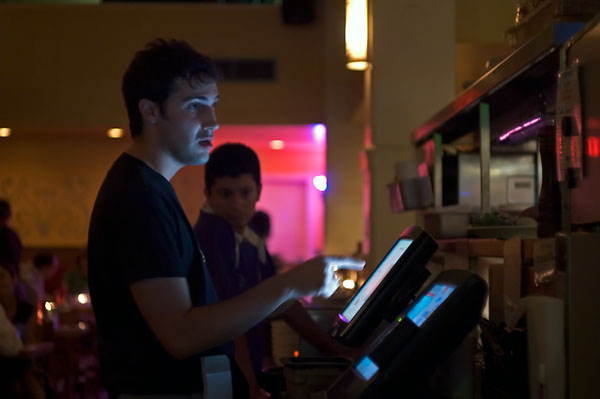
Here's a fairly recent example of a snap I took while sitting down @ my local diner:

226208951_0b3ed78c0c_o.jpg


http://www.flickr.com/photos/furcafe/226208951/

According to the EXIF data, which you can access from the link, the shutter speed was 1/11th sec.

Here's an old shot that I took @ 1/8th sec., according to my records (I've been keeping exposure notes on a PDA for the past 5 years or so):

37827926_084e21a352_o.jpg


http://www.flickr.com/photos/furcafe/37827926/

nzeeman said:
i always ask myself what slow speed one can effectively hand hold and get decent photos (with normal 50mm lens). i can only 1/30 but from time to time i see that some people claim they can hand hold 1/8? so tel me what you can and maybe share some advices. we also can put some of our available light handheld photos in this topic. that also would be very helpful for other members i think.
 
Last edited:
I'll second what Twigs said, but I'll say that it's necessary to have one's elbows pressed tight against one's torso.

No difference between different kinds of eye-level camera, really. I routinely went down to 1/8 or 1/4 sec. with my Canon manual reflexes, M3 and Canon VT Deluxe. Normal or wide lenses, of course, and only when I was able to stand or sit still, preferably with something to lean against or on which to rest my elbows. In place of the last two, I now have a IIIc and a Canon digicam. Haven't quite got the hang of the IIIc's different size and release location, so shake is a danger at 1/20 sec. and slower. The digicam's optical finder is worthless, so it's a whole different, er, game of balls.
 
- Now, wait a minute! Think about it! This discussion could soon turn into 'who's the most stupid photographer around'.

If the goal is 'sharp pictures'; mount your camera to a solid tripod! Sure. A lot of soft press photos are seen around. Regularly I see press photos where the photographer has'nt understood how to set his E-TTL (or the Nikon equaliant) right, even on the front pages of the World Press. The pictures are not only very unprofessionally unsharp, they are just laughable. These people of the press can't be taken seriously in this matter, - most of the time.

Take pro portrait photographers, or within advertising: They use tripods 'all the time'. Regardless even if the shutter time is 1/125. Why? They know that that is what it takes to make 'dead sharp' pictures.

Some here claim that they get sharp pictures at 1/8 hand held? - Now, com'on!

Let the ten (at least) next exposures you make be with a tripod. Look up the negs (or files) and you will see what I mean.
 
these are good points

these are good points

but often when taking candids in available light you can't setup a tripod or the subject will be gone. The other day I took a shot at 1/13 (digital) at equiv of ~ 100mm for 35mm, 400 ASA, 2.8 Leica lens. The IS probably helped, but it's a very usable photo, posted in the shallow DOF portrait thread. Probably later in the day with more cups of coffee, it would have been less sharp ...

Olsen said:
- Now, wait a minute! Think about it! This discussion could soon turn into 'who's the most stupid photographer around'.

If the goal is 'sharp pictures'; mount your camera to a solid tripod! Sure. A lot of soft press photos are seen around. Regularly I see press photos where the photographer has'nt understood how to set his E-TTL (or the Nikon equaliant) right, even on the front pages of the World Press. The pictures are not only very unprofessionally unsharp, they are just laughable. These people of the press can't be taken seriously in this matter, - most of the time.

Take pro portrait photographers, or within advertising: They use tripods 'all the time'. Regardless even if the shutter time is 1/125. Why? They know that that is what it takes to make 'dead sharp' pictures.

Some here claim that they get sharp pictures at 1/8 hand held? - Now, com'on!

Let the ten (at least) next exposures you make be with a tripod. Look up the negs (or files) and you will see what I mean.
 
Olsen said:
Regularly I see press photos where the photographer has'nt understood how to set his E-TTL (or the Nikon equaliant) right, even on the front pages of the World Press. The pictures are not only very unprofessionally unsharp, they are just laughable. These people of the press can't be taken seriously in this matter, - most of the time.


Are you saying there are world press photo laureats that should have used a flash instead of shooting available light... so their pictures would be sharper? Thanks for the laugh.

If you go about insulting worldpressphoto winners you better have the gallery to back it up. Let's see it!
 
Olsen said:
- Now, wait a minute! Think about it! This discussion could soon turn into 'who's the most stupid photographer around'.

If the goal is 'sharp pictures'; mount your camera to a solid tripod! Sure. A lot of soft press photos are seen around. Regularly I see press photos where the photographer has'nt understood how to set his E-TTL (or the Nikon equaliant) right, even on the front pages of the World Press. The pictures are not only very unprofessionally unsharp, they are just laughable. These people of the press can't be taken seriously in this matter, - most of the time.

Take pro portrait photographers, or within advertising: They use tripods 'all the time'. Regardless even if the shutter time is 1/125. Why? They know that that is what it takes to make 'dead sharp' pictures.

Some here claim that they get sharp pictures at 1/8 hand held? - Now, com'on!

Let the ten (at least) next exposures you make be with a tripod. Look up the negs (or files) and you will see what I mean.

That’s quite an opinion you have there, unfortunately I don’t share it, 35mm is made for ease and mobility, yes MF makes more sense on a tripod but 35mm is a suck-it-and-see format, image first and the technical qualities second, works for me, sorry
 
ampguy said:
but often when taking candids in available light you can't setup a tripod or the subject will be gone. The other day I took a shot at 1/13 (digital) at equiv of ~ 100mm for 35mm, 400 ASA, 2.8 Leica lens. The IS probably helped, but it's a very usable photo, posted in the shallow DOF portrait thread. Probably later in the day with more cups of coffee, it would have been less sharp ...
- Sure. I do this all the time myself. And pictures I get. Sort of.

But if you have, say a Leica, - imagine, the Leica engineers have foresaken their holidays just so that you can take pictures with optics capable of 350 - 400 line pares per millimetres. Per millimetres! That is technology en par with the Manhattan Project! And here you are flashing the camera about, hand held, like a tourch! They could just as well leave early and equip you with something from mobile phone world with a greasy thumb mark right across the lense.

Why then Leica? Could i suggest Nokia? Or Erichson?
 
Last edited:
Ok

Ok

Got a really nice high-end Nokia or other high end camera phone? I'll trade you my FZ3 with Leica lens for it, maybe.


Olsen said:
- Sure. I do this all the time myself. And pictures I get. Sort of.

But if you have, say a Leica, - imagine, the Leica engineers have foresaken their holidays just so that you can take pictures with optics capable of 350 - 400 line pares per millimetres. Per millimetres! That is technology en par with the Manhattan Project! And here you are flashing the camera about, hand held, like a tourch! They could just as well leave early and equip you with something from mobile phone world with a geasy thumb mark right across the lense.

Why then Leica? Could i suggest Nokia? Or Erichson?
 
There's a rule of thumb I go by that is the reciprocal of the focal length, meaning about 1/50th for a 50mm lens, etc. But I can reliably hand hold a shot, braced somehow, at least half those speeds. I like a bit of blur, anyway. Now, here's something I would like advice on:

I'm about to start a project using an ND 3.0 filter, which cuts ten stops (it's virtually black when you look through it, like a welder's glass) and a really slow ADOX black and white film at ISO 25. Is there reciprocity failure in b&w film, and if so, can anyone give me any idea how much to compensate? I'm first going to try some tests so I'll probably have the answer when I get the film processed... I will shoot at the light meter recommended speed then try one and two stops of exposure greater. What I'm hoping to do is get virtually empty streets, except for the person or vehicle that is parked, asleep or standing stock still. I'll be shooting with my 50mm lens as it is the only one with a 52mm filter thread, and that's the size of this filter. Should be interesting. I'll definitely get the negs digitized: wish I had a film scanner!!
 
I've used a tripod maybe twice in my life. I own a pretty nice one too. Flash? I've used one once or twice. Don't even own one anymore. Tripod and flash is too much crap to lug around, especially when I just want to carry one lens, one camera, and go. Personally, if I only worried about ultimate sharpness I wouldn't shoot with a 40 year old lens wide open at f/1.2. I sure as hell wouldn't shoot it at 1/8-1/15s either. These aren't sharp pictures, they're usable pictures. Sometimes, thats all that matters. Besides, when I'm shooting at such slow speeds, I'm usually in bars, or some band is playing, etc. Tripods and flash don't go over too well in those environments.

If I wanted to lug out a camera and take pictures of mountains and clouds and deer I would use a tripod, but thats not my style (no offense to anyone who likes those types of photos).

I'm not attacking the "use a tripod" people, but we all know what we were taught in Introduction to B&W Photography. I don't believe we need that info rehashed to us. However, most of us, I believe, have realized what we like and the type of photographs we want to take. If that means not using a tripod or flash, then whats the harm in that?

 
Olsen said:
- Sure. I do this all the time myself. And pictures I get. Sort of.

But if you have, say a Leica, - imagine, the Leica engineers have foresaken their holidays just so that you can take pictures with optics capable of 350 - 400 line pares per millimetres. Per millimetres! That is technology en par with the Manhattan Project! And here you are flashing the camera about, hand held, like a tourch! They could just as well leave early and equip you with something from mobile phone world with a greasy thumb mark right across the lense.

Why then Leica? Could i suggest Nokia? Or Erichson?
Umm. Because there is a whole lot more to a good/successful/whatever image than sharpness. Or resolution. And there is a lot more to Leica/Canon/Nikon/whoever than the resolving power of their lenses.
 
jvx said:
Are you saying there are world press photo laureats that should have used a flash instead of shooting available light... so their pictures would be sharper? Thanks for the laugh.

If you go about insulting worldpressphoto winners you better have the gallery to back it up. Let's see it!

What I am seeing and saying is that many press photographers obviously don't kow how to put their E-TTL flash into the right mode. This is something I see in the press daily. What you get is a combination of available light, but very unsharp and a flash firing. No. This is obviously not the 'laurets', although I am not particularly impressed with the average press photographer. If you lay them as a standard, you don't need much of a camera. - Accept for that I am not that much into 'b&W people photography'.

You find some of my pictures here: http://foto.no/cgi-bin/bruker/dittnavn/index.cgi?brukernavn=tju

- Æhum! Most of them taken hand held, unfortunately...

But I see it myself! Whenever I do use a tripod it is obvious at 100% in PS. You should try it too.

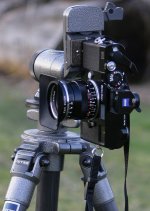
Attached you will find a (hand held) photo of a camera on a tripod. Thanks to a low blow up rate and several kicks on 'sharpen' it is hardly noticable...
 

Attachments

  • WW9B5230copy.JPG
    WW9B5230copy.JPG
    228.2 KB · Views: 0
Press/news photographers are nearly always seeking different images than advertizing photographers, portraitists or serious hobbyists. They are trying to get a moment, and to be in the right place at the right time. Their ability to get the photo fast and sent to the desk fast is preferred over any technical excellence. As in any profession, there are some who are better than others, with many varieties of competencies and individuality.

For some people, rangefinder photography is about having access to 400lpm lenses. But really, for most of us, it's about a small camera that can be carried anywhere and used anytime. I side with Kyle. My goal is technically "usable" and "acceptable" photos that capture a unique moment, not photos with just technical excellence.
 
Last edited:
Back
Top Bottom