Handheld shutter speeds

Not only do we not have a mirror moving around and shaking the camera but we can also see the subject during the 1/15 or 1/8 or even longer.

It's easier to keep still if you can see what you're photographing, and on an SLR the viewfinder goes black for the duration of the exposure.
 
Jon Claremont said:
It's easier to keep still if you can see what you're photographing, and on an SLR the viewfinder goes black for the duration of the exposure.

😱 😕
That sounds magic !! You can keep it quiet or not, and that does not depend on what you see for that 1/8 sec the shutter is open. What you might see , if at all and not always, , is that you have moved while pressing the shutter, but then the damnage is done already.
Sorry, but this seems to be one of these moments when the RF myth turns into satire.

Fitzi
 
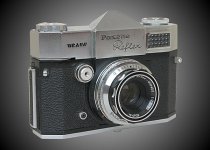
Many many years ago I had an SLR camera I could get hand held shots as slow as 1/8 regularly with, was my Braun Paxette Reflex, but it had two distinct features which I think helped.
1. A very quiet leaf shutter with non-instant return mirror
2. More importantly, a very soft shutter release on the front of the camera which operated at right angles to the usual type of release.
Sadly this is not my camera in the picture.
I find that as I have gotten older, it is more difficult to hand hold slow speeds, probably the result of years of whisky and tobacco!!🙄
 

Attachments

  • paxetteReflexIB01.jpg
    paxetteReflexIB01.jpg
    143.9 KB · Views: 0
Last edited:
John Robertson said:
2. More importantly, a very soft shutter release on the front of the camera which operated at right angles to the usual type of release.
:

John,

actually the shutter release and it's design together with the right "grip" for the right hand is what I keep as much more important than any shutter types or mirror issues. If the shutter is put at a place which makes your hand necessarily move while pressing the button it's getting difficult .

A soft release can help, also an attchable grip, sometimes a halfcase helps too ( a dear friend gave me a halfcase as a gift recently for my Bessa, great !🙂 ) good if your hands a re big and the camera is tiny. A short travel and easy release helps, what usually is described as a quick response.

And most of that mirror vibes are a fairytale form the old time too, I f we do not speak about a F or Nikkormat FTn but for example about a F80 or a modern Minolta Dynax7 the difference is not existing or marginal, compared for example to the metal shutter of a Bessa with that additional blind .

Now the Solms crowd will protest and claim the clothshutter would have less vibes, well I used a M6 for a while and I think if at all the larger mass dampens the shutter more, the shutter itself seems not to work with less vibe.

All all this low light mythos of of RF cameras in general does not mean too much to me, if it comes to people shooting you cannot do much, neither with f 1,4 nor with 1/8 second. It's more luck than ability to get a keeper this way, even if motion blur is part of th concept. Statues at night aren't my obsession .

If at all the RF has a clear advantage then it is the finder's brightness and the focussing precision in the dark. At this point tho it is still unsurpassed I'd say.

Best,
Fitzi

 
Last edited:
My general rule of thumb is: 1/focal length. Add a stop if you're using a rangefinder. Add another if you can really carefully brace yourself, on a table or wall or lying down.

And maybe try one stop slower again, if you're prepared to shoot the frame two or three times and pick the best!

Of course, the basic 1/f assumption goes out the window with formats other than 35mm. More correctly, for example, a standard lens can typically be handheld acceptably well at about 1/50; this applies to an 80mm on 6x6, or a 35mm or therabouts on an APS-C sized sensor, and so on. If you keep what the lens' equivalent 35mm FOV would be in your head, that'll give you a good idea.

Jamie
 
In my own case its still the age ,tobacco, thing that causes the problem. Shooting Konica IR750 (32 ISO) through a dark red filter, I had problems hand holding 1/60 never mind anything longer!!!
 
ernie said:
I find that I can hand hold my Bronica 645RF at lower shutter speeds than any other camera I own. Maybe it is a combination of the ergonomics of the camera and the smooth shutter. Here is a shot taken last weekend on 160ASA film in Wells Cathedral; 1/6th sec hand held with a 65mm lens.

Same here. With the Bronica RF, I've shot at speeds under 1/10th second successfully. I attribute it two things: camera weight and negative size. I think it's easier to hold a larger camera still during long duration shots and the larger negative means less magnification of blur.
 
ferider said:
I always found it interesting that the 2nd Bessa curtains actually steady's the camera, as the two curtains run against each other.

...

Roland.

How does that work? Running against each other?
 
This is probably something really obvious, but it also depends on how close your subject is to you. When the focus is racked out to infinity, the subject would naturally be moving less relative to the image produced. It's another matter altogether when you're focused on something one metre away from you.

Clarence
 
ferider said:
I always found it interesting that the 2nd Bessa curtains actually steady's the camera, as the two curtains run against each other.
Roland.
That's interesting ! I never thought about something like a mass balance in this case. But it possibly has a positive effect, could be.
The mechanical Bessa shutter sounds louder than the vibes would let you expect... , maybe because of these two curtains. And in a direct comparison I found it to be only a bit louder than a M6.

Fitzi
 
ferider said:
Somebody else mentioned, format having an impact, too. Maybe because of weight ? Don't know, but I know that I have been lucky with my 500EL more than once, at 1/30 and 1/15 and the 80 Planar. Maybe because it's heavy, or because the compur is faster than the focal-plane shutter, but it's almost as effective as my M6.

Roland.
Definitely because of the larger negative. You need to enlarge it less, so you are less able to see details like blurring. You might get a soft print, but that is a small price to pay.

With my Canon TLb I can do 1/30th or 1/15th, with acceptable results. My Zorki 4, however, I am not sure about 1/30th or slower.

I have heard, and this makes good science sense, that with leaf shutters, conservation of momentum says that since the force is directed in all directions at once, movement due to shutter is less. Focal plane shutters, however, move only one way (either laterally or vertically), and conservation of momentum steps in a compensates with shake. I still haven't tried out slow shutter speeds with the Seagull, but I would imagine they could be quite slow.

Drew
 
Shooting alot of indoor work with the canon P and either 50 or 35mm lenses, I regularly shoot 1/60 and 1/30 - I've gone as low as 1/8 but my percentages drop quickly with that.
 
I've gotten surprisingly good results at slow shutter speeds with the Fuji GA645Wi, as I think several mentioined factors help. First the larger format is enlarged less, second the wide angle lens means the subject is closer, third the mass of this auto-everything motorized camera, fourth the electronically controlled leaf shutter. If I use target-rifle techniques in squeezing off the shot, then 1/6 or 1/10 sec is not hard to steady.
 
I see all these nice pics taken at much longer exposure times than 1/focal length and I conclude that obsessing over lens sharpness or resolution tests is wasted energy.

A while back, I did some testing with my dSLR and a couple of nice lenses. I shot pictures of an evenly lit brick wall handheld as various shtter speeds from 1/8 up to 1/1000. Then I shot a few more at various shutter speeds with the camera firmly mounted on a sturdy tripod. I looked at the resulting pictures on the computer at 1:1 crops and convinced myself that my best hand-holding form couldn't come close to the resolution achieved from a tripod, even at shutter speeds well above 1/focal length. Try the test yourself.

Once again, the pictures posted by others in this thread look great (at least at the resolution posted). They serve to remind that lens resolution tests are just one of many parameters that contribute to a good photograph and usually not near the top of the importance list.
 
I doubt that the mass of a modern shutter whether leaf or curtain has anything to do with camera shake at low shutter speeds. The mass you're trying to move with the shutter is the combined weight of the camera and your hands and arms.

The mass of the camera opposes the natural twitchiness of your arms. Hence, why I believe that the heavier the camera the more stable the system. (The camera mass damps high frequency body twitches into lower frequency ones).
 
My slowest hand held?

My slowest hand held?

After shooting for over 40 years I was surprised to find that there were rules for this!!! I always thought it was what one could get a way with and that one practiced proper weapon marksmanship technique (which includes controlled breathing).

I can regularly get away with 1/2 second with my M4 if I prop myself, and if no suitable prop is availble I use the standard Leica trick of turning the camera upside down and bracing it against my forehead. I have had luck at one second, but that's luck.
 
Pretty subjective response here, because I don't consider a blurred motion shot to be unfocused...so 1/8 sec on a 35 or even a 50 if I let out my breath and brace myself. I've shot 1/4 sec with good results. I love slow speeds, and have a really really really dark ND filter (3.0 = 10 stops) for that purpose.
 
Nick's right. I much prefer a heavier camera like the Leica to take shots at slow speeds. My wife's tiny Pentax Optio S is so light, even 1/30 sec shots are often blurred, whereas 1/8 with a Leica are okay. Mind you, I think the advantages of heavier cameras has its upper limit: I'm not sure hand holding a pentax 6x7 reflex at 1/8 sec will gain you anything.
 
mc_vancouver said:
Mind you, I think the advantages of heavier cameras has its upper limit: I'm not sure hand holding a pentax 6x7 reflex at 1/8 sec will gain you anything.
True, I think, but in this case the mirror and shutter have significant mass too - slap,slap - but at least the shutter is moving fairly slowly, near the same as the Leica M... About twice the distance in twice the time, resulting in the 1/30 sync speed some complain about, and where there's significant shake. Oh, and the 67II seems gentler in this respect.
 
foto_mike said:
I see all these nice pics taken at much longer exposure times than 1/focal length and I conclude that obsessing over lens sharpness or resolution tests is wasted energy.

A while back, I did some testing with my dSLR and a couple of nice lenses. I shot pictures of an evenly lit brick wall handheld as various shtter speeds from 1/8 up to 1/1000. Then I shot a few more at various shutter speeds with the camera firmly mounted on a sturdy tripod. I looked at the resulting pictures on the computer at 1:1 crops and convinced myself that my best hand-holding form couldn't come close to the resolution achieved from a tripod, even at shutter speeds well above 1/focal length. Try the test yourself.

Once again, the pictures posted by others in this thread look great (at least at the resolution posted). They serve to remind that lens resolution tests are just one of many parameters that contribute to a good photograph and usually not near the top of the importance list.

Agreed, at all points ! I did similar tests in the past. That is indeed the truth behind all this MTF fuss. It is not a very popular truth tho because numbers are so well suited to argue about.😉

Fitzi
 
Back
Top Bottom