How did I get into Leicas? It was Epson's fault...
Unlike many members, I learnt photography using digital cameras, and never really used film: my first "proper" camera was a Canon 10D.
I became increasingly frustrated with my 10D: I wanted a camera that I could control, not one that made decisions for me, and there were too many bells and whistles. To pick a car analogy, I was driving a family hatchback with power steering and an automatic gearbox but hankering after a stripped-down manual sports car.
My sister has an Olympus OM-1n with prime lenses*– an ancient SLR with no automation except centre-weighted metering. You have to focus, set the aperture and choose the shutter speed manually. It’s also tiny compared with modern SLRs. I’ve never used it, but began to think that it would be perfect for me*– if it was digital! Unfortunately, no one at the time (2003) made such a camera. They still don't.
But whilst browsing the Web in 2004, I came across a review of a camera that began
It’s a six megapixel camera with no autofocus, it only has center-weighted metering and either aperture priority auto or manual exposure. It has none of the usual handy features like auto-bracketing, continuous shooting or a movie mode*… a digital camera designed to look, feel and operate like an old-fashioned 35mm rangefinder camera
and concluded
The only analogy I can think of would be stuffing a turbocharger into a wood-framed Morris Traveller.
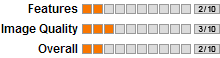
After proving he had no idea how to use this camera, the reviewer gave it a rating of 2/10!
Another reviewer complained,
There are no extra perks of the modern digital camera, it just takes pictures.
This sounded like my type of camera!
What was this awful camera? The Epson R-D1 – a digital rangefinder, with a horrendous price (£2000 without lenses) and a limited 10,000-unit production run. But it seemed ideal to me: small, robust, large optical viewfinder, manual controls, analogue dials instead of an LCD panel, and a multitude of lenses.
I swallowed hard, and handed over my cash.
A few years later, in 2007, I sold the R-D1 and bought a Leica M8. The Leica had more pixels and was more robust: if the R-D1 has one weakness, it's fragility (I taught myself to how to dissemble and repair it - my notes are now hosted by
Cameraquest).
The Leica M8 and Leica the company were quirky, and I had a love–hate relationship with both. I went on to study photography at university, and needed a more practical camera, so sold the M8: I shoot mostly still lifes - not best suited to a rangefinder! I currently use a Nikon D800E. But - unlike the Leica M8 and the Epson R-D1 - I have no love for the Nikon. It's an ugly lump of plastic and alloy, and I hate its ergonomics; however, it is a very efficient
tool, and takes superb photographs. I'd have been gutted if I lost the Leica, but if I lose the Nikon, I'll just shrug and buy another.
One day I'll buy another digital Leica, unless someone makes an all-manual digital SLR equivalent (the Nikon Df isn't it!)...