The Camera Collector’s favorite vintage cameras? Don’t ask!
But I can tell you which quartet of classics I run the most film through!
By Jason Schneider
I began writing The Camera Collector column for Modern Photography way back in October 1969. The idea of writing a column on camera collecting was mine, but Herbert (Burt) Keppler my longtime friend and mentor, not only approved the project but also came up with the title, which migrated from Moden Photography to Popular Photography along with its author in 1987.
Much to the chagrin of my long-suffering wife (and family chancellor of the exchequer) I have amassed 212 cameras over the past half century or so. And, since I’ve always been a “user-collector” rather than a “showcase collector,” I’ve run film through most of them. Therefore, asking me to name my favorite cameras is kind of like asking a parent to name his or her favorite child—a non-starter. So, I’ll do the next best thing and tell you something about four of my most frequently used user-collectible cameras and their fortes and foibles.
Bronica S of 1961: Charming and close focusing, but far from perfect
I run more 120 roll film through my Bronica S than any other medium-format SLR I own (I have four of them, plus compatible lenses ranging from 55mm to 250mm). I like its compact, ergonomic, solid stainless steel body, and the fact that normal lenses (such as the excellent 75mm f/2.8 Nikkor-P, superb multicoated 75mm f/2.8 Nikkor-P.C, or the superlative 6-element 4-group 75mm f/2.8 Nikkor-H.C) get down to about 18 inches on an extendable tube that uses a smooth, precise rack-and-pinion focusing mechanism. The coaxial focusing knob with inset folded film-wind crank on the camera’s right-hand side is also very elegant—and convenient. The Bronica S, and the later Bronica S2 and S2A, all have long reflex mirrors (for better finder coverage) that flip down and slide forwardinstead of flipping up, then lie flat at the base of the mirror box as the focal-plane shutter fires. This unique mirror system (also used in the Bronica S2 and S2A) requires a cloth blind to move into place to cover the upward-pointing mirror to eliminate any stray internal reflections. However, despite its added complexity, the Bronica’s “flip-down” mirror system causes less mirror-induced vibration than conventional systems. Bottom line: I can shoot my Bronica S handheld down 1/30 sec with a reasonable expectation of getting a sharp picture, a 1-stop advantage over the typical 2-1/4 SLR.

Bronica S of 1961 with 75mm f/2.8 Nikkor-P lens, film back, and waist-level finder. Note combined focus knob with folded inset film wind crank on side of stainless steel body.


3 portraits I shot with my Bronica S: Top image of Olivia age 16 was taken with 75mm f/2.8 Nikkor-H.C lens; the other two with the 75mm f/2.8 Nikkor-P. All on Ilford HP5 Plus film.
The Bronica S also has some charming idiosyncrasies some might call, um, shortcomings. While a lot more reliable than the gloriously complex and physically gorgeous Bronica Z of 1959 and the slightly improved Bronica D of 1960 (both notoriously undependable) the Bronica S is no paragon of reliability and can be challenging to repair—alas, shutter problems are rather common. Then there’s the “interminable winding” syndrome. Due to low gearing (perhaps to reduce film winding effort) you must wind the film advance crank through nearly 4-1/2 turns to get to frame 1 after positioning the start arrow on the film’s paper backing, and about 2-1/4 turns for each successive frame! Finally, there’s the little matter of noise—the sound made by the moving mirror and cloth focal plane shutter when you press the shutter release is an impressive “ker-thwack” that may not wake the dead but can likely be heard half a city block away! This is not the ideal camera for discreet street shooting in the manner of Henri Cartier-Bresson. Still, I love my Bronica S’s and have shot many satisfying close-up portraits, art abstracts, and travel photos with all of them—and I intend keep going.
It’s getting harder to find a clean, fully functional Bronica S these days and you may have to acquire one from a Japanese seller and pay the tariff. A near mint Bronica S with 75mm f/2,8 Nikkor-P lens, waist-level finder and film magazine will set you back about $450-$550 plus tax and shipping.
The Topcon Super D: an idiosyncratic masterpiece with superb lenses
The Topcon Super D (and its other iterations The Topcon RE Super in Japan and Beseler Topcon Super D in the USA) is the 35mm SLR I most often use for picture taking. The Topcon RE Super of 1963 was the first 35mm SLR to provide through-the-lens (TTL) metering, employing two CdS cells built into the mirror that has a pattern of slits to admit incoming light passing through the lens. This ingenious system reduces finder brightness to some extent (perhaps 10% compared to conventional SLRs) and increases the mass of the swinging mirror, but it works very well using a manual match-needle system with the moving needle and fixed notch displayed below the viewing screen. Downside: The system was originally designed to be powered by a (discontinued) 1.35v mercury cell so it will have to be adapted and calibrated by a competent repairman (for about 50 bucks) to work properly with current 1.5v silver-oxide or alkaline cells. All versions feature interchangeable slide-on prisms, other finder options, a full range of easily interchangeable focusing screens, and a host of other pro-aimed system accessories.

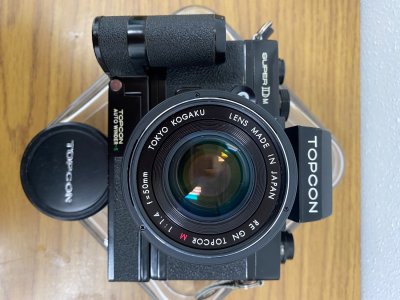
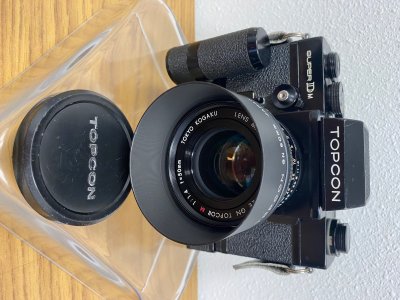
Beseler Topcon Super D early type with later 58mm f/1.4 GN (Guide Number) Topcor M multicoated lens.

Late model Beseler Topcon Super D with awesome 58mm f/1.4 RE Auto-Topcor lens is my primary Topcon shooter.
The long-discontinued Topcon Super D (all iterations) was made by Tokyo Optical Co., a renowned lens manufacturer, and the main attraction of this relatively large, well balanced, and straightforward SLR is its comprehensive array of Topcor lenses ranging from 20mm to 300mm, all of which deliver topnotch imaging performance that ranges from excellent to extraordinary. For example, the 58mm f/1.4 and 58mm f/1.8 R.E. Auto-Topcors are among the finest (longish) normal lenses ever made for any 35mm SLR (and that includes lenses for my beloved black Nilon F with plain prism and Canon New F-1). The compact 100mm f/2.8 Topcor is another optical jewel that’s a great choice for portraiture.

Cutaway of Beseler Topcon Super D showing metering circuitry behind morror, removable pentaprism, and light path.

Machinist in his workshop, shot with Topcon Super D and 58mm f/1.4 R.E. Auto-Topcor lens. Handheld exposure: 1/60 sec at f/2.8 on Ilford HP5 Plus.
The Topcon Super D uses a reliable cloth focal-plans shutter with speeds of 1-1/1000 sec plus B, operates with a rather loud high-pitched click, but relatively little camera-induced vibration (it’s partially damped by the camera’s weight of about 2.6 pounds with 58mm f/1.4 lens). Early versions of the camera have serial numbers starting with “46.” Later versions (Super D, motor compatible Super DM) were introduced in 1971 and have serial numbers starting with “71,” plus a mirror lock-up, a shutter release lock, and a wind-lever throw that’s been reduced from 180 to 135 degrees.

My favorite Topcon RE Super with superb 58mm f.1.8 RE Auto Topcor lens. A steal at $117.50, it required no repairs!
Depending on the specific model and vintage, you can snag a clean used Topcon Super D or Topcon RE Super with 58mm f/1.4 or 58mm f/1.8 R.E. Auto-Topcor lens for about $250 to $350; about $100 higher for the Super DM. Models in black finish or with U.S. Navy markings can run considerably higher.
The Mamiyaflex C2: It’s a great hulking beast but also a great camera
Even you count the Koni-Omegaflex of 1968 to the early ‘70s (total production under 3,000 units) by far the most successful interchangeable lens twin-lens reflex cameras of all time were the Mamiyaflexes, produced from 1956 (the original Mamiyaflex C with pointy “feet”) to the C330s of 1983. All are great picture takers and were very popular among serious shooters and pros in the ‘60s, ‘70s, and into the mid ‘80s.

Portrait of a photographer: Mamiyaflex C2 with 80mm f/2.8 Mamiya-Sekor lens. Handheld exposure: 1/50 sec at f/4-5.6 on Ilford HP5 Plus film.

Jaimen McMillan, founder of Spacial Dynamics, Mamiyaflex C2 with 80mm f/2.8 Mamiya-Sekor lens. Handheld exposure: 1/50 sec at f/4-5.6 on Ilford HP5 Plus ISO 400 film.
My favorite is the second one, the flat-bottomed Mamiyaflex C2 of 1958, which weighs in at about 1.6 kilograms (3.5 pounds) with standard 80mm f/2.8 Mamiya-Sekor lens set and measures approximately 155 x 103 x 103mm, or 6.1 x 4.1 x 4.1 inches (H x W x D). I also have a complete complement of 7 lens sets ranging from 55mm to 250mm, though in truth the only ones I use frequently are the 80mm f/2.8, 105mm f/3.5 and 135mm f/4.5 Mamiya-Sekors. I like the C2 for its minimalist simplicity and brutalist charm, though it is somewhat larger and a lot heavier than subsequent model that incorporate crank wind and a clever parallax indicator that shows the top edge of the actual frame, which the shooter then compensates for by moving the camera up. Incidentally, I always do the same “on the fly” when shooting closeups with my C2.

My Mamiyaflex C2 of 1958 with 80mm f/2.8 Mamiya-Sekor normal lens, an excellent 5-element Heliar design with an 11-bladed diaphragm.
Another reason I love the Mamiyaflex C2 (and even its primordial predecessor the Model C) is that its 80mm f/2.8 Mamiya-Sekor lens in Seikosha MX shutter with the chrome front has an 11-bladed diaphragm, which results in a somewhat more pleasing bokeh than later versions that have a 5-bladed diaphragm (as do all post-war Rolleflexes). The downside is that the fastest shutter speed is 1/400 sec rather than 1/500 sec. as on later lenses, but this is no big whoop. As with all twin-lens Mamiyaflexes, changing lenses is a leisurely affair—you must first turn the side lever to “unlock,” disengage the wire lens retainer and swing it to the right, lift off the lens set, and reverse the procedure when mounting the new lens---nothing onerous, just time consuming. One great advantage of the Mamiyaflex’s “bellows system” of focusing is that the Mamiyaflex C with 80mmm lens can focus down to about 13.3 inches or just over a foot, enabling impressive close-ups without accessories. However, when focusing that close, you must remember to compensate by increasing the exposure by as much as one full stop to compensate for the smaller effective lens aperture!
A better focusing screen can help
Finally, I should mention that while the manufacturers’ original focusing screens in both the Mamiyaflex C and the Bronica S are better than average and quite useable I replaced both with Hi-Lux Screens made by Maxwell Precision Optics, which are not only much brighter, but also “snap into focus” more decisively. They’re pricey, but so is film and processing these days, so they might just save you money in the long run while enhancing your shooting experience. For more information, emaill maxwellprecisionoptics@yahoo.com or call 1+404-317-6825
Leica M3: The closest to perfection in a 35mm rangefinder camera
I bought my first Leica M3 in 1968, a brand-new chrome one made in 1966 and fitted with a Dual-Range 50mm f/2 Summicron with goggles. I like to call it the only camera I’ve ever collected because I bought specifically as an object to admire rather than use for its intended purpose. I will admit that in the last 58 years I have run 10 rolls of film through it, mostly to “field test” the lens which I believe performs as well as any 50mm lens I have ever tested. About 2 years later I bought a “user” M3, an early 2-stroke model, for the grand sum of 200 bucks, which I use with a second-generation 50mm /2 Summicron from the early ‘60s, also a phenomenal lens.

Leica M3 single stroke with 50mm f/2 Dual Range Summicron-M lens with "goggles" and coupled Leica MR meter with incident light panel.

Single stroke Leica M3 of 1960 with rigid 50mm f/2 Summicron (Version 2) with scalloped focusing ring. I don't own one but wish I did!
In the pantheon of 35mm Leica cameras over the past century, the Leica M3 if 1954 stands supreme. It is a masterpiece of integrated design that transformed the rangefinder Leica, taking it to a new level of sophistication and performance, and propelled the photographic industry forward as other leading camera manufacturers, notably Nikon and Canon, responded to the challenge it posed. Were it not for the M3, a camera that set the standard and defined the limits of what was possible in an interchangeable lens rangefinder 35mm system, it is doubtful that the rise of the 35mm SLR, the DSLR, and today’s mirrorless marvels would have occurred as rapidly or rolled out in the same way. Like all great designs, the Leica M3 is an amalgam of the best of existing technology topped off with a number if brilliant innovations that set it apart and transformed it into a timeless classic. The M bayonet mount, the combined range viewfinder with projected, auto-indexing, parallax-compensating frame lines for 50mm 90mm, and 135mm focal lengths, and the film-wind lever are 3 key features that differentiated the M3 from its Wetzlar-made predecessors, and all were derived from features found on previous cameras such as the Steinheil Casca of 1948, which had a bayonet mount and projected frame lines.
However, even the Leica M3 of 1954 isn’t perfect, which is why Leica brought forth a single-stroke-wind version in 1958, the Leica M2 with 35mm, 50mm, and 90mm frame lines in 1957, and the Leica M4 with 4 frame lines 35 to 135mm in 1967. Nevertheless, the continuing development of the analog and digital Leica M is a testament to the soundness and excellence if the original design.
The frame lines in the Leica M3 (or any Leica M for that matter) do not show 100% of the captured image, and the parallax compensation, while impressive, is not perfect. Loading film into an analog M3 is easier than loading a Barnack Leica because of the hinged back, but auto loading it is not. And to rewind an M3 you must turn ye olde textured knob with your thumb and index finger (or on later models use a folding crank). Finally, while the M3’s range/viewfinder is brighter than most, in really dim light it can be hard to see the frame lines or even focus using the rangefinder. If these seem like nitpicks, it’s because they are. Indeed, in terms of the technology that was available the time the Leica M3 was probably as close to perfection as it could have been, and even by today’s standards it’s a mighty impressive machine That’s why it’s still one off my favorite cameras to shoot with and why I still get goosebumps when I simply peer through the finder and listen to the crisp quiet click when I fire the shutter.
Clean Leica M3 cameras are readily available at around $1,500 body only but truly nice examples can run $2,000 to $2,500 and up. A Clean single stroke M3 with Dual Ramge 50mm f/2 Summicron like mine will set toy back around 5 grand. Happy Hunting!
But I can tell you which quartet of classics I run the most film through!
By Jason Schneider
I began writing The Camera Collector column for Modern Photography way back in October 1969. The idea of writing a column on camera collecting was mine, but Herbert (Burt) Keppler my longtime friend and mentor, not only approved the project but also came up with the title, which migrated from Moden Photography to Popular Photography along with its author in 1987.
Much to the chagrin of my long-suffering wife (and family chancellor of the exchequer) I have amassed 212 cameras over the past half century or so. And, since I’ve always been a “user-collector” rather than a “showcase collector,” I’ve run film through most of them. Therefore, asking me to name my favorite cameras is kind of like asking a parent to name his or her favorite child—a non-starter. So, I’ll do the next best thing and tell you something about four of my most frequently used user-collectible cameras and their fortes and foibles.
Bronica S of 1961: Charming and close focusing, but far from perfect
I run more 120 roll film through my Bronica S than any other medium-format SLR I own (I have four of them, plus compatible lenses ranging from 55mm to 250mm). I like its compact, ergonomic, solid stainless steel body, and the fact that normal lenses (such as the excellent 75mm f/2.8 Nikkor-P, superb multicoated 75mm f/2.8 Nikkor-P.C, or the superlative 6-element 4-group 75mm f/2.8 Nikkor-H.C) get down to about 18 inches on an extendable tube that uses a smooth, precise rack-and-pinion focusing mechanism. The coaxial focusing knob with inset folded film-wind crank on the camera’s right-hand side is also very elegant—and convenient. The Bronica S, and the later Bronica S2 and S2A, all have long reflex mirrors (for better finder coverage) that flip down and slide forwardinstead of flipping up, then lie flat at the base of the mirror box as the focal-plane shutter fires. This unique mirror system (also used in the Bronica S2 and S2A) requires a cloth blind to move into place to cover the upward-pointing mirror to eliminate any stray internal reflections. However, despite its added complexity, the Bronica’s “flip-down” mirror system causes less mirror-induced vibration than conventional systems. Bottom line: I can shoot my Bronica S handheld down 1/30 sec with a reasonable expectation of getting a sharp picture, a 1-stop advantage over the typical 2-1/4 SLR.
Bronica S of 1961 with 75mm f/2.8 Nikkor-P lens, film back, and waist-level finder. Note combined focus knob with folded inset film wind crank on side of stainless steel body.
3 portraits I shot with my Bronica S: Top image of Olivia age 16 was taken with 75mm f/2.8 Nikkor-H.C lens; the other two with the 75mm f/2.8 Nikkor-P. All on Ilford HP5 Plus film.
The Bronica S also has some charming idiosyncrasies some might call, um, shortcomings. While a lot more reliable than the gloriously complex and physically gorgeous Bronica Z of 1959 and the slightly improved Bronica D of 1960 (both notoriously undependable) the Bronica S is no paragon of reliability and can be challenging to repair—alas, shutter problems are rather common. Then there’s the “interminable winding” syndrome. Due to low gearing (perhaps to reduce film winding effort) you must wind the film advance crank through nearly 4-1/2 turns to get to frame 1 after positioning the start arrow on the film’s paper backing, and about 2-1/4 turns for each successive frame! Finally, there’s the little matter of noise—the sound made by the moving mirror and cloth focal plane shutter when you press the shutter release is an impressive “ker-thwack” that may not wake the dead but can likely be heard half a city block away! This is not the ideal camera for discreet street shooting in the manner of Henri Cartier-Bresson. Still, I love my Bronica S’s and have shot many satisfying close-up portraits, art abstracts, and travel photos with all of them—and I intend keep going.
It’s getting harder to find a clean, fully functional Bronica S these days and you may have to acquire one from a Japanese seller and pay the tariff. A near mint Bronica S with 75mm f/2,8 Nikkor-P lens, waist-level finder and film magazine will set you back about $450-$550 plus tax and shipping.
The Topcon Super D: an idiosyncratic masterpiece with superb lenses
The Topcon Super D (and its other iterations The Topcon RE Super in Japan and Beseler Topcon Super D in the USA) is the 35mm SLR I most often use for picture taking. The Topcon RE Super of 1963 was the first 35mm SLR to provide through-the-lens (TTL) metering, employing two CdS cells built into the mirror that has a pattern of slits to admit incoming light passing through the lens. This ingenious system reduces finder brightness to some extent (perhaps 10% compared to conventional SLRs) and increases the mass of the swinging mirror, but it works very well using a manual match-needle system with the moving needle and fixed notch displayed below the viewing screen. Downside: The system was originally designed to be powered by a (discontinued) 1.35v mercury cell so it will have to be adapted and calibrated by a competent repairman (for about 50 bucks) to work properly with current 1.5v silver-oxide or alkaline cells. All versions feature interchangeable slide-on prisms, other finder options, a full range of easily interchangeable focusing screens, and a host of other pro-aimed system accessories.
Beseler Topcon Super D early type with later 58mm f/1.4 GN (Guide Number) Topcor M multicoated lens.
Late model Beseler Topcon Super D with awesome 58mm f/1.4 RE Auto-Topcor lens is my primary Topcon shooter.
The long-discontinued Topcon Super D (all iterations) was made by Tokyo Optical Co., a renowned lens manufacturer, and the main attraction of this relatively large, well balanced, and straightforward SLR is its comprehensive array of Topcor lenses ranging from 20mm to 300mm, all of which deliver topnotch imaging performance that ranges from excellent to extraordinary. For example, the 58mm f/1.4 and 58mm f/1.8 R.E. Auto-Topcors are among the finest (longish) normal lenses ever made for any 35mm SLR (and that includes lenses for my beloved black Nilon F with plain prism and Canon New F-1). The compact 100mm f/2.8 Topcor is another optical jewel that’s a great choice for portraiture.
Cutaway of Beseler Topcon Super D showing metering circuitry behind morror, removable pentaprism, and light path.
Machinist in his workshop, shot with Topcon Super D and 58mm f/1.4 R.E. Auto-Topcor lens. Handheld exposure: 1/60 sec at f/2.8 on Ilford HP5 Plus.
The Topcon Super D uses a reliable cloth focal-plans shutter with speeds of 1-1/1000 sec plus B, operates with a rather loud high-pitched click, but relatively little camera-induced vibration (it’s partially damped by the camera’s weight of about 2.6 pounds with 58mm f/1.4 lens). Early versions of the camera have serial numbers starting with “46.” Later versions (Super D, motor compatible Super DM) were introduced in 1971 and have serial numbers starting with “71,” plus a mirror lock-up, a shutter release lock, and a wind-lever throw that’s been reduced from 180 to 135 degrees.
My favorite Topcon RE Super with superb 58mm f.1.8 RE Auto Topcor lens. A steal at $117.50, it required no repairs!
Depending on the specific model and vintage, you can snag a clean used Topcon Super D or Topcon RE Super with 58mm f/1.4 or 58mm f/1.8 R.E. Auto-Topcor lens for about $250 to $350; about $100 higher for the Super DM. Models in black finish or with U.S. Navy markings can run considerably higher.
The Mamiyaflex C2: It’s a great hulking beast but also a great camera
Even you count the Koni-Omegaflex of 1968 to the early ‘70s (total production under 3,000 units) by far the most successful interchangeable lens twin-lens reflex cameras of all time were the Mamiyaflexes, produced from 1956 (the original Mamiyaflex C with pointy “feet”) to the C330s of 1983. All are great picture takers and were very popular among serious shooters and pros in the ‘60s, ‘70s, and into the mid ‘80s.
Portrait of a photographer: Mamiyaflex C2 with 80mm f/2.8 Mamiya-Sekor lens. Handheld exposure: 1/50 sec at f/4-5.6 on Ilford HP5 Plus film.
Jaimen McMillan, founder of Spacial Dynamics, Mamiyaflex C2 with 80mm f/2.8 Mamiya-Sekor lens. Handheld exposure: 1/50 sec at f/4-5.6 on Ilford HP5 Plus ISO 400 film.
My favorite is the second one, the flat-bottomed Mamiyaflex C2 of 1958, which weighs in at about 1.6 kilograms (3.5 pounds) with standard 80mm f/2.8 Mamiya-Sekor lens set and measures approximately 155 x 103 x 103mm, or 6.1 x 4.1 x 4.1 inches (H x W x D). I also have a complete complement of 7 lens sets ranging from 55mm to 250mm, though in truth the only ones I use frequently are the 80mm f/2.8, 105mm f/3.5 and 135mm f/4.5 Mamiya-Sekors. I like the C2 for its minimalist simplicity and brutalist charm, though it is somewhat larger and a lot heavier than subsequent model that incorporate crank wind and a clever parallax indicator that shows the top edge of the actual frame, which the shooter then compensates for by moving the camera up. Incidentally, I always do the same “on the fly” when shooting closeups with my C2.
My Mamiyaflex C2 of 1958 with 80mm f/2.8 Mamiya-Sekor normal lens, an excellent 5-element Heliar design with an 11-bladed diaphragm.
Another reason I love the Mamiyaflex C2 (and even its primordial predecessor the Model C) is that its 80mm f/2.8 Mamiya-Sekor lens in Seikosha MX shutter with the chrome front has an 11-bladed diaphragm, which results in a somewhat more pleasing bokeh than later versions that have a 5-bladed diaphragm (as do all post-war Rolleflexes). The downside is that the fastest shutter speed is 1/400 sec rather than 1/500 sec. as on later lenses, but this is no big whoop. As with all twin-lens Mamiyaflexes, changing lenses is a leisurely affair—you must first turn the side lever to “unlock,” disengage the wire lens retainer and swing it to the right, lift off the lens set, and reverse the procedure when mounting the new lens---nothing onerous, just time consuming. One great advantage of the Mamiyaflex’s “bellows system” of focusing is that the Mamiyaflex C with 80mmm lens can focus down to about 13.3 inches or just over a foot, enabling impressive close-ups without accessories. However, when focusing that close, you must remember to compensate by increasing the exposure by as much as one full stop to compensate for the smaller effective lens aperture!
A better focusing screen can help
Finally, I should mention that while the manufacturers’ original focusing screens in both the Mamiyaflex C and the Bronica S are better than average and quite useable I replaced both with Hi-Lux Screens made by Maxwell Precision Optics, which are not only much brighter, but also “snap into focus” more decisively. They’re pricey, but so is film and processing these days, so they might just save you money in the long run while enhancing your shooting experience. For more information, emaill maxwellprecisionoptics@yahoo.com or call 1+404-317-6825
Leica M3: The closest to perfection in a 35mm rangefinder camera
I bought my first Leica M3 in 1968, a brand-new chrome one made in 1966 and fitted with a Dual-Range 50mm f/2 Summicron with goggles. I like to call it the only camera I’ve ever collected because I bought specifically as an object to admire rather than use for its intended purpose. I will admit that in the last 58 years I have run 10 rolls of film through it, mostly to “field test” the lens which I believe performs as well as any 50mm lens I have ever tested. About 2 years later I bought a “user” M3, an early 2-stroke model, for the grand sum of 200 bucks, which I use with a second-generation 50mm /2 Summicron from the early ‘60s, also a phenomenal lens.
Leica M3 single stroke with 50mm f/2 Dual Range Summicron-M lens with "goggles" and coupled Leica MR meter with incident light panel.
Single stroke Leica M3 of 1960 with rigid 50mm f/2 Summicron (Version 2) with scalloped focusing ring. I don't own one but wish I did!
In the pantheon of 35mm Leica cameras over the past century, the Leica M3 if 1954 stands supreme. It is a masterpiece of integrated design that transformed the rangefinder Leica, taking it to a new level of sophistication and performance, and propelled the photographic industry forward as other leading camera manufacturers, notably Nikon and Canon, responded to the challenge it posed. Were it not for the M3, a camera that set the standard and defined the limits of what was possible in an interchangeable lens rangefinder 35mm system, it is doubtful that the rise of the 35mm SLR, the DSLR, and today’s mirrorless marvels would have occurred as rapidly or rolled out in the same way. Like all great designs, the Leica M3 is an amalgam of the best of existing technology topped off with a number if brilliant innovations that set it apart and transformed it into a timeless classic. The M bayonet mount, the combined range viewfinder with projected, auto-indexing, parallax-compensating frame lines for 50mm 90mm, and 135mm focal lengths, and the film-wind lever are 3 key features that differentiated the M3 from its Wetzlar-made predecessors, and all were derived from features found on previous cameras such as the Steinheil Casca of 1948, which had a bayonet mount and projected frame lines.
However, even the Leica M3 of 1954 isn’t perfect, which is why Leica brought forth a single-stroke-wind version in 1958, the Leica M2 with 35mm, 50mm, and 90mm frame lines in 1957, and the Leica M4 with 4 frame lines 35 to 135mm in 1967. Nevertheless, the continuing development of the analog and digital Leica M is a testament to the soundness and excellence if the original design.
The frame lines in the Leica M3 (or any Leica M for that matter) do not show 100% of the captured image, and the parallax compensation, while impressive, is not perfect. Loading film into an analog M3 is easier than loading a Barnack Leica because of the hinged back, but auto loading it is not. And to rewind an M3 you must turn ye olde textured knob with your thumb and index finger (or on later models use a folding crank). Finally, while the M3’s range/viewfinder is brighter than most, in really dim light it can be hard to see the frame lines or even focus using the rangefinder. If these seem like nitpicks, it’s because they are. Indeed, in terms of the technology that was available the time the Leica M3 was probably as close to perfection as it could have been, and even by today’s standards it’s a mighty impressive machine That’s why it’s still one off my favorite cameras to shoot with and why I still get goosebumps when I simply peer through the finder and listen to the crisp quiet click when I fire the shutter.
Clean Leica M3 cameras are readily available at around $1,500 body only but truly nice examples can run $2,000 to $2,500 and up. A Clean single stroke M3 with Dual Ramge 50mm f/2 Summicron like mine will set toy back around 5 grand. Happy Hunting!
Last edited: