How do you expose?

PatrickT

New Rangefinder User
Local time
1:46 AM
Joined
Mar 8, 2005
Messages
804
Location
SF, CA
I've somewhat changed the way I expose when using my X100S recently. I used to use evaluative metering, but have recently switched to using Spot + the EVF. It's been working amazing so far and I'm loving it. I'm finding that I can get more "accurate" exposures (as in...recording the scene as is) more quickly and efficiently.

Anyway, that led me to wonder...how does everyone else expose? Evaluative, spot, external meter, sunny 16, etc, etc?
 
Spot metering with all my cameras that have it. I place the spot meter on the part of the subject I want to measure and use the Zone system to adjust the exposure.
...Terry
 
Any metering system can be made to work, if you think about what you're doing (and, of course, if you understand what you're doing). It's just that some are harder to override than others.

Cheers,

R.
 
I use "auto-exposure". Most of my cameras have a fully auto mode, so I use it. That way, I need make less decisions at exposure time. For any nit-picky adjustments, I make those at printing time. My 'style' (if I have one) does not rely on fine detail throughout the entire picture, so if I need to adjust by a stop or so, I just do, and do not fret a blocked shadow or blown highlight. If the camera I use does not have AE, then a general metering of the scene prior to shooting suffices. I'll preset my aperture and shutter.
 
Handheld incident for 80% of the time, handheld spot when incident isn't possible or for stained glass, internal meter the other 5%.
 
Averaged reading - either in-camera centre or with a hand-held incident meter, depending on whether the camera has a built-in meter or not.

I adjust to taste. If I deem the viewfinder view to not be an "average" mid-grey, I'll compensate, either by metering something else that I know will give a "correct"* exposure or by deliberately under- or overexpsure. I generally shoot in manual mode, and as a set aperture is more crucial to my work than shutter speed, I typically adjust the latter.

A few points:

- I never ever use matrix exposure mode as then I'd have no control over my camera's tiny and stupid silicon brain.
- Although it's good to get the exposure I want correct in the photograph, it's more important to capture both shadow and highlight detail. I'm happy to adjust exposure (for both film and digital) in postproduction.

I always felt it was a bit of a failure to not nail the exposure when taking the shot - but was gratified to learn that a Magnum photographer I know exposes the same way I do, and adjusts the exposure in Photoshop!

* As we all know, there is no such thing as correct exposure, hence the quote marks.
 
I determine exposure using my brain. Light intensity readings from a light meter are a primary input in my decision, but it is always my decision and not the light meter's. Frequently I will agree and use a simple reflective reading from the camera's built in meter, often in the AE mode. But I am always subconsciously deciding if I want to use that reading to determine exposure or something else.

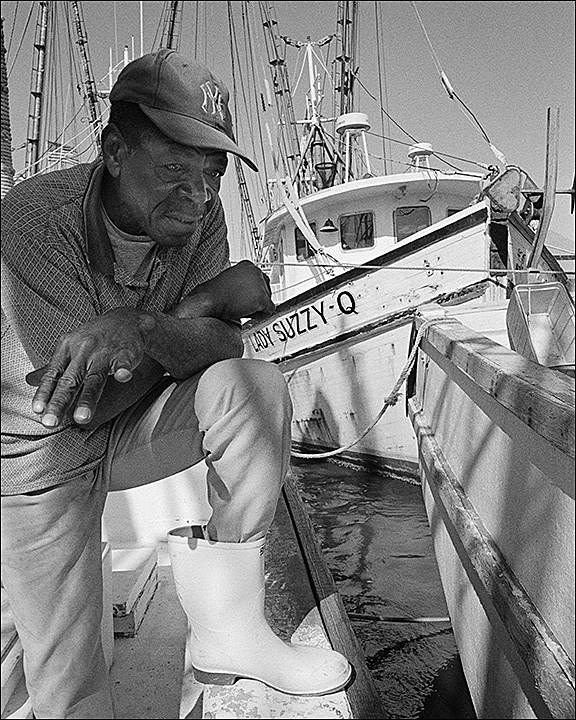
Here is an example of a scene that is impossible to meter. Meter the shadows considering the most important part of the photo is a Negro's face and you have blown out the majority of the scene which is highlights. Meter the overall using any sort of averaging and your facial detail is a blocked up shadow. The only way to determine exposure was a sunny 16 decision with bias considering the films ability to record highlight and shadow detail.

My notes say this was Captain James Ford, the last remaining Negro shrimp boat captain, musing over the closure of the shrimp boat docks in Fernandina Beach FL so they could build luxury condos. Exposure info was not recorded.

Shrimper-James-Ford.jpg
 
I endorse Bob Michaels' "using my brain" method. If you have time, you are smarter than the camera.

I can only comprehend exposure as the light amplitude recorded by the sensor when the shutter is open. ISO has no affect on exposure because ISO does not alter the sensors' sensitivity to light. Only the shutter time and lens aperture determine exposure.

For me the metered value is just a useful initial guess. What you do with this guess depends on the metering mode discussed in previous posts.

Then I think about how to maximize exposure using the lowest possible ISO.

There are the three steps to maximize exposure.

First, select the aperture to obtain the depth-of-field required for the photograph you envision.

Second, select a shutter speed that freezes either camera and, or subject motion as needed. Electronic stabilization or a tripod provide more shutter time flexibility when photographing static subjects.

Third, fine tune either aperture or shutter time to retain only the interesting or important highlights in all three channels. This means some highlights may intentionally be overexposed. If every highlight must be recorded, the shadow regions' signal-to-noise ratio will suffer whenever the range of light intensity exceeds the sensor's inherent analog dynamic range.

As increase in ISO increases the flexibility in selecting aperture and shutter parameters used to achieve the best possible SNR (exposure). This is why SNR performance at high ISO is important. The sensor noise remains constant but the signal (light) is lowered. It turns out for many CMOS sensors raising the ISO (to a point) improves the shadow SNR, once the first twos exposure steps are decided. At the same time the higher ISO can make the last step difficult to achieve. Decreasing the shutter time while keeping the aperture constant reduces the shadow regionSNR. Reversing the roll of the shutter time and aperture have the same effect. In both cases less light reaches the sensor and the SNR is reduced.

Maximizing exposure also maximizes the analog dynamic range recorded by the sensor.

This is not ETTR, instead it is deliberately maximizing the data's SNR. The resulting exposure will often resemble a ETTR histogram, but the similarity ends there.

I first learned the maximize exposure strategy by reading posts from Prof. Emil Martinec. The theory and empirical data for the physics that support his approach are described in the following technical article:

http://theory.uchicago.edu/~ejm/pix/20d/tests/noise/

When time is of the essence, relying on automation is more important than maximizing exposure. Content trumps doubling or even quadrupling the shadow-region SNR. In bright light (fast shutter times) automatically bracketing exposures provides a certain level of insurance against over exposure.

 
Back
Top Bottom