alexz
Well-known
Another issue that somewhat bothering my starting out my B&W adventure:
shooting Tri-X at the nominal (400) I notice the outcome is quite grainy. I cannot attribute it to improper exposure, however probably better development tweaking is the way to try out (along with shadow contrast one per my previous thread).
Now, having zero previous B&W experience, I cannot judgefully attest how grainy it is and I have never saw another B&W film results. The grainess look may also be contributed by my scanner (Nikon LS-40) because Nikon scanners line is know to exaggerate grain to certain degree due to their RGB led scanning approach. I guess I have no choice but to try to figure my own deelopment/scanning approach to try to leverage grain while preserving other qualities as much as I can (contrast, accutance).
So, the question is: what makes the major influence on grain development-wise ? Under/over development ? Agitation ?
I shoot a lot of family/friend portraiture in various lighting conditions thanks to the convenience of my Leica setup, and excessive grain isn't very flattering to child skin tones (or to young women...). Right now I fight with it using NeatImage software, but I suspect there might be certain sharpness impact as a side effect, so that apparently the ability to control one duign development sounds much more robust way to follow...
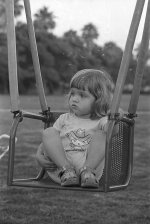
The attached are a sample file (resized) and its small crop (non-compressed, from original TIFF) to assess the garin amount I'm talking about.
Please let me know you opinion, advises...
shooting Tri-X at the nominal (400) I notice the outcome is quite grainy. I cannot attribute it to improper exposure, however probably better development tweaking is the way to try out (along with shadow contrast one per my previous thread).
Now, having zero previous B&W experience, I cannot judgefully attest how grainy it is and I have never saw another B&W film results. The grainess look may also be contributed by my scanner (Nikon LS-40) because Nikon scanners line is know to exaggerate grain to certain degree due to their RGB led scanning approach. I guess I have no choice but to try to figure my own deelopment/scanning approach to try to leverage grain while preserving other qualities as much as I can (contrast, accutance).
So, the question is: what makes the major influence on grain development-wise ? Under/over development ? Agitation ?
I shoot a lot of family/friend portraiture in various lighting conditions thanks to the convenience of my Leica setup, and excessive grain isn't very flattering to child skin tones (or to young women...). Right now I fight with it using NeatImage software, but I suspect there might be certain sharpness impact as a side effect, so that apparently the ability to control one duign development sounds much more robust way to follow...
The attached are a sample file (resized) and its small crop (non-compressed, from original TIFF) to assess the garin amount I'm talking about.
Please let me know you opinion, advises...