If Digital Photography Had Never Been Invented…

What's this digital thing everyone is talking about? Is that a new film format to supersede that APS stuff?

And who dares talk about taking away my Kodachrome!? And to think in the late 80s, I thought seriously about digitizing all my Kodachromes and negatives. How I would have been disappointed after our house fire to realize they were of little use or value, for all that time and money I would have expended.

To me the interesting speculation would center on how will digital sensors improve, or what will they be superseded by?
 
The development and subsequent application of quantum mechanics made digital cameras inevitable.

If war, famine, comet/astroid impact etc delayed or even prevented the birth of QM and the transition of QM theory to advances in electronics the limitations would be defined by the limitations of vacuum-tube technologies (they first appeared circa 1880).

I don't think there would be in-camera light meters because they rely upon transistors. Also the discovery of the photo-electric effect (1873) impacts light meters and the photo-electric effect effect was one of the catalysts for the development of QM. So, the technology for light meters probably wouldn't exist. Likewise experiments with primitive vacuum-tubes itself played an essential role in QM.

QM was also responsible for the analog video detectors used in television cameras.

Once QM was formulated and applied... digital imaging became inevitable.

I also think film would primitive compared to what we have now. The discovery chemistry and development of process chemistry used for the R&D and commercially viable production of modern films would not exist without QM. Theory for R&D chemistry and analytical methods would be a century behind because they are now without QM.
 
Interesting question.

One thing I know for sure: I would have much more money. 😉
Digital photography took me back to photography after a 10 years break.
And this resurrected passion took me back to film photography.
Both hobbies have made me spent a lot of money.

But then I have met so many fantastic people because of that, so actually I am much "richer" now. 🙂
 
The development and subsequent application of quantum mechanics made digital cameras inevitable.
[…]
Once QM was formulated and applied... digital imaging became inevitable.


So, basically, in every digital camera, there's an un-dead cat inside?!

I really do love cats, LET THEM LIVE, please!

😡😡😡 Shame on you cat-un-dead-making digital photographers! 😡😡😡
 
Willie 901, When I was finishing my apprenticeship in the Litho field in the early '60s, our firm brought in the 1st Dr. Hell Color Scanner for our separations. Dr. Rudolf Hell was a genius in this development, and even had patents as I remember going back to the 1920's. My thoughts, and the guys I worked with at that time; was a camera would come out soon; but would be to big too carry.
 
...
To me the interesting speculation would center on how will digital sensors improve, or what will they be superseded by?

It appears the future of image sensors could well be the quantum image sensor. Eric Fossum, who invented and developed APS-C CMOS sensor technology is working on sub-diffraction-limit photodetectors call jots. So is a commercial firm... InVisage.

These devices could increase signal-to-noise ratios by at least a factor of four.
 
Had digital never been invented, wet plate collodion photographers would bemoan film photography for being too easy and not worthy of consideration. Alas, digital came and we all know which way this (wet) dream finally went. 😀
 
Star Trek Lenses!

Star Trek Lenses!

Star Trek.

[…]

What do you think?

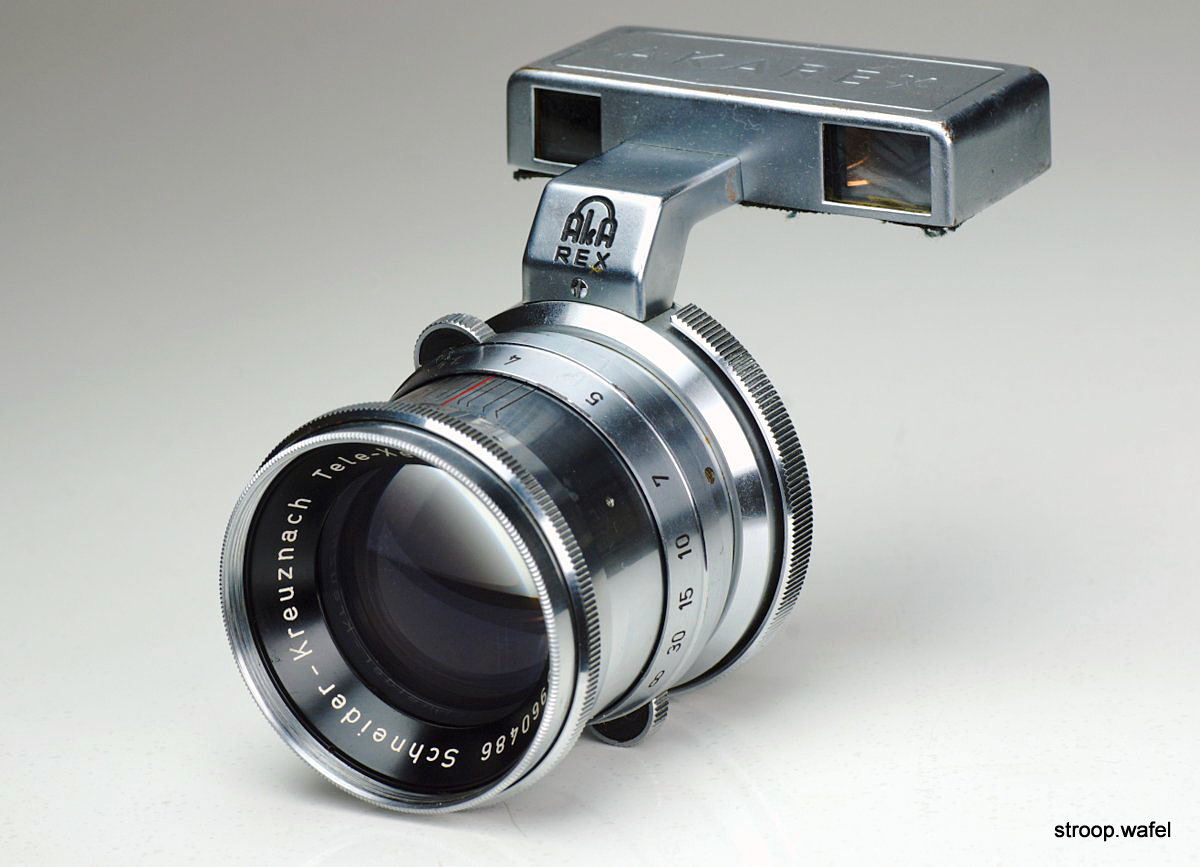
In our «alternate universe», early 21st century without digital imaging, I'd presume many lenses should look like this:

akarex-telexenar.jpg
 
...

The other interesting thing would be the progress of scanners and the possibility of a desktop scanner rivaling what the drum scanners were able to produce.

No, in a fantasy world without "digital sensors" there would be no scanners. In fact, there would be no electronic transfer of photographic images. The likes of Ps would be only usable for "painting" images that were created in such programs.

This would extend to not having any optical sensors at all; no light meters, not optical mice, ... . The only autofocus systems would be sonic echo systems like the old Polaroid "Sonar" systems. In fact, there would be no TV. The development of any optical sensor would inevitably lead to image sensors.
 
No, in a fantasy world without "digital sensors" there would be no scanners. In fact, there would be no electronic transfer of photographic images. The likes of Ps would be only usable for "painting" images that were created in such programs.

This would extend to not having any optical sensors at all; no light meters, not optical mice, ... . The only autofocus systems would be sonic echo systems like the old Polaroid "Sonar" systems. In fact, there would be no TV. The development of any optical sensor would inevitably lead to image sensors.

Hmmm… Why wouldn't we have mechanical image scanning and transmission (e.g., aka telefacsimile)?
Or: Analog television?
 
Hmmm… Why wouldn't we have mechanical image scanning and transmission (e.g., aka telefacsimile)?
Or: Analog television?

"Images" could be sent in the telefax method if, and only if, they could be felt in some way, rather than "seen". Electrically conductive ink or raised ink/paint would be detectable. I might be possible to develop a photographic printing process which would yield a print image with a variable electrical conductivity that was proportional to its visible density. Color images would require printing as color separations which would need to be "scanned" serially and then, on the receiving end, printed as individual separations to be used in creating a color image in the same was as matrices were used in creating dye transfer prints.

TV requires a electronic light sensitive detector. The development of which would invariably lead to sensor arrays, given time.
 
Processors pretty much screwed up photography for consumers. I did my own.

Slides were the way to go because there was no ding dong making wrong adjustments.

Stupid consumers were no help either as they exposed daylight color neg to tungsten and expected it to be fixed. I still have 5 rolls of Portra 100 tungsten in the freezer.

What was amazing were photos taken in Sweden and sent here. Quality difference was amazing. Here we expect 10 cents each and dup prints. Americans will not pay for quality. In the 80`s, my Leica dealer set up a mini lab in his store so Leica customers could appreciate their cameras.
 
This would extend to not having any optical sensors at all;

No - you forget about tube technology. In fact, TV did pretty well for its first 50 years without sensors. But it would not have miniaturised anywhere as well as solid state sensor technology. The last generation of TV studio tube cameras, with tubes that roughly reached 1MP FF technology by resolution and area, were the size and weight of a heavy motorcycle, "miniature" consumer cameras (with tube areas like cheap point and shoot digitals and about 150 lines resolution - little more than 1/4MP with barely two stops of dynamic range) were the size and weight of a quart bottle. Pocketable consumer video cameras only appeared as (analogue) CCD sensors replaced tubes.
 
No, not really «Star Trek» —*I've read about such a device in a «Perry Rhodan» sci-fi novel, or a novel by an author of that series:

In the 26th (or 29th?) century, they used film in their cameras, but: the lens was replaced with a magnetic contraption (IIRC).

Hence my idea that portable MRIs weren't such a bad idea 😉
Bones, in Star Trek, used a device about the size if a smart phone, running it over a body to make an assessment of what's going on.

https://en.m.wikipedia.org/wiki/Medical_tricorder

You can use your tongue to do the same thing.
Robert

Erm, I knew that I had forgotten something important, or more precisely, an (admittedly distant) cousin/uncle of mine was actually the guy who did invent that — IN OUR UNIVERSE, by the way, his name is Ernst Ruska:

«In 1931, he demonstrated that a magnetic coil could act as an electron lens, and used several coils in a series to build the first electron microscope in 1933.»
 
Hi,

About scanning etc, in 1990/91 I was in charge of a small group in an open plan office in the City and, because we were on the ground floor, an open plan office next door was being used as a furniture store as the entire office block was being emptied and modernised.

My immediate boss had worked in the building since the 1930's and would wander around the furniture dump looking at everything being thrown out and found several photo's showing the fall of Singapore (so 1942). These photo's had been sent over a radio link from Singapore using what was called picture transmission. Meaning scanned and then the signal sent by radio.

The service opened in the 1930's via the radio station at Rugby, beside the A5...

Regards, David
 
What would I have done, nothing much; I still have my pre-digital cameras*; I still buy film and I still use it.

But I don't have so wide a choice of film (unimportant thinking about B&W and the FP3, FP4 then FP4+ progression). I use less slide film and I store heaps of film in the fridge as I can't buy it in several shops almost anywhere as I could when needed. OTOH it's a lot cheaper and D&P costs almost the same now as it did in the 90's; meaning a lot cheaper.

Regards, David

PS (EDIT) OTOH thanks to digital a lot of film cameras were dumped in charity shops and I can buy them for pennies; that means I buy and use a lot more film to test them...

* Leica CL, Olympus XA2 and Pentax ME super.
 
Back
Top Bottom