J. Lane Glass Dry Plates

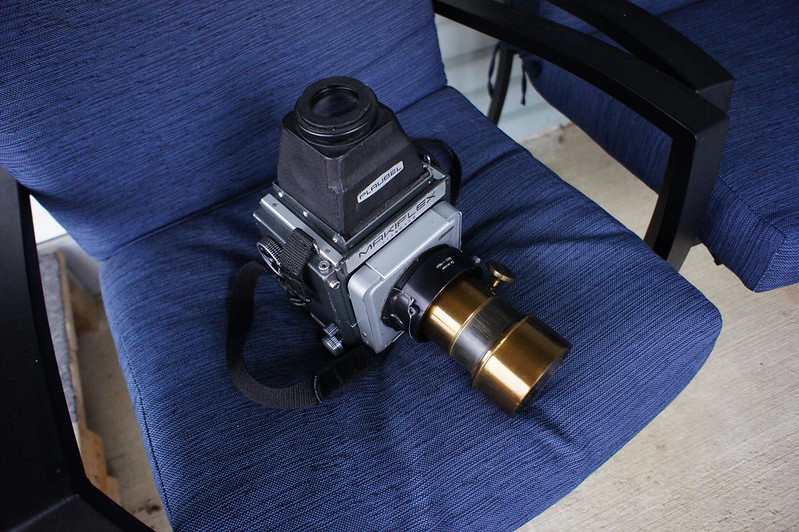
New Petzval Lens on Std Makiflex by Nokton48, on Flickr

OK It's here! Viewing through it, I absolutely love it! Surprisingly sharp on the glass. Shown on Makiflex Standard Body, lens focused on infinity target. I am so glad I took a chance on getting this one.

Later today, I removed the glass elements, nothing is marked anywhere. The central stop looks like it's much later to me, and rather homemade. Made of silver metal and coated with candle soot. I removed that rather easily from inside the barrel, and now I should have an F3.0 or F3.5 lens. Without the central stop, the lens is sharp in the center, and rather swirly at the edges as I have seen in so many Petzval examples.

Now I need to find a proper flange and clean it a bit more. I am super pleased.

Super Cinephors with Makiflex Standard by Nokton48, on Flickr

Look what arrived this afternoon. After five minutes in fading sunlight outside, I can see this bigger Cinephor fits the bill. On the Makiflex it will focus out to about twelve or bit further feet feet out, so incredibly useful to me. The shorter Cinephor works only for extreme close ups on the Makis (about 18"x18" or so). The bokeh is gorgeous, the DOF thin as a sheet of paper. Absolutely love the "look" of it! ��


Both of these lenses I intend to use with dry plates.
 
More NEWS from Jason Lane:


As I continue to experiment with emulsions, I tend to make several test batches which serve as good baselines for adding sensitization, speed, etc. Instead of letting that emulsion go to waste, I figured I'd coat some limited run plates and make them available for folks to try out.

I've set up a shop on my website at this link: https://www.pictoriographica.com/online-shop.html

In there you'll find (currently) two categories of products: Limited Run Dry Plates, and Dry Plate Accessories. Nothing under the latter at the moment. However, under the former category I've added a couple of products:

ASA 2 Orthochromatic Plates. This is a baseline Ortho emulsion with moderate contrast and sensitivity out to green. Use a yellow filter as you would for conventional orthochromatic film.

ASA 25 Fast Orthochromatic Plates. "J. Lane Speed Plates" This is a high contrast, nominally ASA 25 Orthochromatic plate. I've been pushing this out to 32 or even ASA 50, but 25 is a good start. Use a yellow filter to take full advantage of the orthochromaticity as you would for conventional ortho film.

Currently only available in 4x5, I'd be happy to coat in other sizes. Just let me know!

Oh and, once this particular emulsion is gone, there's no more. However, do expect other interesting variants in the future.

Cheers,
Jason

J Lane ASA 25 Speed Plates by Nokton48, on Flickr
 
Redoing Light Traps with Mohair by Nokton48, on Flickr

Tonight I have been working on restoring these RADA 6.5x9cm Plate Holders. The light traps were completely gone in all of these, so I cut a paper pattern, and cut cardboard, and strips of Mohair, to restore the light trapping. Tomorrow I will contact cement the trappings into the holders, and they will be ready to load with dry plates. And I need to develop my first set of 6.5x9cm test exposures. Will be posting them soon. Having a decent amount of usuable holders is really important to me.

Also I am ordering two boxes of the ASA 25 "Speed Plates" in 6.5x9cm for testing.
 
Redoing Light Traps with Mohair by Nokton48, on Flickr

Tonight I have been working on restoring these RADA 6.5x9cm Plate Holders. The light traps were completely gone in all of these, so I cut a paper pattern, and cut cardboard, and strips of Mohair, to restore the light trapping. Tomorrow I will contact cement the trappings into the holders, and they will be ready to load with dry plates. And I need to develop my first set of 6.5x9cm test exposures. Will be posting them soon. Having a decent amount of usuable holders is really important to me.

Also I am ordering two boxes of the ASA 25 "Speed Plates" in 6.5x9cm for testing.


Where could do you get in the web those strips of mohair? Because I've difficulties finding the proper light trap for "bald" plate camera backs & holders.
 
From the large format forum:

Here is a set of images of a familiar scene using three emulsions, (Nathan Lane glass plate, Ilford Ortho Plus, Ilford FP4 Plus, 4 by 5 format) for the sake of comparison. This is a repeated scene of a Stephen N. Leek photo taken around 1920. Leek's image, as a negative, can be seen here

http://digitalcollections.uwyo.edu/luna/servlet/detail/uwydbuwy~74~74~2238749~281536:Trees-and-Lakes?sort=rid%2Ctitle%2Cdate_original%2Csource&qvq=q:ah03138_2136;sort:rid%2Ctitle%2Cdate_original%2Csource;lc:uwydbuwy~74~74&mi=0&trs=1

and here it is as a positive

View attachment 181775

The original image, courtesy of the American Heritage Center, U of Wyoming, is very similar to Ansel Adam's scene "Tetons and the Snake River", taken in 1942. Adam's image has a wider angle of view, and his standpoint was about 5 feet to the left of where Leek (and I) stood, and probably 6 feet higher, as he often stood on the roof of his truck. Adam's scene was probably from mid-summer (early July). S. N. Leek's was likely earlier in the year, and mine matches the snow cover in his scene closely.

My series dates from May 30, 2018. A several-day storm had just ended, and there was some lingering humidity in the air. I used a yellow (#8) filter with the FP4 film, and a 150 mm S-K Symmar f5.6 lens. The full negative covers about the same as what Adam's photo does, the Leek and Adam's image centers differ somewhat; I was not trying to repeat Adam's scene, my scene is centered on Leek's.

I printed these on Ilford MGIV Deluxe Glossy, using #2 filter, and about a 1/2-stop burn-in of the background, so nothing dramatic during printing. Tree growth since the 1920's and 40's has obscured some of the foreground.

Although Leek used glass plates into the early 1930's, I think his post-1912 (roughly) images were probably on a panchromatic emulsion. I have re-taken many of his scenes, using the two Ilford films mentioned above, and the older ones have the ortho look. Leek, among many things, was a hunting guide, and one of his clients was George Eastman. Eastman helped him get started in photography, and his earliest images are from around the late 1890's. The Jackson Hole area was quite remote with very few people then, and it is remarkable how many fine images Leek took via horseback in rough terrain. This one was probably an easy one for him.

View attachment 181776

Lane Glass plate

View attachment 181777

Ilford Ortho Plus

View attachment 181778

Ilford FP4 Plus


This Ortho vs Lane Dry vs FP4+ is worth some testing here. Looking at the three examples there I prefer the tonality of the Lane Plates.

 
Develop it in HC-110 "A" instead of HC-110 "B" for more speed (and of course, more contrast). I can shoot in bright sunlight, with the Makinas handheld, at 1/50 @ F2.9, with ASA 2. So very portable and very do-able. And I love the "look" of the 100mm Plaubel Makina Anticomar at F2.9

This is how they used to do it back in the 1890's 🙂

... but there were no Makinas in the 1890's 😎. At least my fastest lens for 9x12 dry plates is also quite fast, a f3.5 Tessar in a KW Patent Etui (from c.1929). Others are older (pre WW1), but only f8.
 
I have over fifty Plaubel Makina plate holders, which take glass plate or film. Obviously somebody out there was shooting with glass plates in these cameras back then. 🙂 Which I find particularly cool.

He also has a high speed EI 25 dry plate emulsion he is testing. He is sending me two boxes (20 plates), which I will try and report here. So that would be 1/50 at F11 in key bright sun. Not bad! Prolly closer to 1920-30ish film speeds?

I want to compare the tonality of these plates, with what you get with Ilford Commercial Orthographic sheet film, which is an old fave of mine. Another fave was Tri-X Ortho, long discontinued. I have seen some preliminary tests over at largeformatforum.info that indicate the Lane plates have superior tonality. We will see, but I am not surprised. Good to have both. Ilford Commercial Ortho is EI 80 flexible sheet film.

Sometimes daily chores and other obligations take precedence over photographic fun. But spring is coming and I am ready to get out there! I promise results will be posted here soon.
 
Well, I developed yesterday my first three J. Lane Dry Plates, 9x12. It seems that in every case I underesexposed quite a lot. I've to confess that one of the pictures was indoors, as I'm quite suspect of the light leaks of one of the cameras, so I shoot a picture inside home with artificial light but with an exposition of 45s (at f8 as far as I remember). The plate came "almost" transparent, that's a black image.


The other two are underexposed but visible images, but prove impossible to scan with good results. The TIFFs are extremely dark. Maybe monday I will try to use a light table & flash to "scan" them with my Nikon D750!
 

Attachments

  • EH1.jpg
    EH1.jpg
    35.7 KB · Views: 0
  • IMG_20190223_154212b.jpg
    IMG_20190223_154212b.jpg
    21.1 KB · Views: 0
I must confess that my first attempt yielded results similar, very very thin. I attribute this to: 1) not using strong enough developer, I used dilution "H" Hc110 for fifteen minutes. Dilution H is twice as diluted as B. 2) darkroom too cold; 14 C ambient temp, according to Ilford chart, should have used 25 minutes! Finally found this info after the fact. 25 minutes is too long for development in a tray!

Just a static test subject (a statue in full sun). Will repeat, next time using dilution "B" which is what Jason recommends. So we will see.

It was a lot of fun to develop the plates, under one red safelight. I used a plastic kitchen spatula to move them from tray to tray. Good to be back in the darkroom.
 
I must confess that my first attempt yielded results similar, very very thin. I attribute this to: 1) not using strong enough developer, I used dilution "H" Hc110 for fifteen minutes. Dilution H is twice as diluted as B. 2) darkroom too cold; 14 C ambient temp, according to Ilford chart, should have used 25 minutes! Finally found this info after the fact. 25 minutes is too long for development in a tray!

Just a static test subject (a statue in full sun). Will repeat, next time using dilution "B" which is what Jason recommends. So we will see.

It was a lot of fun to develop the plates, under one red safelight. I used a plastic kitchen spatula to move them from tray to tray. Good to be back in the darkroom.
Well, I used R09 One Shot 1+50 for 5 minutes or even more. And room temperature must be arround 21 C. I think maybe my problem was underexposing and also with the scanner itself which seems to go mad with the very low contrast of the plate.
 
I've loaded up five of the RADA 6.5x9cm holders with Jason's dry plates, ready to go out again. These are the holders that I have renovated the light traps, see above. ^^^ I'll repeat the initial tests, only when the light is pure bright sun. 1/2" at f11 has worked well for other folks, so we will see. And I will use 1:31 HC110 concentrate. I will also overexpose a stop or two just to see how it reacts. I'm also testing Foma Retropan 120 at the same time, and shoot some 120 FP4+ also. So I always come back with something. I'm not going to start my shoot my stock of 9x12cm until I have some good results in the smaller format. I'm also inquiring about the SP445 developing tank, now Tim now has holders (4x5 and 9x12) for Jason's plates. Might get more even development, Jason's test look really smooth and even. Even the edges.

Anyone here using the SP445 dev tank for processing Lane plates? That is what Jason uses.
 
A response from Jason:

Dan, I use the SP-445 almost exclusively for developing 4x5 and 9x12. It works very well and I highly recommend it. If you are tray developing, don’t pull the plate from the developer until it looks very dark (until you see details in the shadows), otherwise it will be too thin.


So, look at the shadow values while inspection developing! So obviously I underdeveloped my film run. Let me tell you, it looks pretty dark under a 15W safelight. Hard to gauge proper density. I have ordered an SP445 tank, and a pair of 9x12cm glass plate holders. No more handling of the plates until they go onto the drying rack 🙂 Yes I got some handling marks the first time! This will eliminate that, no more fiddling. And prolly no more edge effects (density buildups) from tray development.

The SP445 only requires 16oz of solution to develop two plates, and the plates wash inside the tank. Two major advantages.
 
Stearman 9x12 Dev Plate Holder SP445 by Nokton48, on Flickr

Here is the dry plate processing holders for the SP445. Jason helped Tim with design and testing. Two of these are in the mail to me. These are 3D printed.

Stearman 4x5 SP445 Dev Tank 4x5 holder by Nokton48, on Flickr

The SP445 tank with 4x5 film holders. Notice that you don't get much "image buildup" along the four edges of the plate. that is an artifact of tray processing. You can see it even in plates developed a hundred years ago. Also the tank is dandy for washing the plates, and no handling until you rack 'em. These plates are expensive and I don't want to mess any more of them up!


https://shop.stearmanpress.com/collections/all
 
Back
Top Bottom