J. Lane Glass Dry Plates

Yesterday I loaded some German RADA 9x12cm holders, with his ASA 2 dry plates.
These tests I will process in the SP445 Spearman Daylight Tank.

I'll be shooting 9x9cm images, onto 9x12 dry plates, with my Plaubel Makiflexes.
Should be cool.
 
Had some experience with the "fast" 25 ASA Jason Lane plates. Look great, and are wonderful to use without the need of a tripod (if there's plenty of sun only, of course). Here being used in No.3A format, with Kodak Folding Pocket cameras:


48249544317_044268aabc_c.jpg


48144167891_34343cbd89_b.jpg


La Salut bridge over the Ripoll river, in my hometown Sabadell, Catalonia.
 
Getting ready for some J Lane glass plates. Just got the plate holders in the mail. These are getting paired with a 6.5x9 Zeiss Ikon Tropen Adoro which needed a bellow replacement so I took the opportunity to add some custom bellows. Not sure how more traditional restorers would feel about it but I already had some fun shooting with a roll film back adapted for the camera.
Rada Glass Plate Holders 6.5x9cm by btsalyuk, on Flickr

Zeiss Ikon Tropen Adoro Bellows Replacement by btsalyuk, on Flickr
 
Whoa, I had almost forgot this thread. Here are some dry plates I shot last year:


49132736687_31fc862049.jpg

9x12 2 ASA, Ihagee Patent Duplex 720. That camera is my grandfather's, made in the 20's and still working flawlesly, although has some foggy lens.


49132407573_ff807da346_c.jpg

and.... another 9x12 2 ASA dry plate. Picture taken with the same model camera, identical to the one above (Ihagee Patent Duplex 720) but bought this year from someone in France. Almost in mint condition. Made in 1925, lens Meyer Görlitz Doppel-Anastigmat Veraplan f4.5 / 135mm.
 
I've also posted this in the stereo thread....

First plates!


First Plates2
by Vince Lupo, on Flickr


First Plates1
by Vince Lupo, on Flickr

Not bad for the first ones, just taken in my backyard -- the good news is that there aren't any light leaks in the Voigtlander!

A bit of emulsion came off a couple of the exposures (the little dots you see in the images are just light reflections from my ceiling lights), so I really need to be careful when handling these plates. Other thing is that I should ask Jason if I'm using the right fixer.

Also, goofy question - are you guys using Photoflo on your plates after you wash them?

The exposures look a little thin, so maybe for the next round I expose at ISO 1 instead of ISO 2. Development could maybe even stand to have another minute (right now it's D76 stock at 9 minutes tray development). Speaking of tray development, I don't think this is the best method if I'm trying to do multiple plates at one time. I'm going to look into perhaps some Kodak 4"x5" hanging racks and some Kodak development tanks. That might be the better way to go, especially for washing and drying afterwards.

The one unfortunate thing is that I'd love to just be able to make contact prints of these pairs as-is for my stereo cards, but since the left is the right and the right is the left, I can't do that. Will have to print them individually and then mount them onto a card.

As far as the initial loading of the plates went, I only shot four exposures, but loading wasn't too hateful (in a Photoflex Changing Room). Two of the plates were a bit tight to load into the septums, but I've since run a thick flathead screwdriver along the inside grooves of the septums so it should be better. I'll likely take one of these already-processed plates and test all the septums with it so that I'm not fighting with them when loading.

Not bad for a first outing - I didn't expect them to be perfect right out of the gate, but I'm pleased with what I'm seeing so far.


Voigtlander Stereflektoskop2
by Vince Lupo, on Flickr


Stereoflektoskop
by Vince Lupo, on Flickr

 
Very cool, Vince. You’ve been busy as well as inquisitive and open minded towards alternate realities.
Haven’t checked this thread for a while, as I was a few months ago thinking of getting some of these for 4x5 and making some contact prints, but thought I was overextended already. Maybe I should rethink that.
Keep us informed of your progress🙂
 
Nice results Vince! That Voigtlander is a beautiful camera.
I've been shooting Jason's 5x7 dry plates for awhile now, and found I got better results at ISO 1, rather than 2.
It is important to handle the plates carefully, especially when wet. I develop in trays and agitate very gently at all steps, as I think it minimizes risk of the emulsion lifting. I don't see any reason you couldn't develop multiple plates in a larger tray as they sit at the bottom of the tray (emulsion side up) and don't slide around much. I develop the 5x7 plates in a larger 8x10 tray, to minimize the chance of any inconsistency from the developer swirling along the sides of the tray. I'd be careful if using hanging racks rather than trays, but it might work. Seems to be more risk of damaging the emulsion when inserting/removing the plate.
I use the same Kodak fixer as I do for film (not the same batch for both, though) and also hypo-clear. I've been using HC-110, but haven't tried D76 yet. I also filter any chemicals that I am going to reuse later, due to the greater risk of emulsion flaking off the plates. Another thing I do is wipe the glass side of the plate with isopropyl alcohol after drying, to clean off any stray emulsion from the coating process.
 

Attachments

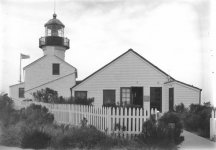
  • Cabrillo_lighthouse_5x7_plate.jpg
    Cabrillo_lighthouse_5x7_plate.jpg
    21.8 KB · Views: 0
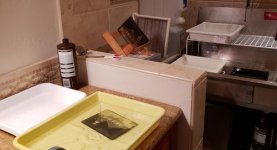
  • IMG_20191226_224550_212.jpg
    IMG_20191226_224550_212.jpg
    25.1 KB · Views: 0
Thanks for the encouragement and suggestions! Are you using Photoflo after the plates are washed?

Here is my first stereo card - and it works! This is scanned from my Nikon Z7 - I had to swap the frames around left/right so that the stereo effect was correct, but overall I’m pretty happy with the initial results.


First Stereo Card!
by Vince Lupo, on Flickr
 
I just ordered a nice-looking set of Kodak developing tanks (4 of them) and 6 4"x5" hangers. The plates should fit perfectly in the hangers, and I think will be a lot better than tray development. Other thing is that I'll be able to wash and dry the plates in their hangers in the 4th tank. At least that's the plan!

Funny, but I was very concerned about buying a stereo camera that only had a plate back, and was in the hopes that somewhere along the line I'd be able to find a 120 rollfilm back for it. But after this first outing, I really see the beauty of this process. Now I just need to get beyond my backyard and make some decent photos!
 
I've also posted this in the stereo thread....

First plates!


First Plates2
by Vince Lupo, on Flickr


First Plates1
by Vince Lupo, on Flickr

Not bad for the first ones, just taken in my backyard -- the good news is that there aren't any light leaks in the Voigtlander!

A bit of emulsion came off a couple of the exposures (the little dots you see in the images are just light reflections from my ceiling lights), so I really need to be careful when handling these plates. Other thing is that I should ask Jason if I'm using the right fixer.

Also, goofy question - are you guys using Photoflo on your plates after you wash them?

The exposures look a little thin, so maybe for the next round I expose at ISO 1 instead of ISO 2. Development could maybe even stand to have another minute (right now it's D76 stock at 9 minutes tray development). Speaking of tray development, I don't think this is the best method if I'm trying to do multiple plates at one time. I'm going to look into perhaps some Kodak 4"x5" hanging racks and some Kodak development tanks. That might be the better way to go, especially for washing and drying afterwards.

The one unfortunate thing is that I'd love to just be able to make contact prints of these pairs as-is for my stereo cards, but since the left is the right and the right is the left, I can't do that. Will have to print them individually and then mount them onto a card.

As far as the initial loading of the plates went, I only shot four exposures, but loading wasn't too hateful (in a Photoflex Changing Room). Two of the plates were a bit tight to load into the septums, but I've since run a thick flathead screwdriver along the inside grooves of the septums so it should be better. I'll likely take one of these already-processed plates and test all the septums with it so that I'm not fighting with them when loading.

Not bad for a first outing - I didn't expect them to be perfect right out of the gate, but I'm pleased with what I'm seeing so far.


Voigtlander Stereflektoskop2
by Vince Lupo, on Flickr


Stereoflektoskop
by Vince Lupo, on Flickr


Wow, that looks amazing. Those are special size Jason Lane Dry Plates, I presume. Maybe 6x13 cm? I have a French Gaumont Stereo Spido that works quite similera to that amazing Stereoflektoscop. And it works with film, too, but it's really difficult to cut it to the exact size. I have both film and plates magazine, so I hope to use it properly.
 
Here is my Gaumont Stereo Spido:


49189974117_46598841b0_c.jpg

Yeah I’ve been looking at those guys - hard to resist these cameras when they are so darned beautiful.

Yes Jason cut the plates to the size I wanted - I think it was 128mm x 58mm. Same price as his others.

My initial stereo card is a tad on the soft side - the mirror in the Voigtlander is desilvered a fair bit, so either I’m focusing onto the back of the mirror or the focusing lens is way off compared to the taking lenses. I have a new mirror coming this week, so we will find out. Either way I’m going to be sending it to Frank Marshman for the full spit’n’polish.


First Stereo Card with Viewer
by Vince Lupo, on Flickr
 
Some great results from the Stereflektoscop, Vince. And I see that no longer can I be blamed for your future stereo camera purchases, thanks to carbo73.


PF
 
yes, those early XX Century stereo cameras have something really special.


And yet I've been taking "more usual" dry plates.


Like this 25 ASA in 3A "postcard" size. Taken handheld with a Kodak No.3A Folding Pocket Autographic Special, model B, made c. 1921-1934. The lens is a Kodak Anastigmat f6.3.


49323817703_f9e15bacf5_c.jpg
 
Here's another Jason Lane Speed Plate 25 ASA in 3A "postcard" size. Taken handheld with a Kodak No.3A Folding Pocket Autographic Special, model B, made c. 1921-1934. The lens is a Kodak Anastigmat f6.3.


This is the Sentmenat castle, in the town of the same name, in Catalonia.


49323493227_2c5c3751a1_c.jpg
 
Nice ones. My Stereflektoskop back had a complete failure two weeks ago and now is totally unusable. However I just got another Nil Melior body which came with a good multi-plate back. Hope to put it to use this week.
 
Back
Top Bottom