J. Lane Glass Dry Plates

yes, those early XX Century stereo cameras have something really special.


And yet I've been taking "more usual" dry plates.


Like this 25 ASA in 3A "postcard" size. Taken handheld with a Kodak No.3A Folding Pocket Autographic Special, model B, made c. 1921-1934. The lens is a Kodak Anastigmat f6.3.


49323817703_f9e15bacf5_c.jpg

Really awesome. I’m curious, do you have the plate holder for the 3A? I just picked one up and I’m definitely interested in trying dry plates eventually, I’m wondering if the combination back is an absolute necessity (seems these cost more than the camera) or if I can get away with loading a single plate directly into the camera in a dark bag… I think it should be held against the focal plane, but I’m not sure. I’m going to experiment with shooting on paper a bit this week.
 
Really awesome. I’m curious, do you have the plate holder for the 3A? I just picked one up and I’m definitely interested in trying dry plates eventually, I’m wondering if the combination back is an absolute necessity (seems these cost more than the camera) or if I can get away with loading a single plate directly into the camera in a dark bag… I think it should be held against the focal plane, but I’m not sure. I’m going to experiment with shooting on paper a bit this week.


yes, unfortunately the combination back is necessary for the Nº3A Kodak folding Pocket. Maybe it could work without, just puting it as if it was a sheet of film. But you can't focus. Your only way could be closing to f22 and trying landscapes as to focus all to infinity. And yes, these backs cost much more than the cameras. I was fortunate to find one in mint condition, with ground glass and plate holder. But it's difficult to use all in the field, having to change ground glass and then plate holder and all. Fortunately the pictures look nice. In any case it's much easier and even cheaper to find a 9x12 or 4x5 camera with it's holders.
 
yes, unfortunately the combination back is necessary for the Nº3A Kodak folding Pocket. Maybe it could work without, just puting it as if it was a sheet of film. But you can't focus. Your only way could be closing to f22 and trying landscapes as to focus all to infinity. And yes, these backs cost much more than the cameras. I was fortunate to find one in mint condition, with ground glass and plate holder. But it's difficult to use all in the field, having to change ground glass and then plate holder and all. Fortunately the pictures look nice. In any case it's much easier and even cheaper to find a 9x12 or 4x5 camera with it's holders.

Thank you for the tips, still very cool. Might be something to experiment with someday. The way I see it, with roll film you have no visual focus aid anyway, so it could largely be the same experience, a lot of stopping down and crossing your fingers. I’d totally get the combo back if it ever turned up for a reasonable price. I haven’t even received the camera yet, should be arriving tomorrow! Just really looking forward to playing around with it. Whatever I do with it, it’ll be a different experience than anything I’ve ever shot for sure. My “daily drivers” are my Leica IIIF and my Nikon F, those were enough of a step back in time for me hahah.
 
Thank you for the tips, still very cool. Might be something to experiment with someday. The way I see it, with roll film you have no visual focus aid anyway, so it could largely be the same experience, a lot of stopping down and crossing your fingers. I’d totally get the combo back if it ever turned up for a reasonable price. I haven’t even received the camera yet, should be arriving tomorrow! Just really looking forward to playing around with it. Whatever I do with it, it’ll be a different experience than anything I’ve ever shot for sure. My “daily drivers” are my Leica IIIF and my Nikon F, those were enough of a step back in time for me hahah.
Maybe it could work. I had now tried just if it fits, with one of my Nº3A cameras (I have 3, I'm in love with those early Kodaks, but not the cheaper, later ones). It fits just in place, exactly in the "hole" that leads to the bellows. Maybe holding one plate there, with a lot of tape (or moving the camera the least) it could stand in place. Anyway it stands about 1 or 2 mm in front of the focal plane, so you MUST close the aperture to the maximum, f22 or f32 to have some focus. Maybe it has more flexibility, I don't know, but just in case...


Anyway at least there's space for a glass plate there, my main concern was that on closing the camera it could be crushed, but no.
 
A bit late to this party but yesterday the 4x5 plates I bought were delivered. i am now waiting on the plate holders.

I have one of the ChromaGraphica Double Dry Plate Holders coming--recently got the "where do we ship to" email--and I ordered a set of the plate holders that Stearman has for their daylight tank.

I bought a box each of the 2 and 25 speed plates to use with my 4x5 camera.

And I have been thinking about how or if I am going to print them. I say "if" because I might just mount the plates onto a black background and display them that way. Sort of like ambrotypes were done (I think? One of the early processes were typically made that way, can't remember which specific process.)

For now, my other option is to scan them and print digitally.

However, I have intended to turn a small room in my basement--originally a coal bin or root cellar i think--into a darkroom.
Since I am now stuck at home and have plenty of time, I am going to get serious about that.

This afternoon is going to be spent vacuuming the spider webs and taking down the cardboard "ceiling" the previous owner put up in there.

Rob
 
got two packs of Lane's 5x7 dry plates
got an old 5x7 Graflex SLR with ONE plate holder
exposure is about a minute with the 240/4.5 Xenar open wide!
big fun
 
A bit late to this party but yesterday the 4x5 plates I bought were delivered. i am now waiting on the plate holders.

I have one of the ChromaGraphica Double Dry Plate Holders coming--recently got the "where do we ship to" email--and I ordered a set of the plate holders that Stearman has for their daylight tank.

I bought a box each of the 2 and 25 speed plates to use with my 4x5 camera.

And I have been thinking about how or if I am going to print them. I say "if" because I might just mount the plates onto a black background and display them that way. Sort of like ambrotypes were done (I think? One of the early processes were typically made that way, can't remember which specific process.)

For now, my other option is to scan them and print digitally.


Rob

I think there's more to making an ambrotype beyond simply putting a black background behind it (actually I just watched a YouTube video of someone showing the entire process, and it is a process!). I think if you just put the glass negatives as-is on a black background you aren't going to see anything.

There is actually someone out there who is doing direct positives with Jason's plates (I'm sure you could find it online somewhere), but one thing you could do in terms of printing would be to make simple contact prints, and that wouldn't necessarily require a darkroom as such. Another thought might be to do something like cyanotypes or even platinum/palladiums, and here again they wouldn't require a 'darkroom'. Just some random suggestions 🙂

I'm in a state of suspension right now with my stereo glass plate venture -- my multi-plate back for the Stereflektoskop failed entirely and now it can't be used (would love to find some single glass plate holders for it). I found another Nil Melior camera body that has a nice falling plate back, but right now the front lens/shutter assembly is with Frank Marshman waiting to be fixed. And two other stereo cameras with glass plate backs are stuck in Europe and I likely won't see them for a month or more.
 
Here's the best of my first two 4x5 plates. Shot at ISO 1 in a pre-anniversary Speed Graphic with a 150mm Carl Zeiss Jena Tessar. Developed in Rodinal 1+25. I think I got the exposure right, but underdeveloped it a bit.


49750817946_cfe1946f63_o.jpg
 
Talking about 4x5 Jason Lane plates, that's a 2 ASA one developed in HC110. Picture taken with a Pacemaker Speed Graphic, Kodak Anastigmat f4.5. For plate holder I used an adapted filmpack holder. It's easy, just made a "filler" in black foam core and put it behind the dry plate.

Jason told me that the wavery patterns appear sometimes, specially in underexposed plates.

49530860002_00acfe740e_b.jpg
 
Sant Felix baroque bell tower, in Sabadell, Catalonia.

Hand held Ihagee Patent Duplex 720, 9x12cm, made c. 1925; Meyer Gorlitz Doppel Anastigmat Veraplan f4.5 / 135mm. Jason Lane dry plate 2 ASA, developed in HC110.

49596303266_2a5f4f8da0_b.jpg
 
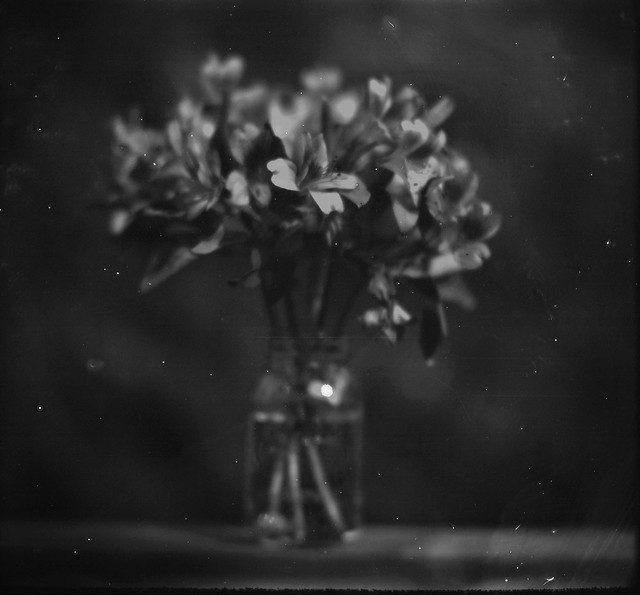
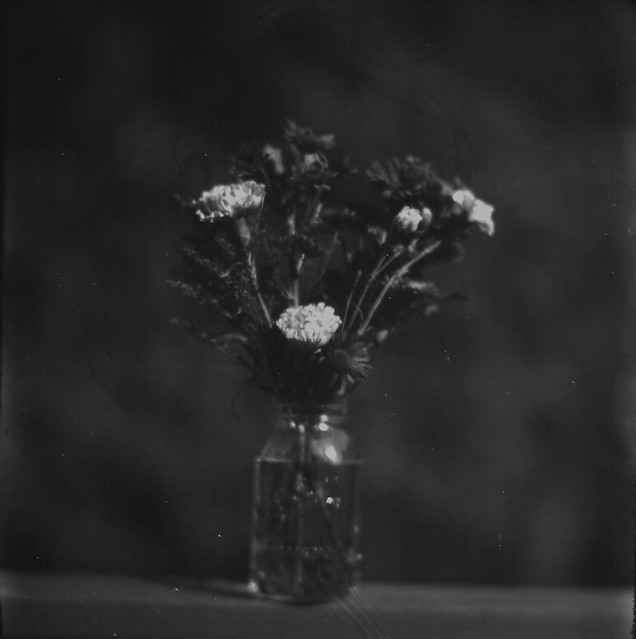
Flowers Back Porch J Lane Dry Plate Multigrade dev by Nokton48, on Flickr

9x12cm J Lane Dry Plate, loaded into a 9x12cm RADA Normalfaltz Single Plate Holder. Exposed in Plaubel Makiflex Automatic with a lens purchased from an Antique shop in the UK. An 8 inch F4 (?) approx brass projection lens of the Petzval variety. 1/4 sec exposure at wide open F4 (?) approx EI of 1, lightest cloud veiling direct key sun. Almost key light. No fill. Glass neg processed in Ilford Multigrade paper dev 10 mins at 20C.

I also shot frames with modern film, Efke PL100 and FOMA 100. Will be interesting to see the differences.

Petzval Lens Six Inch F3.5 from London by Nokton48, on Flickr

Lens used for above ^^ It shows some promise.

It does have a period look to it.........
 
J Lane 9x12 Dry Plate Makiflex Petzval ADOX Borax MQ by Nokton48, on Flickr

Another test a direct comparison J Lane Dry Plate 9x12cm in ADOX Borax MQ. Jason makes this formula to match the 1890's emulsion of old, different sensitivity vs. Ilford Ortho + ASA of 1 required shutter speed of two seconds at F4 in key bright sun. No fill

4X Projection print of glass negative using Omega DII with Omegalite. Ilford Multigrade dev Aristo #2 RC
 
I'm quite proud of this portrait: hand held, ground glass focusing and with 2 ASA dry plate! The exposure was 1/4 of a second, at full aperture (f4.5). Thankfully I had full cooperation of the model, who stod completely still, and that's even more difficult!

Ihagee Patent Duplex 720, manufactured in 1925; Meyer Görlitz Doppel-Anastigmat Veraplan f4.5 / 135mm lens, Jason Lane ASA 2 dry plate (9x12 cm), developed with HC110. My grandfather had an almost identical camera. This is his grand-nephew.

49615398731_088ef45c7b_b.jpg
 
Not me - if anything I’ve had to adjust development to keep the highlights down. I’m exposing them at ISO 12 and developing D76 1:1 for 10.5 minutes. This combo brings up the shadow detail but also keeps the highlights in check. I’m going to try 1:2 dilution and maybe 13-14 minutes to see if that works even better.

Are you using tray development? What’s your agitation rate?
 
Yes tray development with agitation rate as directed on box. 30 seconds at start and then 15 second every 1 min after. I metered at ASA 25 and it was definitely cloudy that day so possible underexposure.
 
One of the things that Jason asked me to try was to do a presoak in water for 30 seconds before putting them in the developer. I haven’t yet tried it, but he suggests that it actually increases the speed somewhat by doing this. Hopefully I’ll give that a shot to see what happens. Not that it necessarily matters, but I’m developing in tanks with the metal Kodak hangers.


Polyscop Stereo1
by Vince Lupo, on Flickr


Polyscop3 Stereo
by Vince Lupo, on Flickr


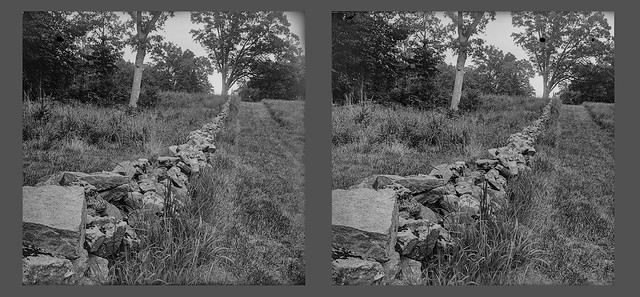
Near the Tracks, Gettysburg
by Vince Lupo, on Flickr
 
Back
Top Bottom