Spyderman
Well-known
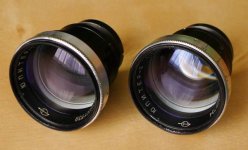
As you may have read in other threads Jupiter-3 is a Soviet Sonnar type lens made in Soviet Union from pre-war German design. The assumption of Dante Stella has been generally accepted that its focal length is 52.3 or .4 mm and therefore doesn't focus correctly on RF cameras that suppose the standard focal length 51.6mm.
Some lenses were a little off (i.e. closer to the Leica standard) since they were manufactured, some were modified at some point in their life, and some are still waiting to be modified and enjoyed by their owners.
Disclaimer: please attempt this only if you have some experience with lens repair and are able to do it properly. It would be a shame to destroy such a good lens as J-3 is. Better use it on Zorki than destroy it while trying to mod it for Leica.
There are basically 2 ways to modify such lens.
1) change the main shim that set the distance of optical block from film
2) change focal length by decreasing the distance between front and rear groups within the optical block
The option number 1 has been extensively discussed and you can find tips on how to do it in other threads. I want to point out that it is only partial solution - you can make the lens focus correctly only at 1 certain distance, all other distances will be slightly off. If you set the point of precise focus at 2m, half the error will be at infinity, and half at 1m. Or you can fine-tune it for the distance where you expect to use it most. The DOF might hide the error at other distances or it might not.
The option 2 is what I'm going to describe in this post.
Changing the focal length is possible only on older versions of Jupiter-3. I have 2 samples (1 in Kiev mount and 1 in LTM) from 1962 and 1963. The older has unscrewable rear group and can be modified. The newer one has one-piece optical block and is much more difficult to modify (maybe using lathe).
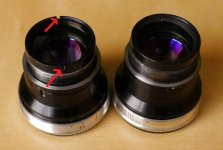
The one on the left is the older type. You can distinguish it by the 2 notches on the rear edge.
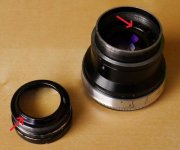
To shorten the focal length of the optical block you need to unscrew the rear group. Cover the inside of the front part with sticky tape to prevent fine dust from entering the diaphragm. Place sandpaper on flat surface, and start sanding the rear of the front group shell by rotating the front group block on the sandpaper while pressing down lightly. You want to remove material equally along the circumference. Use vernier caliper to measure the length of the front group block before sanding and often check how much you've taken from the material. About 0.3 to 0.5 mm shortening is enough.
It is possible that after the sanding, it won't be possible to screw the rear group fully in. The problem with my lens was that the bevelled edge of the rear group (red arrow in the lower left corner of image 3) would touch the ring inside the front part (second red arrow). I had to file some material from the rear group bevel and then blackened it with marker pen (you can use other flat black paint). If you need to do this filing - first remove the rear group glass from the aluminum tube.
After putting it together, the main shim needs to be adjusted (lens collimation, to make the lens focus at the distance indicated by rangefinder). After the modification, the distance scale can no longer be reliably used.
I managed to adjust my lens this way and make it focus correctly at 1m and infinity according to the Leica rangefinder.