I've recently experienced, for the first time with a Kiev, a few overlapping frames at the end of a film (in a Kiev 4) which from reading other posts here is not an uncommon problem.
The take-up spool on this and the other Kievs, is removable and generally seems to be much looser fitting on the spindle than those on the Feds and Zorkis, and I wonder if this may contribute to the problem?
As a follow up,in the experience of other users are the later Kiev 4M and 4AM models which have fixed spools, less prone to overlapping frames?
Hi SCOTFORTHLAD,
In my experience there are several factors that MAY cause unevern spacing. The first in my opinion is a weakness it the very Contax design in this specific area. But this is a retrospective view. I am in no position to speak as an historian looking from before the war towards the future, in terms of technical advances and potentials.
Now, in my opinion (and I actually use and prefer the 4AM model after some home reforms) the 4AM has no advantage at all in this respect - as the fixed spool is of no help for frame spacing.
This is because after you have solved all intermediate issues related to frame spacing, then you arrive to the final one and it is
the level of pressure the fork is adjusted to. I may say that this level should be higher than what we may think by instinct.
The Kiev 4AM fixed spool is, like in all previous models, rotated via a fork which by its turn gets its stream from the same gears as in previous models, with the exceptions related to the different external big winding knob,
The intermediate problems are the following:
aa) The camera gears should be decently clean and lubricated.
a) The re-winding knob must rotate free without film. This should be achieved either by cleaning and greasing, or by changing the spring of the rewind fork into a softer one, or both - the most common case. If the re-wind knob doesn't turn free, it will putting resistance when winding and advancing frames to expose.
b) The loading of film should be done with great accuracy, taking care that before closing the back, the film within the camera is under tension. The film holes should match the sprocket teeth.
c) The sprocket teeth must be "young" and able to catch the film
d) The back pressure plate of the film should push the film as any plate of any camera should. Take care yours is not tyred. If it is, alter the ends of the pressure plate with a thin end plier so that the plate will stand farther from the back and thus apply more force on the film. But do it only if you notice the plate is tyred.
d) all what is above the winding fork should be clean and greased.
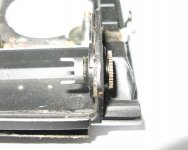
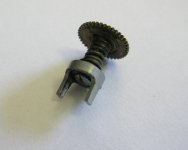
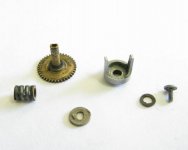
e) Finally we arrive to one of the most important issues, very often hidden from our knowledge. The winding fork is engaged to the camera gears by a screw in its center. Yet between the screw and the fork there is a semi-rectangular disc (washer) to ensure that once the screw is tigthened -the fork will move both directions without changing the screw position, i,e, without unscrewing the screw.
Being aware of this detail is like looking from afair at the mountain we are to climb. Which is always better than start climbing with no idea of what. And let's pay great attention to the following.
In the female side of the fork, where both the disk and the screw will be placed, there is a slight depression of the same shape as the semi rectangular disk. This is to prevent the disk to move (if the disk moves, the screw will move with it)
But since you will be screwing the screw at high pressure, to overcome the resistance put by the other washers and the strong spring above the fork, most of the chances are that when tightening the screw you will rotate the disk out of place - making the whole operation unusefull.
Even worse, you will have to turn a lot both directions the fork in order to know if the disk is in place or not. This is because our famous screw may show us he is not changing position as if the disk was in position - but in fact it is a temporary feature due to the pressure and with one or two films the frame spaces will start to deteriorate.
So what to do? First, don't loose patience. With a measure of exercise you will start "feeling" by tact that you are screwing the fork with the disk in place.
e) After the disk is in place you may start taking pictures. According to the frame spacing you will see, you will start slightly adjusting the pressure to reduce or distance spaces between frames. This stage I have called the final one. I bet you will have to tighten.
Cheers,
Ruben