leica films and dslr scanning

lukitas

second hand noob
Local time
12:11 PM
Joined
Dec 6, 2012
Messages
802
Location
Brussels, belgium
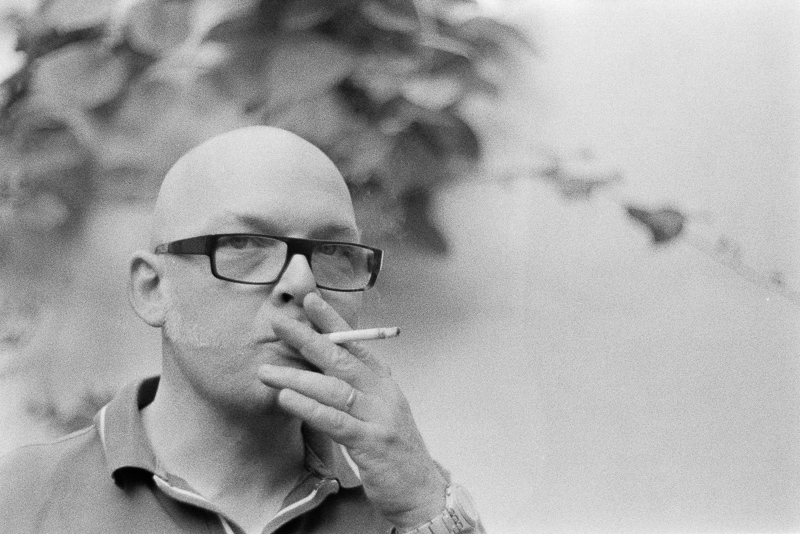
Here are the latest developments on how I scan film from my M3 and M2.

I use a Nikon D3100, it's 18-55 kit zoom mounted on a 12mm extension tube which allows for auto-everything. The lens is set at close to 50 mm, the camera mounted on a flash bracket taped to an enlarger head (Durst, B&W up to 6X6cm). I used f9, and underexposed about a stop

The negatives pass through a gate, the bottom of which is cut out of stiff cardboard, the top is half of a negative holder from the enlarger, the half that has a slightly larger hole than 36X24mm. This gate is stuck to the middle of a 6X6 condenser lens from the enlarger.

For light, I use a battery-powered, 24-lamp LED flashlight, covered with two diffusing surfaces : paper at about 5mm above the lamps, plastic at about 2,5 cm above the lamps. The condenser sits on top of the plastic diffuser.

I was a bit surprised at the 5 pictures a day limit on the gallery, could have showed you more...

U54266I1375549347.SEQ.4.jpg


U54266I1375549346.SEQ.3.jpg


U54266I1375549345.SEQ.1.jpg


U54266I1375549345.SEQ.0.jpg
 
Very nice photos.

I don't know anything about the limits of the gallery, but IMO it's rare that one needs to show more than five or so photos on a given theme at any one time. That's a matter of the viewer's attention span. More than a few photos and most viewers just skim and move on.

G
 
I don't know anything about the limits of the gallery, but IMO it's rare that one needs to show more than five or so photos on a given theme at any one time. That's a matter of the viewer's attention span. More than a few photos and most viewers just skim and move on.

G

You're probably right. And it is good, to have to limit oneself, think about which ones are worth the upload.

On the other hand, as I often wait two months or more to get my negs developed, I periodically find myself with a glut of pictures I would like to share, and five a day is a bit frustrating. Ah well.

U54266I1375705016.SEQ.0.jpg


U54266I1375705017.SEQ.1.jpg


U54266I1375705017.SEQ.2.jpg


U54266I1375705017.SEQ.3.jpg


U54266I1375705018.SEQ.4.jpg
 
I'm enjoying the progress of your photos! 🙂

The renderings look good, they look like film images as they ought. To me, grain and other film defects are part of what I love about film images so a bit of grain and such is quite all right.

G
 
Looks great. One thing I noticed when I tried to digitize my film with digital cam is that getting an even lighting across the frame is actually more difficult than I imagined. Using a strobe (even with small diffuser attached) results in a hotspot in the middle and using a digital screen resulted in pixels being seen in the image.
 
@ classique : if your light source is uneven, take a shot with no negative, to use as a mask in photoshop. A bit of a fiddle, but once you're happy with your exposure correction, you can automate for a series of scans.
If you use a (computer) screen as backlight, keep some air between the negative and the screen. Half an inch should eliminate any trace of pixels, if your aperture isn't too small.
Kludging a half-decent negative holder keeps your film flat, and it keeps dust to a minimum.
 
I'm enjoying the progress of your photos! 🙂

The renderings look good, they look like film images as they ought. To me, grain and other film defects are part of what I love about film images so a bit of grain and such is quite all right.

G

Thank you kind sir!

I think I am getting the grain of the film itself, but I am not quite certain.
When the dslr is out of focus, there is just as much grain in the scans, so I suspect the camera is doing some sharpening magic on the raw files. That would make the grain pop.

I wonder if I could get significantly finer grain, using the same film and ISO (HP5@400), if I develop them myself. Now, they come back from the lab.

Of course, FP4 would give quite a bit more detail, but at the price of two stops, and I am wary of shooting slower than a 125th.

ah, the misery of hipster photography 😀
 
Looks great. One thing I noticed when I tried to digitize my film with digital cam is that getting an even lighting across the frame is actually more difficult than I imagined. Using a strobe (even with small diffuser attached) results in a hotspot in the middle and using a digital screen resulted in pixels being seen in the image.

I use a color-corrected, flat panel lightbox as a light source. Absolutely even illumination.

G
 
Thank you kind sir!

I think I am getting the grain of the film itself, but I am not quite certain.
When the dslr is out of focus, there is just as much grain in the scans, so I suspect the camera is doing some sharpening magic on the raw files. That would make the grain pop.

I wonder if I could get significantly finer grain, using the same film and ISO (HP5@400), if I develop them myself. Now, they come back from the lab.

Of course, FP4 would give quite a bit more detail, but at the price of two stops, and I am wary of shooting slower than a 125th.

ah, the misery of hipster photography 😀

Don't know of any DSLRs that apply sharpening to raw files. Hmm.

G
 
You really should get a dedicated macro lens that offers a better flat field than that zoom. I can guarantee your DSLR scan quality will jump drastically higher
 
I use a 55/3.5 micro-Nikkor. It's a very early version, and cost me about $60. I did tests against two later ones I own (one a 60mm AF-D) and they were all equal at f/8, so I leave the early one with my copy rig. FWIW, enlarging lenses were distinctly inferior. Normal primes or zooms, we won't even talk about that.

One thing that helped me a lot was someone's tip of putting a mirror on the neg stage (I use a copy stand and a led movie light with a diffuser on it) and centering it in the view by tilting the camera around. When you get it centered, everything is parallel. Almost all the B&W on my flicker site is done with this setup, and there's a photo and explanation on there somewhere, too.
 
You really should get a dedicated macro lens that offers a better flat field than that zoom. I can guarantee your DSLR scan quality will jump drastically higher

You're probably right. I tried my trusty nikkor 50mm 1.4 ai, and it really sucks at close range : very fuzzy corners, even with the partial coverage of the asp-c. The 18-55 zoom is a lot better in that respect. I tested it on a fm2, (viewfinder only), and was surprised to find decent full frame coverage, from 55 down to about 35. But if a nice micro-nikkor will do even better...

I am saving up for a lens, but then I would have to figure out which one to get first : a nice DR summicron, or a better scanning lens. As I am reasonably happy with my scanning set-up, I think lenses for my leicas are a higher priority. And if anybody should have a 35mm 'cron lying about doing nothing, don't hesitate contributing to a good cause : support a 'budding' photographer 😉
 
One thing that helped me a lot was someone's tip of putting a mirror on the neg stage (I use a copy stand and a led movie light with a diffuser on it) and centering it in the view by tilting the camera around. When you get it centered, everything is parallel. Almost all the B&W on my flicker site is done with this setup, and there's a photo and explanation on there somewhere, too.

Great tip. I'd forgotten that one.
I remember it works perfectly, pin-point alignment every time.
 
Don't know of any DSLRs that apply sharpening to raw files. Hmm.

G

it's a nikon D 3100. If it doesn't sharpen raw files, I wonder how I get so much grain in what are basically slightly unsharp scans. I won't show them here, too much hassle uploading bad scans, but I assure you it looked as if I had film grain, at the pixel level.

Not sure quite what is going on here.
 
The plot thickens. These were taken on XP2, C41 development b&w film, rated at 400 ISO

U54266I1376086016.SEQ.4.jpg


U54266I1376086015.SEQ.3.jpg


U54266I1376086015.SEQ.2.jpg


U54266I1376086015.SEQ.1.jpg


U54266I1376086014.SEQ.0.jpg


I get the impression i'm getting more detail. I don't really see less or finer grain, but I may be wrong. Maybe it's just better discipline - higher speeds
 
Back
Top Bottom