
Louis Faurer print. Sonnar?

megido

Well-known
Local time
12:21 PM
Joined
Oct 3, 2013
Messages
303
My local museum is currently showing the work of Louis Faurer. One particular photo caught my eye, primarily for its OOF quality. The attachment doesn't do the print justice.
The image in question is from 1944 and made me wonder whether this could be an example of the Sonnar type OOF that many here revere. Personally, the quality of wide open OOF rendition has never really been of any great interest before but after seeing this print in the flesh, it piqued my curiosity.
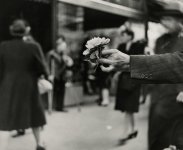
 

Attachments

  • IMG_5491.jpg
    IMG_5491.jpg
    20.8 KB · Views: 0
The photo looks very much with OOF areas similar to what my 1934 Summar produces.

A better bet would be if you can that is , is to study what photo gear that photographer was known to personally use at that time.
 
IIRC he started out with some "miniature" 127 film 30x40mm camera - which is the frame ratio of that picture - and later turned to Leicas. Neither is likely to have had a Sonnar.
 
IIRC he started out with some "miniature" 127 film 30x40mm camera - which is the frame ratio of that picture - and later turned to Leicas. Neither is likely to have had a Sonnar.
I only thought 'sonnar' knowing that its oof look is quite distinctive. What impressed me was the ability to retain some real 'clarity' to what had been thrown out of focus. A look that struck me as quite unique whatever the lens.
 
Surely we can reverse engineer the gear, judging by the twice-a-week threads about "selling my v3 summicron for the specific look only v2 can give me"?
 
Oftentimes, I would bring a 16mm camera along with my Leica, and photograph New York streets.
http://www.loeildelaphotographie.com/en/2016/09/19/article/159919372/louis-faurer-par-lui-meme/
Louis Faurer, By himself
SEPTEMBER 19, 2016 - FRANCE , WRITTEN BY L'OEIL DE LA PHOTOGRAPHIE

Also introduced for the first time are many of Faurer's Kodachrome reversal transparencies from the same time period (taken with his Leica rangefinder, very patiently handheld at night to render acceptably sharp images at 40 ASA). The resultant C-type prints made from internegatives are very faithful to Kodachrome's trademark warm tonality, and give us an alternative take on 1940s/50s Times Square. Art Institute of Chicago
 
Surely we can reverse engineer the gear, judging by the twice-a-week threads about "selling my v3 summicron for the specific look only v2 can give me"?

Not a gear obsessive by any stretch of the imagination. I was just struck by the quality of this pariticular print.
 
Oh come now. Surely one of those internet experts who are able to instantly identify the lens from any given photograph will be able to weigh in on this and give us a definitive maybe.

😀
 
Back
Top Bottom