Minolta CLC metering system

caila77

Well-known
Local time
1:00 AM
Joined
Nov 1, 2005
Messages
485
Location
Italy
I have always read that Minolta’s CLC metering system consists of two CdS sensors that read the light in two different positions of the frame (one higher and one lower). The advantage would be limited to photographs with a difference in light between the upper and lower parts of the frame: typically, but not only, landscape photos that include the sky. This theory is repeated on many websites and in numerous videos online.

The same information (or almost the same) can be found by querying AI:

“How CLC Works
Two Cells, One Goal: Instead of one cell averaging the whole scene, CLC uses two strategically placed CdS cells to read different parts of the image.
Compensates for Contrast: The system identifies discrepancies between the cells. In high-contrast scenes (like a bright sky), the cell metering the darker foreground is given more sensitivity (often twice as much), ensuring shadows aren't lost.”


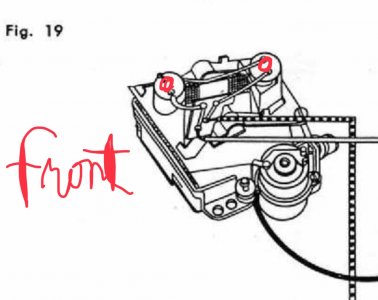
However, this has never completely convinced me. First of all, the term CLC indicates something different (Contrast Light Compensator). My impression is that the CLC system allows, through two differently calibrated cells, the reading of both highlights and shadows in different ways, in order to optimize exposure. As a result, the exposure of cameras equipped with the CLC system would be better in the presence of strong lighting contrasts, regardless of their position within the frame.
I have never conducted formal tests, but using both camera bodies with the CLC system (SRT101) and without it (X300s, X300, and X700), my impression is that the CLC system provides better-exposed frames in situations with strong light contrast, regardless of the position in the frame . Minolta itself, in the SRT 101 manual, only refers to high-contrast scenes without providing information on any position of the sensors .

Looking at the image in the manual, could it be that the sensors are actually affected by the position?

cclcsrt.jpg
 
Last edited:
The CLC system works very well when the camera is positioned in the landscape mode. It doesn't perform well in the portrait mode because of the placement of the CdS sensors. When I worked for Minolta in the 1960's and 1970's, we were well aware of this situation and instructed Minolta in Japan to include this information in their printed materials.
 
The CLC system works very well when the camera is positioned in the landscape mode. It doesn't perform well in the portrait mode because of the placement of the CdS sensors. When I worked for Minolta in the 1960's and 1970's, we were well aware of this situation and instructed Minolta in Japan to include this information in their printed materials.
Thanks for your input. It seems to be a matter of location. I couldn't find any information about this, not even in the manuals (different versions), which obviously don't explain the technical details of how the light meter works.

ai link sotto diverse versioni dei manuali di fotocamere che utilizzano il sistema clc


I recently took some photos with the X300s and the SRT101 in high-contrast conditions and got better results with the SRT (same subjects, same time, same film and same processing).
 
I wonder if you can empirically check this somehow.

Try a grey card on the window and get a reading with the top part being bright.

IMG_20260113_105500_(600_x_600_pixel).jpg

Then turn the card sideways and get the top of the viewfinder to read on the grey part of the card.

Will that work? Contrast should be the same.

(I am thinking loud now...).
 
I wonder if you can empirically check this somehow.

Try a grey card on the window and get a reading with the top part being bright.

View attachment 4885184

Then turn the card sideways and get the top of the viewfinder to read on the grey part of the card.

Will that work? Contrast should be the same.

(I am thinking loud now...).
Thanks for the idea, I'll definitely do some more in-depth testing as soon as I can find a couple of hours.
 
If you look at the location of the two cds, CRC designed for optimizing landscape with large portion of bright sky in the frame. Like other cds meter systems, the CRC is a very simple but smart design
 

Attachments

  • IMG_3104.jpeg
    IMG_3104.jpeg
    129.6 KB · Views: 8
If you look at the location of the two cds, CRC designed for optimizing landscape with large portion of bright sky in the frame. Like other cds meter systems, the CRC is a very simple but smart design
Correct. This is exactly what the Minolta engineers in Japan factored into the CLC design. Many Japanese amateur photographers use their cameras to photograph landscapes with people in the foreground. Thus, the solution for underexposed foregrounds was CLC.
Raygram-Hornstein, the USA company for Minolta's importing, wholesale distribution and sales, trained our retailers to emphasize the advantages of CLC to their customers, particularly those customers who favored shooting with slide films, where achieving correct exposure is critical.
The success of the SRT line of cameras began in 1966 with the SRT-101 and ran continuously through until 1981 with the budget-priced SRT-100X.

The SRT-101 was so successful that Minolta's USA Headquarters adopted the address of 101 Williams Drive, Ramsey, NJ 07446.
George Williams was the Comptroller for Minolta USA, so the Minolta executives in Japan used George's last name to name their street address in New Jersey.
 
t’s been a while, but I finally managed to run a few tests.
Following Pan’s suggestion, I used my home window on a sunny day as a reference.
I took spot meter readings of the lower part of the frame and the upper part, getting these exposure values:

lower part: ISO 200 – f/8 at 1.6s
upper part: ISO 200 – f/8 at 1/500s

WhatsApp Image 2026-01-27 at 11.44.23.jpeg


Then I framed the same scene, splitting the composition evenly: half the frame filled by the window frame and half by the outside view, and I exposed using my Minolta SRT101 with a 28mm f/2.8 lens. After that, I rotated the camera 360° while keeping the same framing.

In both cases I got the same exposure: ISO 200 – f/8 at 1/125s.


This makes me think that the two cells of the CLC system are calibrated the same way.


Then I changed the framing to favor the upper part, with about 2/3 of the frame capturing the much brighter outside area.


WhatsApp Image 2026-01-27 at 11.46.28.jpeg


In this case the two exposures ended up being different by about two stops:


ISO 200 – f/8 at 1/125s with the camera in the normal position
ISO 200 – f/16 1/125'' with the camera upside down
 
In this case the two exposures ended up being different by about two stops:
This sounds correct. The overall contrast remains the same for the scene but once the brightest part is placed on the bottom (upside down position) the camera gives less exposure.

Did I get it right? I think it sounds correct.
 
Some of the Minolta rangefinder cameras from that era were also badged CLC.
How did they achieve this using only a single cell situated above the lens?
Or was it just marketing hype?

Chris
 
Some of the Minolta rangefinder cameras from that era were also badged CLC.
How did they achieve this using only a single cell situated above the lens?
Or was it just marketing hype?

Chris
True, in that case the cell should be divided into two parts.
The two halves of the cell should measure the brightness of the upper and lower parts separately.
 
I wonder where the cell is on the later SRT 100x, which didn't have the CLC badges, and I think had a simpler metering system
 
I wonder where the cell is on the later SRT 100x, which didn't have the CLC badges, and I think had a simpler metering system

The last of the SR-T 201s didn't have CLC metering, either. (I have one.) They did have the more modern split-image center/microprism surround focusing aid, however, which earlier 201s didn't have. (The better focusing aid is more important to me.)

- Murray
 
Back
Top Bottom