More on the Pentax film camera project

A number of people have commented on the vertical framing. I shoot half-frame a lot and all my cameras, Olympus, Canon, and Fujica have vertical framing. That is just the product of the format and horizontal film advance.

I've scanned half-frames with no problems on two different Epson flatbeds, V600 and V850.. No, you can't scan the negatives on automatic (thumbnail) like regular 35mm but instead just go to normal, frame the negative and scan. It is slower because each negative has to be scanned separately.
 
Theoretically if the film market potential was there for all the Gen Z lot, then surely the latest Polaroid cameras would be flying off the shelves. I've never seen one in the wild. The Instax cameras probably sell OK, but again, you don't see that many of them. I think we have two of them in the loft somewhere. My kids don't care.
Last I heard, Fujifilm sells more Instax cameras every year than all the dedicated digital cameras from all manufacturers combined. It’s a wildly successful product, and makes up a significant share of Fuji’s profits.

I don’t know about Polaroid’s sales, but the fact that you can buy them in every Target and Walmart tells me they’re not a flop.
 
That's odd, I have no problem scanning half frame. I don't have the lab scan my film anyway.
I'm not a fan of vertical framing. 90+% of my photos are in landscape mode....even portraits. I hate turning the camera. I tip my hat to the engineers at Pentax for the horizontal perspective of the Pentax 645 too.
 
Last I heard, Fujifilm sells more Instax cameras every year than all the dedicated digital cameras from all manufacturers combined. It’s a wildly successful product, and makes up a significant share of Fuji’s profits.

I don’t know about Polaroid’s sales, but the fact that you can buy them in every Target and Walmart tells me they’re not a flop.
I think his point is that Instax sells, but who uses it long term.
 
I'm not a fan of vertical framing. 90+% of my photos are in landscape mode....even portraits. I hate turning the camera. I tip my hat to the engineers at Pentax for the horizontal perspective of the Pentax 645 too.

Agree. It may be of interest to some that, over the decades I sold stock, less than 10% of my sales were vertical images. A few portraits, but overall the majority of what I had published was horizontal. Even portraits. In the '80s I sold a fair few images to leading publications (Economicst etc) who preferred horizontal framing as they could then adjust the images accordingly for one- or two-columns.

One client told me he liked my 'long' (= horizontal) images as it gave them space to the left and right to play with, crop to fit or insert text as required, and so on.

I retired from stock sales just before Covid. Things may have changed now but I suspect this 'rule' has stayed, assuming anyone out there in the big bad world is still buying stock and not just copying it from the web or picking it up for 50 cents or $1.
 
Last edited:
Following on my earlier post about this small beast. At first glance, it reminded me of the long-ago Olympus Pen half-frame. There is also a whiff of the Fuji XE digital cameras about it. Just my initial impressions. Results have yet to be seen.

At US$500 (less a few cents) it will be interesting to see what the markup in Australia will be. Likely around the AUD $1000 mark. Too rich for my blood, but I have to try to be positive and not my usual cynical self, so I wish Pentax all the luck in the world with it. Students with cashed-up parents may flock to it, with the price of film down here the half frame format could be a real winner if it catches on and the results are not too grainy.

Initially on reading the specs in the (as usual excellent) Casual Photophile, it struck me as being rather basic. Except for the shooting modes. Far too many, much too like the Fuji XE range. A little less tinkering with the amateur settings could have meant this would be an ideal street camera for those seeking the 1950s-1960s gritty Tri-X look. Shutter speeds are also somewhat too low, much like all those 1950s metal point-and-shooters. Ten rolls of film for one CR2 is a no-no for me, but I rather suspect this may brand me as mean. Sorry if.

That it's a half-frame may be its strongest selling point. With film edging up to the price of silver nowadays, this may be a winner.

I did think of buying one to take with me on my next trip to Indonesia (December 2024). I have about 80 rolls of mostly B&W film left in my analogue fridge at home and I've wanted to make use of it for one final 'shoot' before I completely exit the film scene. So far I'm still on the fence about this camera, but time will tell and we will see.

So overall, this new Pentax is, for me as an initial impression anyway, more under- than overwhelming. But I will wait for a 17 to turn up at my secondhand dealer in Melbourne, and give it a look-seethed . It's not as if I don't already have enough film cameras, but then, well, do I have to explain this? We all know, don't we...
 
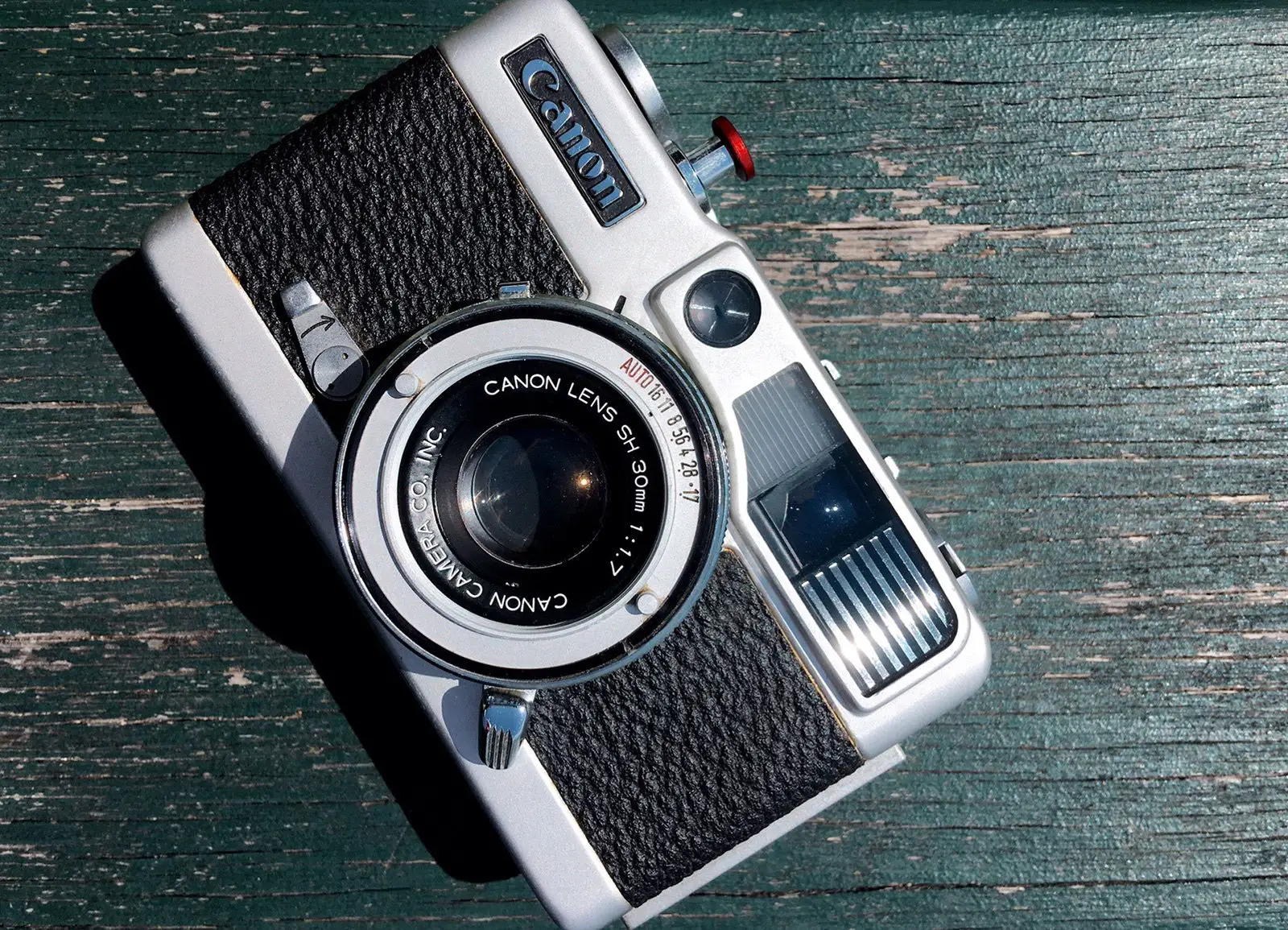
I have two half frames, one is a Pen FT that is pretty much as-new, with the 38/1.8 lens, and this Canon Demi EE17 which I've been refurbishing.

It had some wiring issues to the battery chamber, and I decided to paint it. It's not all put back together yet, the covering is loose in this photo, it's not glued down yet.

I'd be interested in the Pentax for the 25mm lens, the Canon is a little longer at 30mm but it's also a lot faster. (review here: Canon Demi EE17 Review - A Surprisingly Good Half Frame Camera - By Phil Stefans)

And of course the Canon can be used fully manual, doesn't need a battery at all except for the meter (which works.) Of course, no built in flash. Shutter goes to 1/500 instead of a half-stop slower of the Pentax.

This body cost me about $100.

IMG_9609 Medium.jpeg

Here is what an original silver one looks like:


Canon-Demi-00001-e1550608872581.jpg
 
Last edited:
At US$500 (less a few cents) it will be interesting to see what the markup in Australia will be. Likely around the AUD $1000 mark. Too rich for my blood, but I have to try to be positive and not my usual cynical self, so I wish Pentax all the luck in the world with it. Students with cashed-up parents may flock to it, with the price of film down here the half frame format could be a real winner if it catches on and the results are not too grainy.

The RRP here is $AU899 @DownUnder

And the estimated arrival date for regular stock is the 18th of July.

Marty
 
I don't know what type of market research was conducted that begat this strange fruit.
My young photography students were eagerly awaiting the new Pentax 35mm camera to replace their older, heavier, sometimes unreliable, and economically unrepairable 35mm SLR's.
I am very disappointed....so are my students.
What serious analog photographers want and require are fully manual/automatic 35mm cameras that use existing lens mounts.
The K-mount is perfect!
I believe that a "new style" K1000 SLR (maybe plastic) body could have been retailed for under $500, providing a decent profit margin for Ricoh/Pentax Corp.
Thousands of students shot millions of photos with K1000-type cameras.
Why did Pentax turn their back on a proven winner?

Because they didn't want to compete with the three million plus K1000s they already made in the used market. The K1000 was priced at $315 (body only) when it was discontinued in 1997 (Pentax K1000 - Wikipedia). Adjusted for inflation, that works out to about $620 in today's dollars. You can buy a perfectly good K1000 with a lens for around $200 today (less if you're patient or lucky). While you can't compare the price of a brand new camera to a 40 year old used camera, I think at least for this initial offering Pentax needed something that would differentiate the camera from what's available in the used market for one-third the price they would have to sell a new camera for. (And I expect if they recreated the original all-metal K1000 and not the later Chinese-made plastic version it would cost a great deal more than $620. The price of the K1000 when it was introduced in 1976 was $299.50 with a 55mm f/2 lens—that's $1,653.14 adjusted for inflation.)

I'm also unclear on why you would think a 35mm SLR is economically unrepairable. If the camera is not damaged, a routine CLA should get it back up to factory spec at a very reasonable cost. I've had a couple of mine serviced and the cost was in the $75–$150 range.
 
I don't hate the pictogram themselves. It's just that they look a bit...overwhelmed by the array of exposure controls that occupy the rest of the camera's top view.

Another "for the kids" decision maybe. But I can't help but wonder if it'll be a bit more, well, precise to use if they have the actual distance scale at the top.

Now I do hope these can pay off, so hats off to you. They really have put a lot of effort into it. Toward a somewhat skewed direction.
I hope so too, and for sure I'll buy 1 just for kicks. I havent shot half frame in several decades since I borrowe a Canon Demi

Y hiope this one is successful and re-opens the door for a K-mount film camera that replaces my old MZ-7 which sooner than later will have the pastic gear failure
 
Have to say, after looking a bit more closely, aside from the rather ugly "steam punk" look, a six position mode dial that does not include manual setting of exposure time really puts me off.

My Minox 35GT-E does not have manual exposure time settings either, but since it is ONLY center-weighted average metering and always requires you set the aperture manually, you can get any specific time you want easily and reliably by fudging with the ASA setting dial.

I much prefer the Rollei 35S with only a match-needle, manual metering system, and all mechanical shutter etc so that when the battery dies you can ignore the meter.

G
 
Maybe we've flogged this long enough. Now, what do you think Ricoh/Pentax will do with the bazillions of dollars they'll make from the P17? I know what I'd like: a fixed lens, manual focus medium format rangefinder like one of the Fuji "Texas Leicas". Simple and straightforward, easily mastered by students and amateurs, but a joy for accomplished photographers as well. OK, even throw in a non-TTL meter and electronic shutter for AE.
Will this happen? Not a chance! But it's a fun thought-experiment.
 
I think Mint's camera will be closer to $800. Also, though I haven't held either camera in my hand, I have a suspicion that the Pentax, while cheaper, will be somewhat better made than the Mint Rollei 35AF. Mint has much less manufacturing know-how and most of what they have made is very plasticky.
I was just reviewing the Rollei 35AF blog posts and, to your mention of "plasticky", do be aware that the Rolleil 35AF is an all metal camera, just like the Rollei 35S.

G
 
If anyone interested, here is a 17x24mm slide holder for 3D print

 
Sad thing is the price of the original pen f will spike because of this new Pentax. The pen f was a well built camera
 
Back
Top Bottom