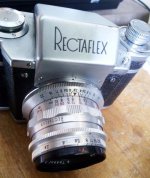
Hi Brett, thanks for your comment. Yes, if I know of someone travelling to the USA it is a great opportunity. By the way, I did some testing a few minutes ago and the shutter only slows down on slow speeds. From 1/200 up, it works fine!! What do you think of this? And naturally, as soon as I take some nice photos with it, up they will go here.
Best wishes,
EDUARDO
Hi Eduardo,
It's encouraging that the mechanism is basically functional, of course. It's generally a great deal easier to make one run well if it is basically in sound order and needing servicing and probably new curtains, than rehabilitating an example which is terminally worn or has broken parts. Having said that, even if the higher speeds of your Rectaflex sound OK it doesn't necessarily mean the times will be accurate. Being a focal plane shutter the blinds need to travel across the film gate at the correct speed and in the correct relationship to each other to achieve good exposure right across the image frame. You would quite likely find that if the shutter accuracy was checked at the beginning, centre and end of the film gate there may be considerable variation.
This is not a particular criticism of the Rectaflex, by the way Eduardo. In original, untouched condition, many cameras of a similar age using cloth focal plane shutter curtains would also run unevenly. It simply reflects the effects of age on the suppleness of fabric curtain material, and how even minor changes in friction in the mechanisms (due to a need for fresh lubrication and/or adjustment) can alter the speed at which the curtains travel, and consequently, the slit widths at the faster speeds. It's all fairly typical stuff that will impact many classic mechanisms across the whole spectrum of value and desirability from ALPA to Zenit.
In the (unlikely, I think) event your cameras high speeds are actually still accurate, I could only offer some general observations about why the middle and slower speeds might be recalcitrant, but not the higher ones. I do not know enough about the Rectaflex mechanism to comment specifically. But in common with most other classic focal plane shutters of similar age, it likely reflects the need for servicing and cleaning of the mechanism in general, and of the speed escapement (or escapements, some designs do have more than one) in particular, which are not being engaged at the high speeds (and hence, will not impact the accuracy of those speeds).
I suppose that brings us back to where we started, Ie. that careful servicing of the camera and probably new curtains is dictated. But what you've mentioned all sounds fairly promising, as it seems the camera is doing its best to work despite the effects of age on fabric and lubricants. It's the sort of prospect I'd be delighted to find myself, let alone at your purchase price.
It is not easy to find hard information about the longevity and reliability of the Rectaflex cameras. The later, re-designed Lichtenstein variants, whilst highly collectible, do not have a good reputation for longevity. As I recall, my friend and photographic author Ivor Matanle did not recommend the Rectaflex as a camera for frequent use, when, in the 1980s, his book
Collecting and Using Classic SLRs was published. In part I think this reflects the historical importance of this line of cameras, their relative rarity, and status as collectibles. But were I in your shoes (and I wish I was!), then, I would repair a Rectaflex and absolutely use it. And if I enjoyed the experience and liked the resulting images (and on past experience with all sorts of odd, rare or unusual designs, I probably would!), then, I expect I would want to use one rather a lot. But I have always believed cameras, even the most beautiful types,, are functional objects and made for the purpose of creating images, so regularly take out all sorts, such as Praktinas, pre-war Contaxes, or ALPAs. I suspect that if you take care to learn the peculiarities of its design, heed any particular instructions about Eg. setting various speeds, and operate its controls carefully and with mechanical sympathy, it will probably stand up to regular use OK. It's most likely better for the camera to be used regularly but carefully than to languish in a cabinet for months or years at a time, anyway. Leaving one to sit unused for extended periods is probably the best way of all to ensure that a camera will not run very well.
Keep me in the loop please. I'll likely never own a Rectaflex myself (although, I also said that about ALPA, once) however it's certainly a model on my list of dream cameras to own.
Cheers,
Brett