Rangefinder/slr History

I really think it would be incorrect to think the rise of the SLRs was due to some conspiracy by the camera companies. My understanding of Nikon history is that they were utterly surprised when RF sales fell off a cliff. They assumed SLRs would be something of a passing fad and had production plans to build SPs and Fs side-by-side, sharing as many parts as possible. They even developed an extraordinary prototype rangefinder camera -- the SPX -- that shared the slightly larger Nikon F chassis and incorporated both a zooming 35-135mm viewfinder and through-the-lens metering. Demand dropped to zero and the camera never went into production.
 
To continue the story....
Nikon Started designing the F a couple of years before the introduction late 1959, important to note that the sole importer in the USA, EPOI owned by Joseph Ehrenreich, was not too fond of the Nikon F, mainly because of the pointy prism, and demanded Nikon introduce more Rangefnder lenses before the introduction of the F, hence such jewels as tha 100cm f6.3 and the 2.1cm f4 in the rangefinder mount. If you look at the production date you realize that Nikon started making the F in march of 1959 but wasn't introduced to USA untill the end of the year.
One other point I like to make, Nikon produced 140,000 rangefinder cameras from 1948 to 1965 but once the F came out they produced over 100,000 units in less than 4 years! The demand was simply so great that they stopped making rangefinders after 1960 (other than 2500 black S3s for 1964 Olympics) in favor of the F.
The Nikon F by itself did the rangefinders in...there was no photgraphy tool at the time that would come close...for sport shooters and photojounalists it was a dream come true.

Isn't it great that we're in the year 2006 and there are at least 4 or 5 different rangefinder cameras to be had? and thats just the new stuff.
Kiu
 
I don't believe there necessarily was a conspiracy by the camera companies. However, I think many of them saw that RFs had reached the limit of existing technology & realized that the 1st company to market a fast, responsive SLR, i.e., 1 that could be used somewhat like an RF, only w/the advantage of WYSIWYG, would have a big seller on their hands. Zeiss Ikon, for example, had already developed a prototype of what became the Contax S (in post-WWII E. Germany), the 1st pentaprism SLR, in the 1930s, & was working on the Contarex as early as the mid-1950s. Nikon's achievement, among many, was to get the 1st modern (instant-return mirror, etc.), affordable, professional quality system SLR to market. Other companies failed on the marketing side (e.g., Zunow) & others were too late (e.g., Zeiss Ikon).

VinceC said:
I really think it would be incorrect to think the rise of the SLRs was due to some conspiracy by the camera companies. My understanding of Nikon history is that they were utterly surprised when RF sales fell off a cliff. They assumed SLRs would be something of a passing fad and had production plans to build SPs and Fs side-by-side, sharing as many parts as possible. They even developed an extraordinary prototype rangefinder camera -- the SPX -- that shared the slightly larger Nikon F chassis and incorporated both a zooming 35-135mm viewfinder and through-the-lens metering. Demand dropped to zero and the camera never went into production.
 
1 that could be used somewhat like an RF, only w/the advantage of WYSIWYG, would have a big seller on their hands.

Back in the early 1970's when I was getting into semi-serious photography, I and my friends who were acquiring new cameras really considered the modern rangefinder and the modern SLR to be very similar, and as I remarked in a previous post in this thread, both desirable over the scale focus and roll film cameras.

In fact, as I think about it the way it was back then, I don't remember the term "Rangefinder" (used to describe a type of camera) used that much.

I remember we used the term "roll film camera" for those that were not 35mm.

Both the modern rangefinder and the modern SLR had in common:

1. Through the viewfinder focusing. This was most definitely high-tech for the time, and was the latest and greatest compared to guesstimating distance or using a fixed focus lens.

2. They were both 35mm in the same basic style. Lever advance, crank rewind, mostly back loading. More shots per roll (20 or 36 at the time) than roll film cameras, which were usually 8 or 12.

3. Both had big fast sharp normal lenses. Indoor photos without flash! 🙂

4. Most of them were match-needle exposure.

The big thing that the SLR had over the RF was the WYSIWYG factor.

Many teens of that age were coming from the basic box camera, and both of these were a major step up.
 
NIKON KIU said:
Hi Bill, The year was 1959 Nikon was about to introduce their first full automatic reflex( says it right on the early boxes), it was the first SLR camera to have instant return mirror, interchangeable viewfinders, 100% image viewfinder, motor-capable.... It was called a Nikon F....changed everything. Kiu

This may have already been addressed as I haven't read every post to this thread but the Nikon-F did not have the first instant-return mirror in an SLR. That honor goes to the Asahiflex of 1954 (Pentax), fully five years ahead of Nikon. The Pentax Spotmatic was the first SLR with TTL metering. The 1930's Exakta was the first truly successful SLR. The Contax-S had the first pentaprism.

The Nikon-F took a lot of these ideas, added a few of their own and produced a world-class camera system that became the benchmark of quality SLRs. For years it was THE SLR associated with Professional Photographers. Furthermore, just as a well maintained Leica, Exacta, Pentax or other quality camera will still shine in the hands of a good photographer, so will a Nikon-F. Quality is quality regardless of the marque it carries.

Walker
 
It is interesting to note no one is making a parallel between the SLR take over and the current digital take over: camera evolution. Yes, our love for RF doesn't have to contradict the simple truth, SLR is a more advanced concept, opening wider possiblities, as digital SLRs are a more advanced concept than film SLRs.
Of course we always can pick this or that feature lacking in the following step, but can anyone seriously argue that SLR takeover was a step backwards ?
 
ruben said:
It is interesting to note no one is making a parallel between the SLR take over and the current digital take over: camera evolution. Yes, our love for RF doesn't have to contradict the simple truth, SLR is a more advanced concept, opening wider possiblities, as digital SLRs are a more advanced concept than film SLRs.
Of course we always can pick this or that feature lacking in the following step, but can anyone seriously argue that SLR takeover was a step backwards ?

Personally I am not surprised that nobody wanted to include such a parallelism here.
Neither digital is a camera evolution ( it's a medium evolution,positive not per se and not for all tho) nor digital SLRs are a more advanced concept than film SLRs. A SLR design is a SLR design , and wether the different medium inside has advantages or not depends from the photog and his priorities.

bertram
 
Neither digital is a camera evolution ( it's a medium evolution,positive not per se and not for all tho) nor digital SLRs are a more advanced concept than film SLRs. A SLR design is a SLR design , and wether the different medium inside has advantages or not depends from the photog and his priorities.

bertram
__________________
Vivre c'est choisir !


A monkey is a monkey and a human is a human, on this you are right. But a mentally retarded and a physically mutilated human is still a much more elaborated concept of nature than a clever monkey. You have to be quite byassed to ignore the progress in evolution, a fact backed by science.

The basic concept of SLR, viewing with your eye through the lens what the film 'views' is more advanced than the RF concept of viewing through the viewfinder a parallaxed image, and having to compensate for it. SLR design opened the door to macro and astro photography, as well as many other possibilities.

Digital photgraphy is a more advanced concept than film photogrphy in spite of resolution lag, as it skips over the processing stage, enabling to transmit the image from one corner of earth to the other after the image is made. The shitty LCD screen at the back of the camera enables the photographer to edit the images on the spot, speeding furthermore his final result. For those not in a hurry, the connection to the computer and the dry darkroom with Photoshop and other programs opens quite multiple options of refinement. Yes, you can do the last via scanner, but you are "compensating", as the RF compensates parallax.

At every stage of camera evolution, one or more features of the older concept were always left aside, this has been a contradictory constant, but no reason to claim for no-progress. Thus for example View cameras enabled and enable perspective correction, a feature not found in the more advanced concept of the compact RF.

I myself do not own any digital, nor even autofocus, and love my Kievs even more than my OM slrs, but love is love, as progress is progress.

Cheers,
Ruben
 
Last edited by a moderator:
VinceC said:
>>Exakta produced the first 35mm SLR in 1936. <<

Yes; But it didn't have instant-return mirror and didn't have Pentaprism. I recall reading an article somewhere that the non-instant-return mirror models of the early and mid-1950s were popular with professionals for their zoom and close-focus ability. Jimmy Stewart plays a professional photographer in "Rear Window" mid-1950s, and he's using some now-obsolete SLR with a telephoto and non-return mirror.

A small aside about the camera that Jimmy Stewart used in 'Rear Window'. A friend from flickr told me that the camera appears to be a German Exacta (interestingly with a left hand shutter release). The lens on the camera is long enough to be a 400mm. The Exacta logo is hidden. 'Rear Window' was on production in 1952-3 so this is an example of an SLR purportedly in use by photojournalists just a little while before the Japanese SLR's invaded the market.
 
VinceC said:
>>Exakta produced the first 35mm SLR in 1936. <<

Yes; But it didn't have instant-return mirror and didn't have Pentaprism. I recall reading an article somewhere that the non-instant-return mirror models of the early and mid-1950s were popular with professionals for their zoom and close-focus ability. Jimmy Stewart plays a professional photographer in "Rear Window" mid-1950s, and he's using some now-obsolete SLR with a telephoto and non-return mirror.

There is a group of Exakta enthusiasts who are every bit as dedicated to their "now obsolete" SLR's as any of us are to our rangefinders. The quality of the Exaktas up to - and including - the VX-IIa is to the highest standards. I rebuilt my VX-IIa myself and it's as smooth in operation as any of my Leicas and that's saying something.

Of course the first Exaktas didn't have a pentaprism or instant-return mirror. Neither did the first Nikon-F have a TTL meter prism finder. The first rangefinders by Leica, and later Nikon, also weren't nearly as refinded as their later models. Exakta did, however, equip their SLR with a pentaprism by 1950...... and it was interchangeable! The instant-return mirror came with the VX-1000 model of the mid-1960's.

The first Nikon SLR - the F - was designed with the benefit of the innovations developed by others over many years. That's not a criticism but an observation. What would the SLR have been if Nikon had invented it in 1959? Exakta didn't have the advantage of hindsight in 1936 but their first SLR was little short of brilliant. The Kine-Exakta I laid the foundation for the later cameras by other makers.

It's easy to regard the early Exaktas as "obsolete" but so also are our beloved rangefinders "obsolete". One not familiar with the Exakta can be forgiven if they look down their noses at it. It's appearance is odd, the controls are opposite of almost all other cameras and it's idiosyncrosies are many. But make no mistake: it's a picture-taking machine of the first order, capable of top-quality work if the user is up to the task.

I believe it's obvious that I like the Exakta but I take no offense that others think it "obsolete". Many think film cameras - rangefinders in particular - are obsolete. That's OK too. That means I can now buy cameras I couldn't previously afford at rock-bottom prices and smile the whole while.

I own a lot of "obsolete" SLR's; Exakta, Pentax, Praktica, Ricoh, Yashica and more. They are all capable of first-rate work. Who can ask for more?

The two images below were taken some 35 years ago with Exaktas. If I'd said they were taken with a Leica or Nikon, would anyone think I was not telling the truth based on the images?

Walker

 

Attachments

  • Henry in Race Car Nov 1971-100dpi.jpg
    Henry in Race Car Nov 1971-100dpi.jpg
    136.1 KB · Views: 0
  • Reading in the Park.jpg
    Reading in the Park.jpg
    329.3 KB · Views: 0
Last edited:
These are amazing photos doubs43. I could easily mistake them, perhaps especially the second one, for Medium Format, let alone a Leica.
 
telenous said:
A small aside about the camera that Jimmy Stewart used in 'Rear Window'. A friend from flickr told me that the camera appears to be a German Exacta (interestingly with a left hand shutter release). The lens on the camera is long enough to be a 400mm. The Exacta logo is hidden. 'Rear Window' was on production in 1952-3 so this is an example of an SLR purportedly in use by photojournalists just a little while before the Japanese SLR's invaded the market.

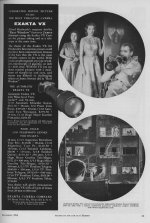
It's an Exakta VX. The lens could be a 400mm Astro Berlin. I've read that the lens used in the movie differs from the lens used in the ad.

Here's a full page advertisement from the November 1954 issue of Modern Photography. Rear Window was released in 1954.
 

Attachments

  • exaktavxad.jpg
    exaktavxad.jpg
    484.9 KB · Views: 0
doubs43 said:
There is a group of Exakta enthusiasts who are every bit as dedicated to their "now obsolete" SLR's as any of us are to our rangefinders. The quality of the Exaktas up to - and including - the VX-IIa is to the highest standards. I rebuilt my VX-IIa myself and it's as smooth in operation as any of my Leicas and that's saying something.

Of course the first Exaktas didn't have a pentaprism or instant-return mirror. Neither did the first Nikon-F have a TTL meter prism finder. The first rangefinders by Leica, and later Nikon, also weren't nearly as refinded as their later models. Exakta did, however, equip their SLR with a pentaprism by 1950...... and it was interchangeable! The instant-return mirror came with the VX-1000 model of the mid-1960's.

The first Nikon SLR - the F - was designed with the benefit of the innovations developed by others over many years. That's not a criticism but an observation. What would the SLR have been if Nikon had invented it in 1959? Exakta didn't have the advantage of hindsight in 1936 but their first SLR was little short of brilliant. The Kine-Exakta I laid the foundation for the later cameras by other makers.

It's easy to regard the early Exaktas as "obsolete" but so also are our beloved rangefinders "obsolete". One not familiar with the Exakta can be forgiven if they look down their noses at it. It's appearance is odd, the controls are opposite of almost all other cameras and it's idiosyncrosies are many. But make no mistake: it's a picture-taking machine of the first order, capable of top-quality work if the user is up to the task.

I believe it's obvious that I like the Exakta but I take no offense that others think it "obsolete". Many think film cameras - rangefinders in particular - are obsolete. That's OK too. That means I can now buy cameras I couldn't previously afford at rock-bottom prices and smile the whole while.

I own a lot of "obsolete" SLR's; Exakta, Pentax, Praktica, Ricoh, Yashica and more. They are all capable of first-rate work. Who can ask for more?

The two images below were taken some 35 years ago with Exaktas. If I'd said they were taken with a Leica or Nikon, would anyone think I was not telling the truth based on the images?

Walker

Great looking photos, Walker! Were you able to find an Exakta service manual?

Walker
 
RJBender said:
Great looking photos, Walker! Were you able to find an Exakta service manual? Walker

RJ, I did. It was written by a gentleman named Miles Upton and it's as well done as any manual I've seen. Excellent illustrations and directions. Is it perfect? No..... but it's still a wonderful repair manual and easily worth the cost which is now lower than when I bought mine because Miles has found a cheaper and faster way to reproduce it. I believe I paid $65 plus shipping and it's now $50 plus $6 shipping. A link to Miles' web site is: http://www.exaktaphile.com/

Once there, click on "Menu" in the lower left corner and then "Repair Book".

BTW, I replaced the shutter curtains in mine when I overhauled it. The manual makes it about as easy as it could possibly be done.

Walker
 
Walker, I owned an Exakta once. I was 18 in first year at university and sent to Olden Cameras in NYC for a new one for $40. It had no pentaprism (I was on a student budget), just a waist-level finder that was tricky to use for verticals 😀

I traded it in the following year on a Minolta HiMatic 7. Kinda wish I'd kept both of them!

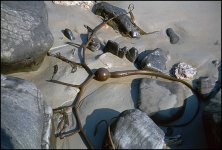
Here's a Kodachrome I shot of bullwhip seaweed at Laguna Beach, CA with the Exakta (1963)

Gene
 

Attachments

  • 19631200-cs1-18--bullwhip-seaweed-laguna-beach-ca.jpg
    19631200-cs1-18--bullwhip-seaweed-laguna-beach-ca.jpg
    104.8 KB · Views: 0
Last edited:
GeneW said:
Walker, I owned an Exakta once. I was 18 in first year at university and sent to Olden Cameras in NYC for a new one for $40. It had no pentaprism (I was on a student budget), just a waist-level finder that was tricky to use for verticals 😀

I traded it in the following year on a Minolta HiMatic 7. Kinda wish I'd kept both of them!

Here's a Kodachrome I shot of bullwhip seaweed at Laguna Beach, CA with the Exakta (1963) Gene

Gene, that shot is as sharp as a tack and the colors are excellent. I like it. Do you recall which lens was on your Exakta and the model of the body?

I bought my VX-IIa in 1968 or early 1969. I think it came from Wall Street Camera but possibly 47th Street Photo or another of the NYC shops. The lens was a manual 50mm f/2.8 Tessar. I later added 35mm, 135mm & 200mm Vivitar lenses. All were pre-set models. I still have them but I've added auto lenses to my collection. I've always preferred the plain ground glass focusing screen but I do have split-image and other finder screens.

Exakta models V, VX, VX-IIa, VX-IIb and VX-1000 aren't expensive to buy but most will require a CLA. I don't care for the VX-IIb as the finder doesn't lock into place.

Walker
 
doubs43 said:
Gene, that shot is as sharp as a tack and the colors are excellent. I like it. Do you recall which lens was on your Exakta and the model of the body?
Unfortunately I don't remember the model or the lens name, except for remembering it was either 58mm or 60mm, which seemed to me, even then, to be an odd size for a standard lens.

Gene
 
GeneW said:
Unfortunately I don't remember the model or the lens name, except for remembering it was either 58mm or 60mm, which seemed to me, even then, to be an odd size for a standard lens. Gene

Gene, it may well have been the CZ 58mm f/2 Biotar which, I believe, is a semi-auto lens. You set the aperture and then "cock" the blades. When you push the button, it "fires" the aperture blades, closing down to the set value and as you press the button further, the shutter trips. The Biotar is an excellent lens as your picture indicates.

Walker
 
doubs43 said:
Gene, it may well have been the CZ 58mm f/2 Biotar which, I believe, is a semi-auto lens. You set the aperture and then "cock" the blades. When you push the button, it "fires" the aperture blades, closing down to the set value and as you press the button further, the shutter trips. The Biotar is an excellent lens as your picture indicates.

Walker
Yes, that's how it worked! I'd almost forgotten. And Biotar rings a bell too. I think that was it. It served me well.

Gene
 
doubs43 said:
RJ, I did. It was written by a gentleman named Miles Upton and it's as well done as any manual I've seen. Excellent illustrations and directions. Is it perfect? No..... but it's still a wonderful repair manual and easily worth the cost which is now lower than when I bought mine because Miles has found a cheaper and faster way to reproduce it. I believe I paid $65 plus shipping and it's now $50 plus $6 shipping. A link to Miles' web site is: http://www.exaktaphile.com/

Once there, click on "Menu" in the lower left corner and then "Repair Book".

BTW, I replaced the shutter curtains in mine when I overhauled it. The manual makes it about as easy as it could possibly be done.

Walker

Thanks, Walker!
Here's the link: http://www.exaktaphile.com/vx2ar/bookbuy.html

R.J.
 
Back
Top Bottom