rangefinders take pictures; SLRs make pictures. Agree?

I think many of us already use our RF & SLR's that way. If you can get up close and personal, go RF. If you cannot, and need to be able to work from a distance, then go SLR. I often have both with me.

 
JeremyR said:
I'll finally add that there's a certain but intangible something about shooting with a rangefinder that has started to lure me away from the SLR in the first place. I don't think the RF has caused me to necessarily think differently when composing a photo (or waiting for the right moment), but I do somehow feel more "connected" (to what I'm not sure) when using the rangefinder.


Jeremy
What I think may be going on between these two kinds of viewing systems is the number of dimensions and what we consider reality. When we look out of a window at the world, it seems to be the same world we live in. When we see a projection or one of our prints, the lack of the third dimension tells us that this isn't the same world we live in. I agree that the sensation of "connection" will have an impact on the choice of subject and how we relate to it and how we'll capture it in two dimensions. What may be clouding the difference is TV, where if we follow a program series, we'll begin to relate as though we were in that world. This new mental talent makes it easier to use an SLR and I suppose an EVF.
Bob
 
Bob Ross said:
What I think may be going on between these two kinds of viewing systems is the number of dimensions and what we consider reality. When we look out of a window at the world, it seems to be the same world we live in. When we see a projection or one of our prints, the lack of the third dimension tells us that this isn't the same world we live in.

I never thought of it in such a way, but I think there's some truth to that. An SLR viewfinder could be described as more "two-dimensional" than that of a rangefinder--and while I've never given it much thought, this could very well account for some of the difference in perception.

Others have mentioned the use of primes versus zooms. For what it's worth, while I have a zoom or two in my SLR kit, I usually shoot with primes--so at least for me, the RF "connection" goes beyond the use of a single focal length. Maybe next time I'm out shooting I'll try to be a little more cognizant of my thought processes; it might prove interesting.

Cheers,
Jeremy
 
When Pierce said, "But none of the differences between these two cameras is as important as the difference in viewfinders. Guess what, the name of the game is seeing," this is certainly the essential difference between my usual RFs and SLRs, since I have nothing at all like the EOS he mentions. My SLRs can be exemplified by the simple and compact Pentax LX, with no motors or zooms or exposure programs or auto-focus. So that's only ONE of the major differences, as the rest of what he described can be considered "user interface." And he seems to think (and I'd agree) that these conveniences also strongly affect what one does with the gear.
 
My DSLR (Nikon D70) has taught me a lot through instant feedback and experimentation - certainly more in the last year or so than the previous 4 years with my F80. However, I find it makes me a lazy photographer, particularly coupled with a wide-range zoom. Also, the lack of manual control (I'm an analogue dials sort of person) I find disassociates me with the act of taking the picture. I'm having enough issues dealing with the move to digital let alone being further divorced from the process by automatic metering, no aperture ring and the ability to stand in one place and just zoom.

I guess I think too much but there's something soulless and unsatisfying about the whole process.

Contrast that with occasional film shooting with my Dad's old Ambi Silette:

It slows me down, makes me think, makes me consider whether I need to press the shutter. If I was more proficient at using a totally manual camera and had the time/space to scan/store sheaves of positives I'd use it a hell of a lot more. With my SLR I find I am overloaded with information and as a glasses wearer I just end up getting eye strain staring at it in the v/f.

My SLR also makes me feel self-conscious, its far too easy to get spotted out and about with one and I actually find I use my phone cam more these days!


I've been seriously considering an Epson RD1 as a result. I'd probably have to sell my SLR kit to justify the expenditure so it has been interesting reading this thread. More food for thought...
 
For me there is no difference in making and taking a photo. It's just the terminology used for the capture of an image.

There is however a clear difference in the way the image is viewed and captired.

The RF user sees the whole scene 'in focus' and by either using hyperfocal settings or other can see the whole area of view in focus. The SLR user by contrast in todays world will only see the view of the used lens at full aperture with a narrow DOF for a bright VF image. This for me anyway is the fundamental difference between the 'use' of an SLR and an RF.

So I guess I cannot vote on this.
 
Terao said:
My DSLR (Nikon D70) has taught me a lot through instant feedback and experimentation - certainly more in the last year or so than the previous 4 years with my F80. However, I find it makes me a lazy photographer, particularly coupled with a wide-range zoom. Also, the lack of manual control (I'm an analogue dials sort of person) I find disassociates me with the act of taking the picture. I'm having enough issues dealing with the move to digital let alone being further divorced from the process by automatic metering, no aperture ring and the ability to stand in one place and just zoom.

I guess I think too much but there's something soulless and unsatisfying about the whole process.

Contrast that with occasional film shooting with my Dad's old Ambi Silette:

It slows me down, makes me think, makes me consider whether I need to press the shutter. If I was more proficient at using a totally manual camera and had the time/space to scan/store sheaves of positives I'd use it a hell of a lot more. With my SLR I find I am overloaded with information and as a glasses wearer I just end up getting eye strain staring at it in the v/f.

My SLR also makes me feel self-conscious, its far too easy to get spotted out and about with one and I actually find I use my phone cam more these days!


I've been seriously considering an Epson RD1 as a result. I'd probably have to sell my SLR kit to justify the expenditure so it has been interesting reading this thread. More food for thought...
My first DSLR was a D70. Like you I find it a little too automated. I also had issues with the viewfinder (just a bit too dim and small for my eyes) and a few quality issues that made me distrust it. My next DSLR was a D100. I quickly fell in love with it. I found it alot more "film like" at higher ISO's and a much more reliable body. Keep in mind I have two now. One with close to 50k exposures. Still works like new. Another at a little over 140k. The mode dial is a little loose and won't always easily find the mode I want but other than that it works perfect. Still not exactly what I wanted but pretty close. Then I bought a D200. A much improved viewfinder (finally) and metering with the old AIS lenses. Set it too manual focus and set the apeture control for the apeture ring only and it's much more of a joy too use. The focus indicator isn't as good as the one on my F100 (with actual arrows showing which way you are out) but still pretty good. Keep in mind that the D200 will meter with whatever you can put on it. Building your own lenses for fun is alot less work with it.

I'm not saying that a RF isn't a better way for you to go. Just throwing that out as another option you might not have considered. I mainly use RF's for fun and the D200 now as a tool. It's a pretty good tool though. It has withstood alot of abuse and is literally put away wet quite often.
 
When using the same focal length lens, I do not see any real difference between rangefinder and SLR photography.
 
raid amin said:
When using the same focal length lens, I do not see any real difference between rangefinder and SLR photography.
I quess when you get right down to it, it all depends on each person's perceptions of things. My favorite focal length for my SLR's or DSLR's is 45mm. Because of that I really wanted 45mm specifically (35, 40, and 50 are all close but never seem just right for me personally like 45). Luckily their are alot of old affordable fixed lens rangefinders that fit the bill. For me the big difference is I can see out of the frame with a RF while with my SLR's it's what you see is what you get.
 
I think the DSLRs deserve a bit of justice. Simply because a bunch of ill qualified photographers use them doesn't mean that the DSLR is not a good camera.

Zoom and autofocus are quite essential in many situations and we RF-ers just invent ways of doing without zoom and autofocus.
 
I don't think we are cutting down either way of taking photographs. Cameras are just tools.

Remember, the discussion is centred around an article by Bill Pierce. I felt he was defending a plot of creative territory for rangefinders in an SLR dominated industry. Yes, they both take picures when you come down to it but how do the tools effect the result? How does a photographer with a Leica work a room compared to one with an SLR? Do they work differently and think differently about an event? The article had some thoughtful ideas.

I like the handcraft quality of my rangefinder. It's a pleasurable and satisefying way to make pictures. My DSLR is more a power tool (literally and figuratively) and that can be a lot of fun sometimes too!
 
wyk_penguin said:
I think the DSLRs deserve a bit of justice. Simply because a bunch of ill qualified photographers use them doesn't mean that the DSLR is not a good camera.

Zoom and autofocus are quite essential in many situations and we RF-ers just invent ways of doing without zoom and autofocus.
No offense but I'm sure you can find alot of ill qualified photographers using just about any type of camera (I'm proof in point of an ill qualified photog with a RF). I don't think the point is saying one is necessarily better than the other but more about how the experience with one vs. the other may be different for some folks. Honestly for most of what I like to do I think my DSLR's are better tools for the sole purpose of creating an image. My purpose is more often than not to simply relax and have fun. For that I prefer an old Yashica RF. Even more so than a more modern RF even.
 
Well, as usual, a lot of good points made by many here.

Most of my years of shooting has been with SLRs, starting with a Canon F-1 in 1975 and ending with a pair of Minolta Maxxum 9xi's, which I used for the better part of ten years(!), ending in early 2002. The Canon was fully manual (if you left off the huge Motor Drive MF and shutter-priority option Servo EE Finder...yes, I had both), the Minoltas, IMO, the epitome of the all-singing, all-dancing, auto-everything pro film SLR. Took a lot of pictures with all these cameras, many of them decent, to me anyway. It was the purchase of a Konica Hexar autofocus that got me to questioning the whole SLR way of seeing things photographically. At base, you can take a picture with any camera, but it's silly to think the hardware doesn't make any difference in terms of how you interact with it. And that interaction, for better or worse, will have some influence on the final image. It's not a matter of "use this camera, son, and you'll be a better photographer!". It depends on intent – what do you want to do, and why? – and then choose the appropriate tool for the work. Sometimes as in my case), it means choosing one type of camera. For someone else, one type of camera just won't do it for them: they need several formats, several film types, or perhaps no film at all (and I don't just mean digital). One of the beautiful things about photography, at least for the moment, is that there's no ONE "way" to go about things. Cameras, formats, processes, the field is so rich, and there really are people out there using them, making stuff that gets my attention, and sometimes startling me.

For the last four years, the 35mm rangefinder has been the tool of choice for me, the thing that aligns with my vision and creative nervous system best. Doesn't mean it's the best there is, let alone the best for everyone.


- Barrett
 

Attachments

  • B032804-2:05a.jpg
    B032804-2:05a.jpg
    107.9 KB · Views: 0
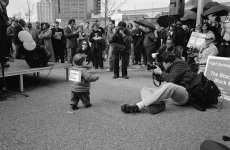
Ha! that's a great picture! The child looks like a little robot. Thanks for your comments too. I appreciate the many perspectives that have come out on this topic.
 
shoe boxes with pin holes take/make pictures. SLR's and DSLR's are for serious work and people who havn't learnt about rangefinders, rangefinders are all about LOVE.
 
Mary Ellen Mark has used both 35mm SLRs and rangefinders. I can not tell which picture was taken by which type of camera. The same can be said of Salgado.

I think Bill likes to romance about gear. He does not seem to have any facts to back up his position. He also is picking his facts without finding out if it is actually true - zone focusing can be done with any type of camera with DOF scales. The same can be said about using or not using the finder when shooting.
 
It is interesting to note that many of the SLRs discussed here are of the automatic variety... I like my manual focus, and my hyperfocal distancing... Sometimes limitations can provide interesting work. I went out this weekend with two cameras: A Zorki RF with a 35mm and a Pentax K1000 with a 80-200 zoom. By avoiding the "Normal" I did force myself to find new perspectives of the different scenes I encountered.

As far as the "mirror blackout".... well, I do believe I really appreciated RFs when I had an assignment; take a long exposure to show movement. I chose a nighttime street corner, and using a slow speed I could tell where the car would be at the beginning and end of the frame.

I think that a good photographer is what makes and takes the images, no matter what the gear (within reason, of course). After all, we can't program a DSLR to do composition!
 
James Brannan said:
My first DSLR was a D70. Like you I find it a little too automated. I also had issues with the viewfinder (just a bit too dim and small for my eyes) and a few quality issues that made me distrust it. My next DSLR was a D100. I quickly fell in love with it. I found it alot more "film like" at higher ISO's and a much more reliable body. Keep in mind I have two now. One with close to 50k exposures. Still works like new. Another at a little over 140k. The mode dial is a little loose and won't always easily find the mode I want but other than that it works perfect. Still not exactly what I wanted but pretty close. Then I bought a D200. A much improved viewfinder (finally) and metering with the old AIS lenses. Set it too manual focus and set the apeture control for the apeture ring only and it's much more of a joy too use. The focus indicator isn't as good as the one on my F100 (with actual arrows showing which way you are out) but still pretty good. Keep in mind that the D200 will meter with whatever you can put on it. Building your own lenses for fun is alot less work with it.

I'm not saying that a RF isn't a better way for you to go. Just throwing that out as another option you might not have considered. I mainly use RF's for fun and the D200 now as a tool. It's a pretty good tool though. It has withstood alot of abuse and is literally put away wet quite often.

Well, we sound similar. I hate the viewfinder with a passion on the D70. The auto nature of the beast means you feel obliged to keep your eye welded to it and if you can't see the shot how can you take it?

Have used D100s and D200s and they are an improvement (the D100 is very filmic as you say, something intangibly good about the images it produces). Getting off topic now but my other reason for considering a rangefinder is that with all these (now permanent) carryon restrictions I need to rationalise my gear. If I can't carry a 70-200mm VR in hand luggage than I'd rather do without, and suddenly a prime-equipped rangefinder makes sense. I rarely use a big zoom (would only miss it for motorsport photography) and really miss my wideangle landscape photography on a cropped sensor. The Voigtlander 12 is a better lens than the Nikon 12-24mm zoom and a damn sight lighter...
 
Back
Top Bottom