Running out of light... full frame?

eric4

Established
Local time
10:19 PM
Joined
May 13, 2013
Messages
54
Howdy y'all
I'm starting to shoot more events these days and enjoying getting better at them as well.

Shot a wine auction dinner the other night with my K-3 and Ricoh GR, but had to start cranking the cameras up to 6400 ISO just to get an exposure.

I mostly had the DA 55 1.4 on my k-3, as my other two lenses were the 100 2.8 macro (noisy) and the sigma 17-70 2.8-4 (slow)

Going through the photos, I'm slightly disappointed by the amount of noise I'm getting on the APS-C sensor. And one thing Pentax seems to be lacking are fast, wider primes.

This client didn't have any issues with the noise/quality, but I don't feel comfortable delivering this type of work to future clients.

I really like my Pentax K-3, it's great in the studio (my primary work) and I like the controls and build etc. I don't think I want to jump into a new full frame DSLR system due to the high cost and I already don't like pointing a big camera at people in intimate situations.

So that leaves the m240 or sony a7ii/s. I love shooting with rangefinders and already have the VM Nokton 50mm 1.5 M-mount which is sharp wide open.
Does anyone have experience shooting these three cameras past 6400 with clean results? If so, what would you recommend?

0x8Pg5m.jpg
 
I've shot a lot of dark events, and the one thing I would say is you're aiming for far too light an image, the above photo is not a realistic portrayal of the scene as it would have looked to your eye on the night, so why not let it be as was, fairly dark and much moodier. I generally shoot with Canon 5d iii and fuji Xpro, but I rarely set either higher than 2500iso.
 
Frankly, I don't see as much noise or artifacts or anything in there. It's a nice image, and while there may be some things in the man's face (along his jaw), it's still a very good shot. I'd be proud of it.
 
There's an obvious abundance of grain - looks like 400 speed film. Are we looking at the same image?

Any modern FF sensor will give you excellent noise performance even @6400.
 
Sony have very good deal for now:

http://store.sony.com/a7-full-frame...0B1Q_f_PuAzNCbLVyOkeJ0UmM5NCU?_t=pfm=category

It is fine if you are going to use existing RF lens, but I recommend to check available glass for this camera. This is what turns me off every time I'm ready to jump on it.
Nothing to compare with my Canon L glass and used 5DMKII is cheap or even new 6D, which is really good at high ISO in color.

For now I'm OK with old Canon 500D cropper. New camera like this costs something like $500.

ISO6400:

IMG_9918.JPG
 
Frankly, I don't see as much noise or artifacts or anything in there. It's a nice image, and while there may be some things in the man's face (along his jaw), it's still a very good shot. I'd be proud of it.

Thank you.

I'm not trying to say that I would be getting better photographs with a full frame sensor necessarily. It would just make me feel more comfortable having a more robust file and not have to shoot wide open f1.4 and not be concerned with too slow of a shutter speed.

Maybe I should just rent a Sony and try it out. Would you guys recommend the a7ii for it's image stabilization? Or the a7s for the high ISO capabilities?

qbhEAqY.jpg
 
Just a thought to help.

I'm guessing JPEG (JPG) file?

If it is then:

In Photoshop (Oldie moldie me I still use CS4) go to:
Image,
Then click on levels.
Click on the blue channel.
Set at anywhere from 87 to 90.
Then go to by clicking on image:
Hue/Saturation.
Click on the red channel.
Set to around -7
Does this help?

I don't use this method anymore as I capture using RAW format.
 
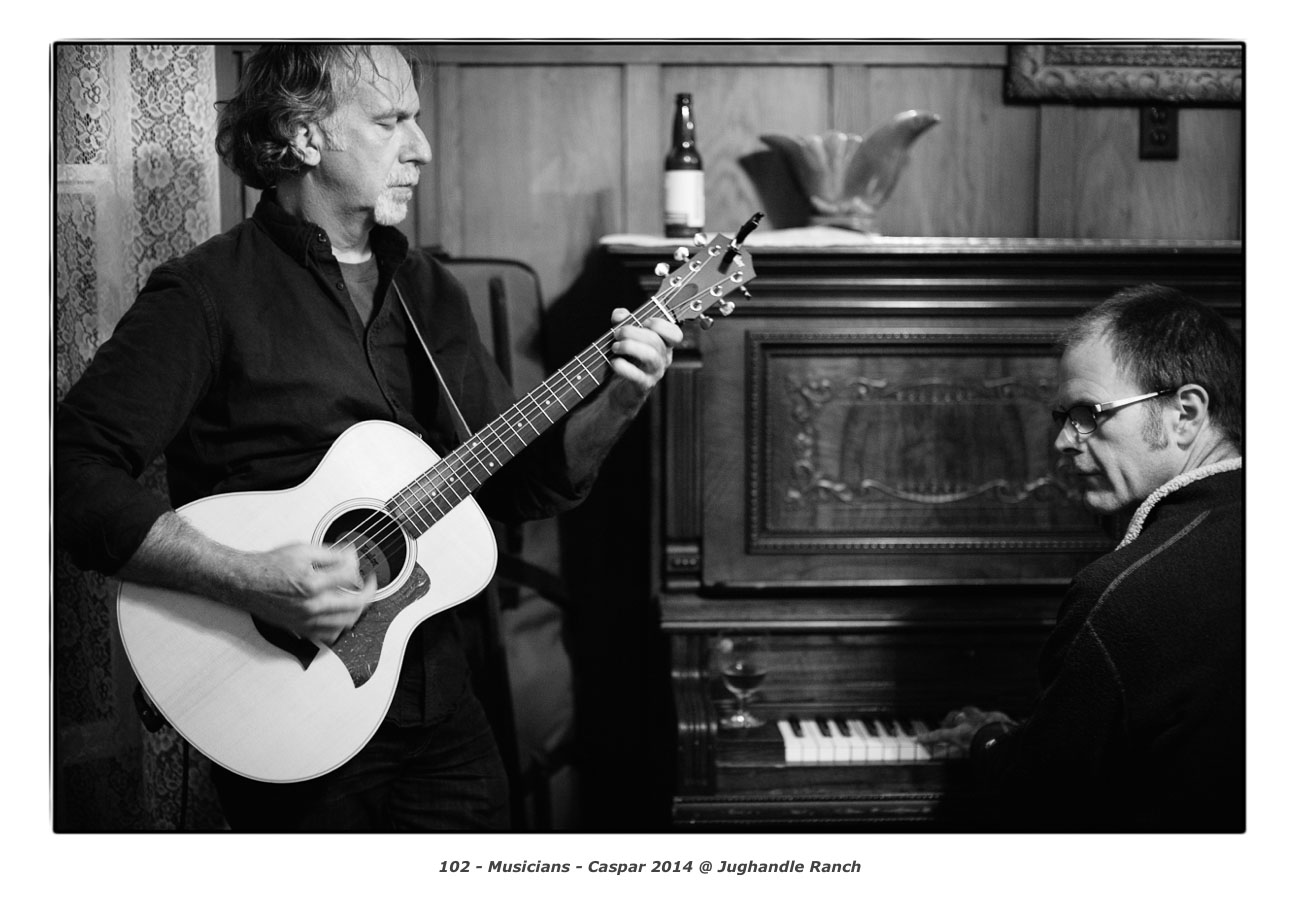
Well, this B&W is an out-of-camera JPEG with the M-P typ 240 using the Nokton 50/1.5 ASPH (LTM) lens.


Leica M-P + Nokton 50mm f/1.5 ASPH (LTM)
ISO 3200 @ f/1.5 @ 1/25
OOC JPEG

It stands up to printing at 11x17 inch very nicely: tight, small grain pattern which aids a perception of sharpness rather than noise.

I haven't pulled it from raw into a color rendering yet.

BTW: The Olympus E-M1 with equivalent focal length fast lens (Summilux-DG 25mm f/1.4 ASPH) nets similar quality at ISO 6400 and I can go a stop longer on the exposure (1/15 sec) due to the image stabilization. Can't go any longer on exposure than that due to subject motion. You get more DoF due to the smaller format/shorter lens, etc, at the same light gathering power. So I'd say that FF isn't absolutely necessary.

G
 
Just a thought to help.

I'm guessing JPEG (JPG) file?

If it is then:

In Photoshop (Oldie moldie me I still use CS4) go to:
Image,
Then click on levels.
Click on the blue channel.
Set at anywhere from 87 to 90.
Then go to by clicking on image:
Hue/Saturation.
Click on the red channel.
Set to around -7
Does this help?


Yes, it definitely hides some of the artifacts and restores more natural tones in the skin. Thanks for the tip!

Is there noise reduction software that does a better job than Lightroom's settings?
 
The noise reduction stuff I have examined all make the image a little too soft for my tastes.

If you convert to a B & W it tends to show less noise.

The light on the lady with the hat looks good.

Sorry I don't use Lightroom.
 
Well, this B&W is an out-of-camera JPEG with the M-P typ 240 using the Nokton 50/1.5 ASPH (LTM) lens.

It stands up to printing at 11x17 inch very nicely: tight, small grain pattern which aids a perception of sharpness rather than noise.

I haven't pulled it from raw into a color rendering yet.

BTW: The Olympus E-M1 with equivalent focal length fast lens (Summilux-DG 25mm f/1.4 ASPH) nets similar quality at ISO 6400 and I can go a stop longer on the exposure (1/15 sec) due to the image stabilization. Can't go any longer on exposure than that due to subject motion. You get more DoF due to the smaller format/shorter lens, etc, at the same light gathering power. So I'd say that FF isn't absolutely necessary.

G

Great shot! And a very clean result at 3200, glad to see the Nokton working so well on a digital sensor.

I should maybe reconsider Olympus, I used to have an E-M5, but it was too lethargic and I didn't like the viewfinder quality. Sounds like the E-M1 is a nice improvement.
 
There is the FA Series with the 31/1.8, 43/1.9, and 77/1.8. I have used the 31/1.8 and the 77/1.8 with my K52s and enjoy the results. I believe the 31.8 is equivalent to a 47mm and the 77/1.8 is equivalent to a 115mm on a APS-C sensor.
 
There is the FA Series with the 31/1.8, 43/1.9, and 77/1.8. I have used the 31/1.8 and the 77/1.8 with my K52s and enjoy the results. I believe the 31.8 is equivalent to a 47mm and the 77/1.8 is equivalent to a 115mm on a APS-C sensor.

I've considered some of the FA limiteds, as pentax doesn't have too many fast lenses. I would love that 31mm on a full frame Pentax

My only concern is the noisy screw drive motor for events. Although on a wider lens like the 31, the focus throw isn't as long as my 100mm macro, so it's an abbreviated whirl.
 
A key mistake people often make is assuming they have to expose interior/dark scenes the exact same way they would shoot in bright daylight. However, our eyes/brains are used to dark scenes looking a bit dimmer. Including bright point sources in the frame, such as lights or candles, gives us a relative reference point for lighting.

What I'm seeing in these pictures is that you could actually afford to underexpose a bit more, to help convey the intimate evening mood. As for noise, I would crush the black levels down - the most noise appears in the darkest areas of the frame, and further darkening will help to hide it.

The gear you have is more than adequate for shooting these sorts of scenes. Just practice!
 
A few thoughts:

I worked for a time in prepress. A dark, moody image that looks good on a computer display, may not translate well to print. High quality printing on glossy stock may be OK, but cheaper quality magazine/newsprint can be problematic. It's one of the difficulties delivering images to clients if they don't know or can't tell you specific end uses. In any case, nowadays with most things being displayed on an electronic device, you probably can get away with things on the dark side.

Regarding the cameras you asked about: I only have extensive experience with the M240 and would say that while 6400 can be usable, I prefer to keep 3200 as the max, and if possible, 1600. At 3200, at least with my camera, banding starts to become evident and the files are not all that malleable in post. You need to be pretty spot on with your exposures. Also, if you're someone who likes to grab a couple quick shots to ensure you have one with everyone's eyes open, a good expression, no camera shake or subject motion (if at marginal shutter speeds), as soon as you set the M240's ISO above 1000, it goes from ~3fps to ~1fps. This really annoys me, but might not be a problem for anyone content with shooting in single shot mode.

Regarding the a7S vs. a7II: I shot a few weeks with the a7S. It's strength at high ISOs is good color quality, however, I wouldn't consider it to be all that much cleaner (also based on comparison with my 1DX files) for luminance noise. The primary reason I would get it over other a7 cameras is the fully electronic shutter, which is dead silent. However, if you're using native glass on it, you can hear the aperture stopping down (generally very minor and probably irrelevant in dark situations) and focus drive, particularly if adapting older screw-drive alpha lenses. With adapted fully manual glass, of course it's totally silent. The a7II gives you IBIS, which can be very useful at marginal shutter speeds with normal to short telephoto lenses in this kind of work. Usually people aren't moving around too much, so image stabilization will buy you some sharpness. Another consideration is the size of files you're delivering to your clients. Is 12MP enough? For event type work, I think it would be. In fact, past experience has been that the average non-techy person's computer system tends to bog down with huge files. You could very well downsample 24MP a7ii files to ~12MP and it will mask the noise difference between the two. Downsampling with a touch of sharpening will give you a sharper 12MP image from a higher resolution sensor than from a native 12MP sensor.

Something else to consider with really low light work is how well EVF based systems will or won't handle such conditions. Will the EVF become really laggy and grainy? Will AF hunt a lot more? A concern I would have is how unusable a camera might become if the AF system starts having problems focusing. You could completely miss moments waiting for something to lock on.

IMO, the fastest focusing system for really low light is often a rangefinder, followed by some of the higher end DSLRs with -2, -3EV AF systems.

Another M mount lens to keep in mind if you're considering the a7/a7S route is the 35/1.2 Nokton. It will give you the moderate wide you're maybe looking for, with better technical performance than the 35/1.4. It also is one of the few RF wides that works really well with unmodified a7 series bodies.
 
Just a bit of praise for that photo: I like the grain too. And it's a nice shot. I think it might look better in B&W and with the blacks deepened a little and the exposure backed off a bit.

Also: I loved the FA Limiteds when I had them. They're so great: their rendering of images of course but also their handling and appearance. The 31 in particular. I do hope the proposed Pentax FF camera actually comes to pass.
 
I have Topaz DeNoise and am constantly amazed at how well it will reduce or eliminate noise and yet retain detail. That and Topaz Detail are the two cornerstones of my lowlight pix. Free trials on any of the Topaz products at TopazLabs.com. And no, I don't work for them. In fact, I don't work.
 
Back
Top Bottom