Bill N
Member
What have you figured out over time? Or from reading?



DOF scales are an approximation. I always err on the side of caution and use the scale for the aperture that is one stop larger than the one in actual use. Also, DOF scales on many FSU lenses sometimes have no connection with reality when compared to the scales of comparable focal length lenses from Japanese or German manufacturers. When they differ, they are usually far too generous.
Many lenses with focus tabs position the "zero" point where the tab is facing straight down from the lens in a very useful zone, EG 2 meters. I believe that's where my Voigt 35/2.5 Skopar LTM focus stud ends up.
I zone focus a lot with film (which is my main "street" process, film cameras look more disarming) and find that the grain with B&W film processed with rodinal hides slight focus inconsistencies quite well. I haven't yet figured out how to make digital look so indifferent to the exact DoF "slice" but am still seeking it.

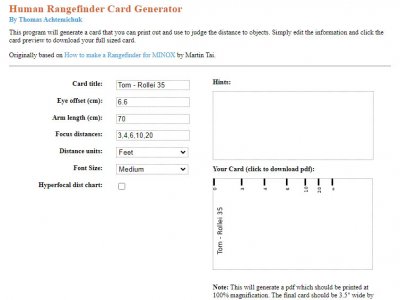
In his book on photography, Dick Boer gives two useful rules for focusing, which I have found invaluable when using a folder.
To get both the background and a near object sharp set the focusing to 30 feet (10m) and set the lens to f/8. You will get sharp focus from 18ft (6m) to infinity. This is effective for landscapes, street scenes and buildings.
For near subjects set the focusing to 12 ft (4m) and the aperture to f/8. You will get sharp focus from 9 ft (3m) to 20 ft. (7m). This is effective for groups and any close subject more than three paces away.
Boer continues: “Drill yourself thoroughly in these two rules. They will help you enormously. You will take a sharp picture while others are still fumbling with their focusing. Always use f/8.”

DOF scales are an approximation. I always err on the side of caution and use the scale for the aperture that is one stop larger than the one in actual use.
With 35mm lens you don't have to worry much on digital.
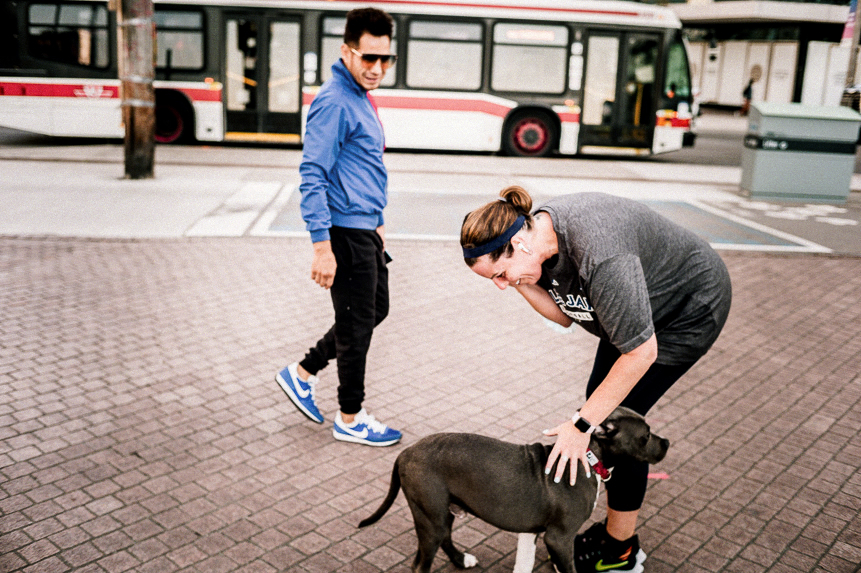
This one was with 35 around f2. I only had second or two, so I did quick glance at focus scale for estimated distance.
I want it to be on the DOG and hand and it is where with slight OOF 🙂
If it works for you, good. For me, the shallow DoF doesn't work at all in that photo, the man and woman are focal points along with the dog and the blur bothers me a lot. But that's just f2 as an aperture choice, not something that grain would have made look much different.

Doesn't work for you, sorry 🙂
I posted here absolutely not for an artist's evaluations. But as example of fast focusing without RF. Could we keep it this way here?


Took this in Seattle last month. I was walking opast the scene,went to one of the two pre-marked hyperfocal points on the lens (25' I believe), but realized I needed to open the aperture more because it was getting late and I was using ISO125 film, but I just pivoted and took the shot. It is borderline. I did not want to start fiddling, and ruin the scene. I could have used maybe 10-15 more feet on the focus (or 1-2 stops smaller), and motion blur might also involved (the lamp post looks acceptably sharp). I think I was at 1/60th shutter speed, f4 or f5.6. At f8, I would likely have been fine.
Kodak Retina IIIc; Rodenstock 50mm f2 Heligon; Ilford FP4+, Rodnal
Seattles Finest by Mark Wyatt, on Flickr