Short tele better for landscapes ?

Short tele better for landscapes ?

  • I shoot almost ALL landscapes with wides

    Votes: 23 14.6%
  • I Use short teles or "normals" VERY seldom for landscape

    Votes: 30 19.1%
  • I use short teles or "normals" as oft as wides for landscape

    Votes: 85 54.1%
  • I shoot almost ALL landscapes with short tele

    Votes: 19 12.1%

  • Total voters
    157

Bertram2

Gone elsewhere
Local time
11:27 AM
Joined
Jan 18, 2005
Messages
1,416
Hi to all,
I just would like to collect some personal experience from those members who shoot landscape with RF and SLR:

Especially the RF community is tending towards the wider lenses, and as the very most of them I also used wides for landscapes mostly.
I did not even think about a longer lenses (50 to 90) like a reflex the decision was for wide, as if this would be the only way to do it. Maybe also a bit because I remembered my former SLR landscapes with long teles from 105 on,which mostly showed a quite exaggerated (compressioned) perspective.

Since a while I learn that a 50 often makes the better landscape and sometimes a 75 is still better than the 50, more and clearer details, stronger concentrated on the essential impression of the environment.

It just takes more time to din the crop which "shows les and says more" if you know what I mean. And I am beginning to practise it , let's see if I can get used to.

Wides i use only for places without enuff room to move backwards, so to say. Cityscapes, street, indoor.

Opinions and experiences ?

Thanks !
Bertram
 
Hi Bertram,

I don't think that there's any way anyone can help you with this question. What focal length lens to use depends soley on the physical circumstances of each particular picture-taking situation and the effect that you want to acheive.

Hopefully others can be more helpful than this!
 
I like the normal lens myself. I've used wider and longer lenses but I just don't feel like I have the same control or vision as I do with the normal lens (be it in 35mm or medium format).
 
FrankS said:
Hi Bertram,

I don't think that there's any way anyone can help you with this question. What focal length lens to use depends soley on the physical circumstances of each particular picture-taking situation and the effect that you want to acheive.

Hopefully others can be more helpful than this!

Frank,

actually I don't need any help here, I am just interested in learnin' if others are going the same way as I go at the time. It's only about opinions and experiences of other members. I am anyway (unfortunately) one of those who don't believe anything if it is not the result of their own experience ! 🙂
Best,
Bertram
 
i don't really do landscape stuff anymore but when i did i quickly discovered, for me, that a longer lens actually gave mw more of what i was looking at when i was looking at the landscape.

it helps to isolate. a wide lens includes to much as often you can't get in close enough for a landscape pic.
a wide view dilutes the majesty of a grand scene into tiny details on the film and subsequent print.

go a little longer...

joe
 
i don't really do landscapes, but sam abell uses a 28/90 kit for all his work, and he takes great landscapes.
 
I think it all boils down to where you take your pictures. If like me, you're living in a densely populated country (Netherlands), where there's always a high-rise building or a power cable on the skyline, then you'll learn to appreciate the isolating value of a short tele. Another problem is that most of my country is flatter than a pancake, so it's really difficult to do the near/far kind of pictures that benefit from a wide-angle. End result: it's 50/50 between the 25mm wide and a 50mm normal.
 
I seem to have the rather predictable habit of trying to get something in the foreground of my landscapes; it can he harder with a longer lens keeping everything in focus so I'll typically use one when my foreground object is large enough!

This is with a Jupiter-9 85mm lens;
 
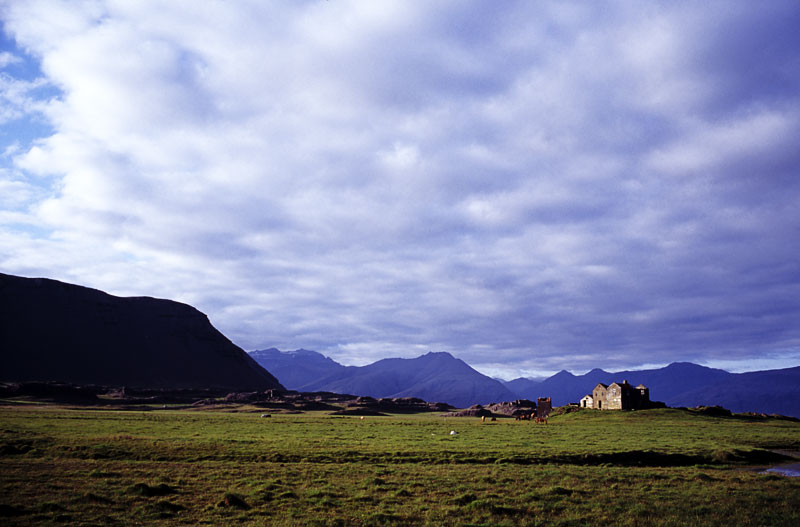
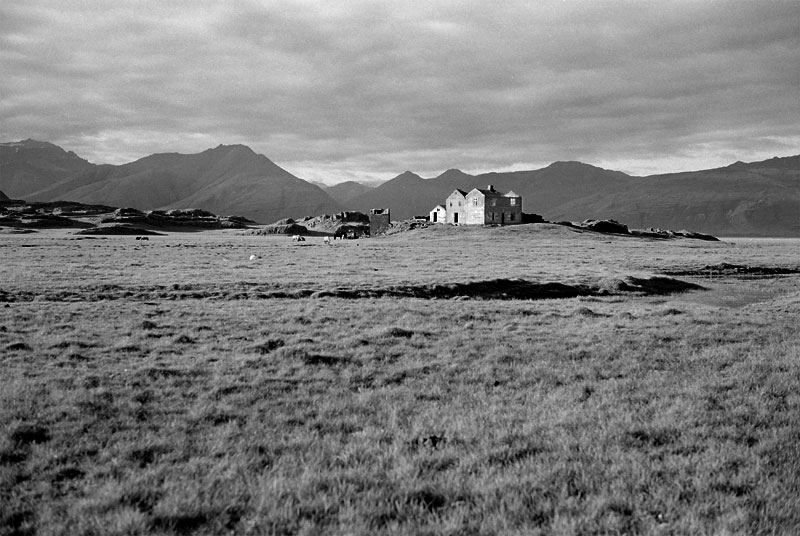
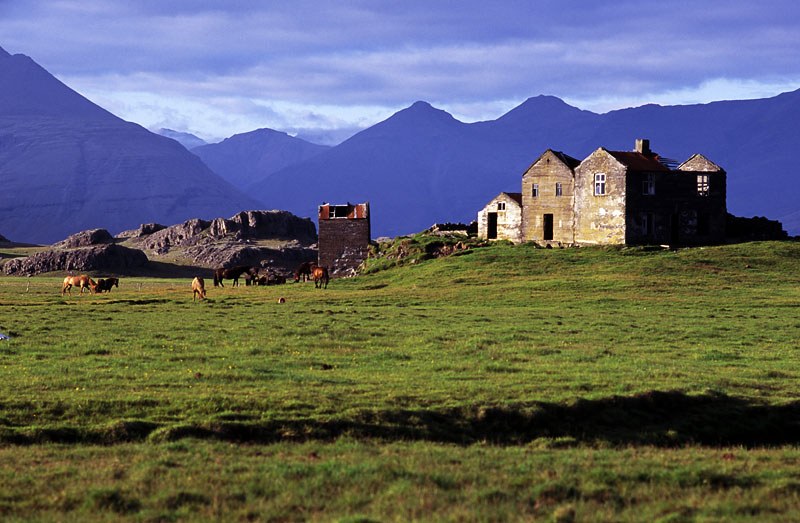
I think the same scene can often be successfully photographed with all different focal length lenses (of course, not all scenes), but it is really what you want to stress. If you are not sure, why not try them all? Here is my interpretation of a farmhouse on the horizon that I saw in Iceland:

21mm
horsefarm-ruins3.jpg


35mm
horsefarm-ruins4.jpg


135mm
horsefarm-ruins1.jpg
 
But I would add that I think short teles can be very good for landscapes. They compress depth a bit, and they are usually very well corrected and give a less distorted image than superwides. As was mentioned earlier, they also can help you isolate areas of a scene if there are distracting elements around (though this was rarely a problem in Iceland...)

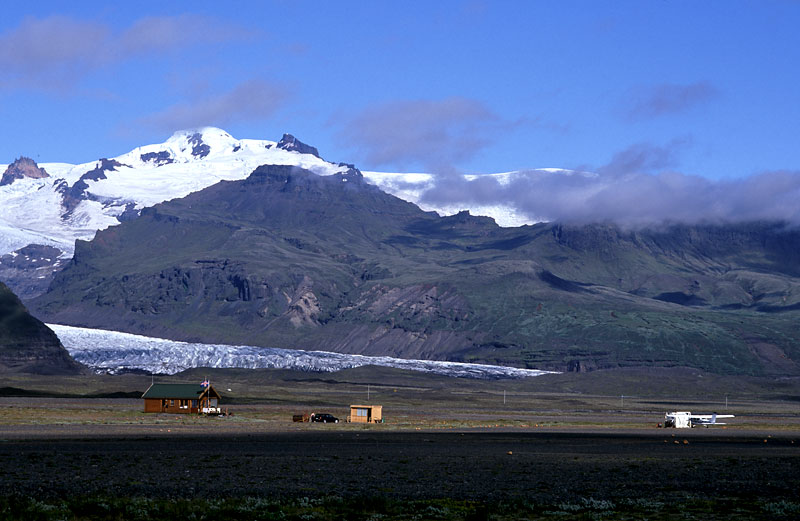
Here's one taken with the 75mm summilux

skaftafell-airport.jpg


The 100mm apo macro in the R system also does an excellent job for its incredible sharpness and color accuracy.

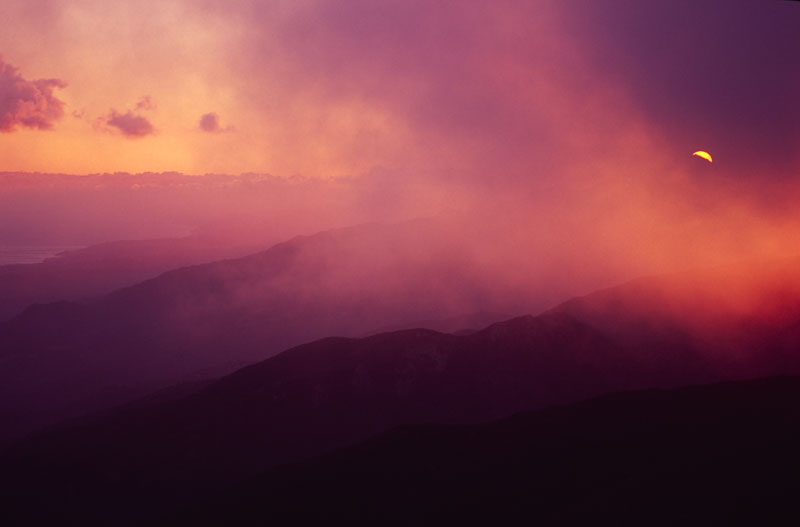
foggy-sun.jpg
 
Last edited by a moderator:
StuartR said:
I think the same scene can often be successfully photographed with all different focal length lenses (of course, not all scenes), but it is really what you want to stress.
21mm
horsefarm-ruins3.jpg


35mm
horsefarm-ruins4.jpg


135mm
horsefarm-ruins1.jpg


Stuart,

thanks for these examples ! They are visualizing perfectly my thoughts. In this case the short lens did the best job ind showing less but saying more, IMO at least.

Nonetheless wides can be the better choice for landscapes, i find them useful at the seaside when you got high skies with big 3d clouds in the 2 upper thirds of the pic to demonstrate the spacious environment. And of course there are photogs using wides exclusively but also perfectly controlled for landscapes, a matter of style.


As far as I am concerned I simply detected that I often took a wide for landscape without thinking, just as if landscapes are the natural environment for wides. And I observed that many other do so, and they all have the same probs, they don't get the foreground under control and the miniaturization of details let's the pic get meaningless..

Maybe that's all mostly a simple beginner's mis-take, but I think it is also the attempt to follow the "modern" wide style of report photos we all see daily in magazines and even in TV nowadays.

In general each focal length different from 50 must be well understood before one can use it perfectly for what it is good for, the often seen thoughtless abuse of wides proves it. The results lok por but not modern 🙁

Regards
Bertram
 
I like all three shots, especially the last. Almost like a portrait of the house against a backdrop. When going to Skyline Drive in Virginia to catch Fall colors, I used to carry a range of lenses for the F2, 24, 43~86, and 200.
 
I agree, the third is definitely the nicest to me. But di you shoot it with the building on the first third up too ? 'cos the sky looks great 🙂
 
Wide angles are often synonymous with landscape photography.
There can be said a lot about using other lenses however too.
In the examples above there is already stated that "what you want to emphasize" should determine the use of lens.

I would like to add a few

First of all you get different type of pictures:
Long lenses: you get more graphical type of landscape pictures ... more 2D
Wide angles: more depth ... 3D


But wide angle landscape pictures tend to fail miserably if you are unable to get a composition with a lot of foregroundinterest. And his depends a lot on the scenery you are shooting.

Are you able to walk into the scenes?? Or are you shooting from the roadside .. encountaring a lot of fences and other obstacles a lot of the time?
If the latter is the case ... i would recommend a longer lens.

I live in a European (low!!) hillside environment .. a lot of farmland with fences and roads. You simply can not walk where you would like too. There also is not a lot to put in the foreground except grass ....... in that type of environment i tend to use a 70-200 zoomlens on a DSLR 80% of the times.
If i take a fixed focal length lens i take a 85mm (or a 75mm on rangefinder) ...

In general i think unless you shoot: in the high mountains, coastal areas or inside forrests .... a longer lens is often a better choice.


My favourite landscape photographer is Charlie Waite .... www.charliewaite.com

I studied his work carefully in the past... at least 40% of his work is with a short-medium telelens.

The wide angle fixation comes largely from shooting American National Parks with Large Format cameras. It is a certain school of landscape photography ..... but the field is broader!!


You might also check 2 of my galleries with landscape pictures to get an idea.... most of them are with longer lenses:


http://www.shutterfreaks.com/gallery/album48
http://www.shutterfreaks.com/gallery/album47

Kind regards

Han
 
Last edited:
When I used to shoot landscapes, I preferred the normal lens for whatever format I used. But in Korea, I loved the 18mm for letting me get shots of temples I might not have gotten otherwise as I couldn't back up without falling off a mountain, or because I wanted more of an interior. I seldom used tele's. I think that may have been more my style than anything else. From lusting for telephotos, to getting them along with wides, and seeing what I got in the viewfinder, I soon gravitated more to normals and wides.
 
I consider the 50, 85 and 135mm to be my "landscape" lenses -- I probably use the 135mm more than the other two because of its ability to isolate a slice of the scene.

I think of my wide angles -- 21, 28 and 35 -- as lenses that are more suited for interiors or confined spaces. Or for environmental portraits/still-lifes in which you show how the subject fits into the larger scene.
 
I liked StuartR's #3 as well.

Numerous comments have also been made in various books that a long tele allows you to get to where it's physically impossible to, just as an ultra wide allows you to get the whole shot in.
 
Actually, long lenses do not compress depth. Standing at the same spot and aiming the camera in the same direction, take a picture with a 135mm and a 35mm. If you crop the 35mm shot so that it has the same field of view as the 135mm shot, they will look exactly the same as regards perspective/depth. If you don't believe me, try it and see for yourself.

I generally prefer 40mm for mountain scenery here in the southeast, but anything from 28mm to 90mm can be useful.

Richard
 
Back
Top Bottom