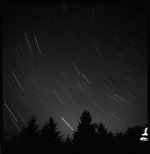
star trails

If you're going to shoot B&W I'd suggest Fuji Acros. Acros has the best reciprocity characteristics of all B&W films. Check Fuji for recommendations. To the best of my memory there's no correction for 1 minute exposures. Best bet is to check though.

The reciprocity failure of the film will simply be accounted for when the best frame of the test shots is found.
 
From my experience, if you are using fast film, I would avoid shooting wide open for long exposure star trails. Unless you are under dark, transparent skies, the image will result in washed out blacks. Even natural sky glow will play a part in illuminating the sky. Of course, if you are using a slower film, then yes, you will need to open up your lens.

As was discussed earlier, Milky Way shots are entirely different and you will need a high ISO and a fast lens.
 
I checked my 6x9 contact print from previous year meteorite shower in August.
It was taken on HP5+ for few hours. I left lens wide open; f5.6.
I could see circular traces and few from falling meteorites.
The darker area of camera pacement is the better.
 
I planned on shooting star trails on my upcoming trip to West Virginia (very dark skies and beautiful nature), but I just realized that there are bears, so I think I'll chicken out. 😱
 
I have shot a lot of star trails. You are better off with Provia. But you can also use Portra 160. Slower film is better. Slide film helps keep the black sky, black. You will not need to compensate for reciprocity failure. If you have light pollution, try f5.6 for 50-60 minutes. If you have no light pollution, f4 for 90-120 minutes. Watch for condensation on your lens. It was pitch black in the sky when I made the second one, which is why slide film is better. Scanning is also a challenge as well. The scanner tries to compensate for the exposure.

Provia. 60 mins
https://www.flickr.com/photos/aperture64/8247215004

Portra 160. 60 mins
https://www.flickr.com/photos/aperture64/15154816282/

This is really good info. Do you mind expanding on the other aspects of equipment? Now I'm getting the itch for some star trail shots...
 
It's puzzling that exposure info I've read on line are significantly different than your exposure data. (I know, I read it on the internet ...😉)

If it's the long exposure that's puzzling, that's because you want a long enough exposure to allow the star trails to show up with the earth's rotation. Not enough time and the trails will be too short, too long and the sky can become too cluttered (imo). Many will include Polaris (North Star) in their star trail photos as all the other stars will appear to revolve around that star and give some star context.

As others have noted, dark skies are key as sky glow from light pollution from nearby towns may drown out your stars. A darker sky will allow fainter stars to show up against the sky when they might get lost otherwise.

This particular photo was taken with the 50 Distagon, wide open at f4, 400TX, for about an hour, maybe bit less. Push processed in Rodinal.

 

Attachments

  • IMG-7152.jpg
    IMG-7152.jpg
    15.3 KB · Views: 0
If it's the long exposure that's puzzling, that's because you want a long enough exposure to allow the star trails to show up with the earth's rotation. Not enough time and the trails will be too short, too long and the sky can become too cluttered (imo). Many will include Polaris (North Star) in their star trail photos as all the other stars will appear to revolve around that star and give some star context.

As others have noted, dark skies are key as sky glow from light pollution from nearby towns may drown out your stars. A darker sky will allow fainter stars to show up against the sky when they might get lost otherwise.

This particular photo was taken with the 50 Distagon, wide open at f4, 400TX, for about an hour, maybe bit less. Push processed in Rodinal.

Yeah, after doing more reading, your exposure settings and those from internet sources are pretty close. Seems to be a 2 stop diff. Close enough for government work. 😉
 
Frank, you may find some useful information on astro-landscapes here.
Link --> http://www.luminous-landscape.com/essays/night_sky___astrophotography.shtml

I also dug out a little night exposure slide rule that was published in Popular photography many years ago. (It says copyright 1964 S.P. Martin)

Plugging in ISO 100 gave these results for star trails... f/8 @ 3 hrs. or f/5.6 @ 90 min.

Glenn
 
This image shows the (rather obvious) benefit of getting away from city lights.

bortle.jpeg


And this link will take you to a Google Earth overlay of light pollution (a bit dated, from 2006): link

Good luck and be sure to show us your shots!
 
Back
Top Bottom