

russelljtdyer
Writer
The idea of using a micro four-thirds camera with m-mount lenses seemed like a good one. However, camera shake has ruined the experience for me. If I use my Lumix GF-1 with a Voigtlander adapter and my Zeiss ZM f/2 50mm lens outside in full sunlight, I can get marvelous digital photos. However, if it's a dim day or if I try to take pictures indoors without plenty of light or a flash, the results are terrible. Because a standard 50mm lens is equivalent to about a 100mm lens on a 35mm film camera, everything seems exaggerated, including the camera shake, which ruins all of my photos. The camera works fine if I use one of Panasonic's lenses with image stabilization, but not with a manual focus lens without it.
As an alternative, I can set the ISO very high, but that leads to too much noise in the images. Another alternative is to use a flash when indoors, but that's not always desirable. Plus, a flash won't always have much of an effect outdoors. The best way to eliminate camera shake, of course, is to use a tripod. However, that's not always a convenient choice.
Watching the news recently, I saw a politician surrounded by reporters and photographers. One of the photographers held up his camera with two hands over the reporters in front of him to take a picture of the politician. He had a flash bracket attached to the bottom of his camera, without a flash. He was using the flash bracket as a handle. It was on the screen for less than a second, but it caught my attention. It occurred to me that it would help to steady the camera.
Tonight I decided to test this theory. Below are four shots of books on my bookcase. The lighting is just from a single halogen light bouncing off of the ceiling--no flash. The lens is the Zeiss ZM f/2 50mm lens, with the aperture set to f/2. Since I'm photographing these book spines at a perpendicular angle, I don't have to worry about depth of field. The shutter for all four shots is 1/25 of a second and the ISO is at 200.
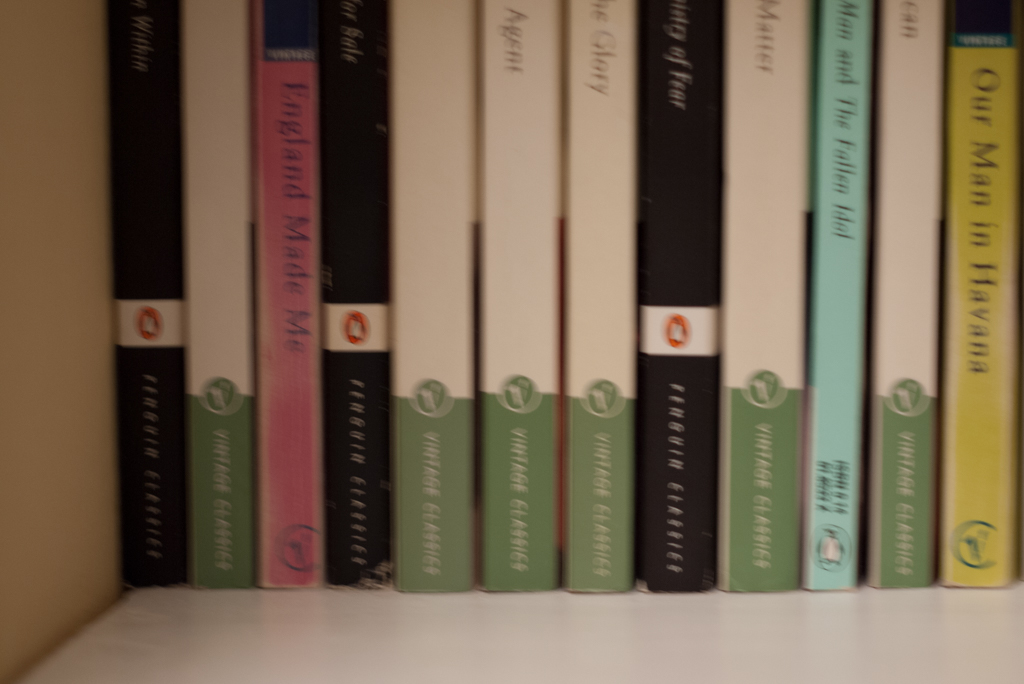
This first shot is done with me holding the camera in front of me, using the LCD screen to focus and frame the shot. You can see that there's plenty of camera shake.
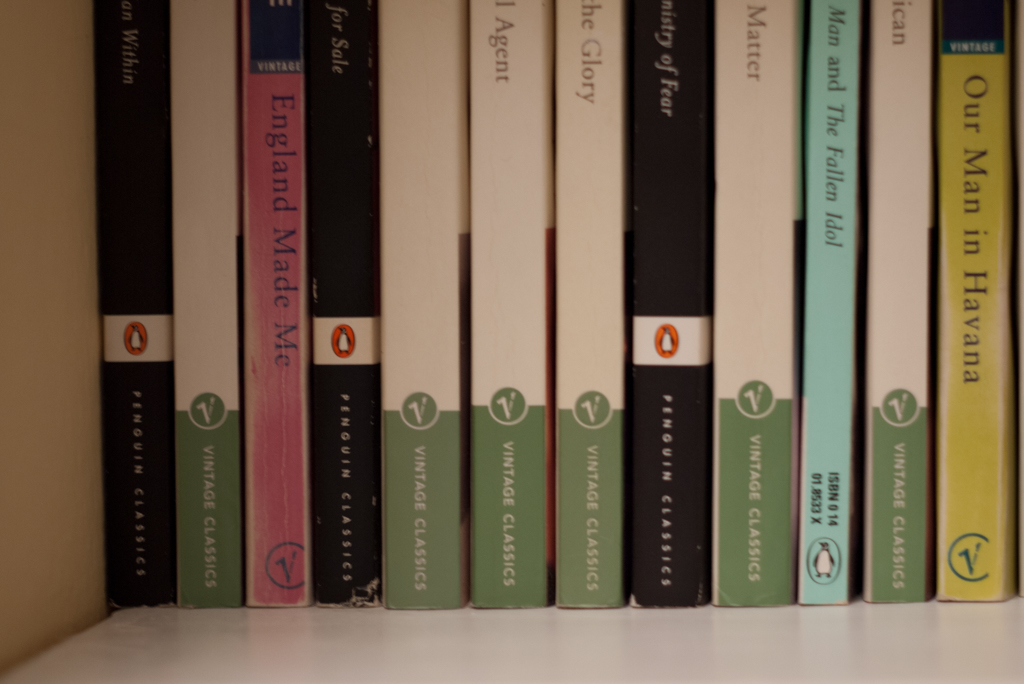
This second shot above is using the electronic view finder (EVF), holding the camera up against my face. There's still camera shake, but it's much better bracing it as one does with the EVF. However, the viewing through the EVF is not very pleasant after several photos.
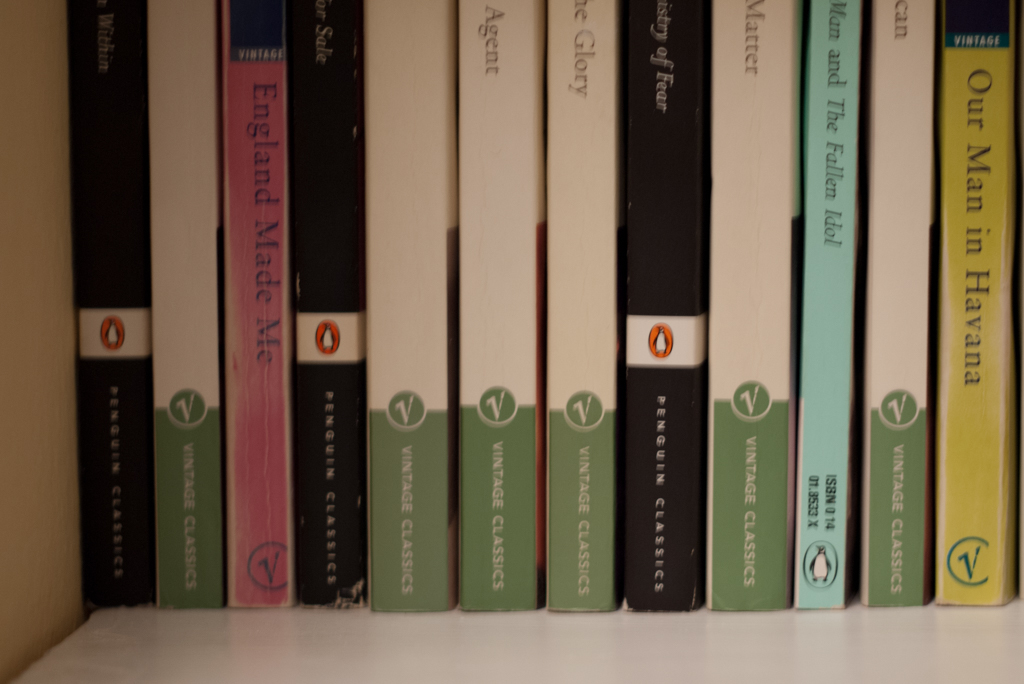
This third one is done using a small hand bracket and holding the camera in front of me, using the LCD screen for focusing and framing. It's a close call between using an EVF and a flash bracket. However, I think the bracket is a bit steadier. I've tried multiple times to shoot this photo under these four basic arrangements--so as to make sure that it was me shaking more one time than the other. The results almost always came out the same: the EVF is always a bit better, but sometimes much better than nothing. And the flash bracket is always much better than nothing, and sometimes noticeable better than the EVF. I did try both the EVF and the flash bracket together, but the combination didn't seem to affect the results.
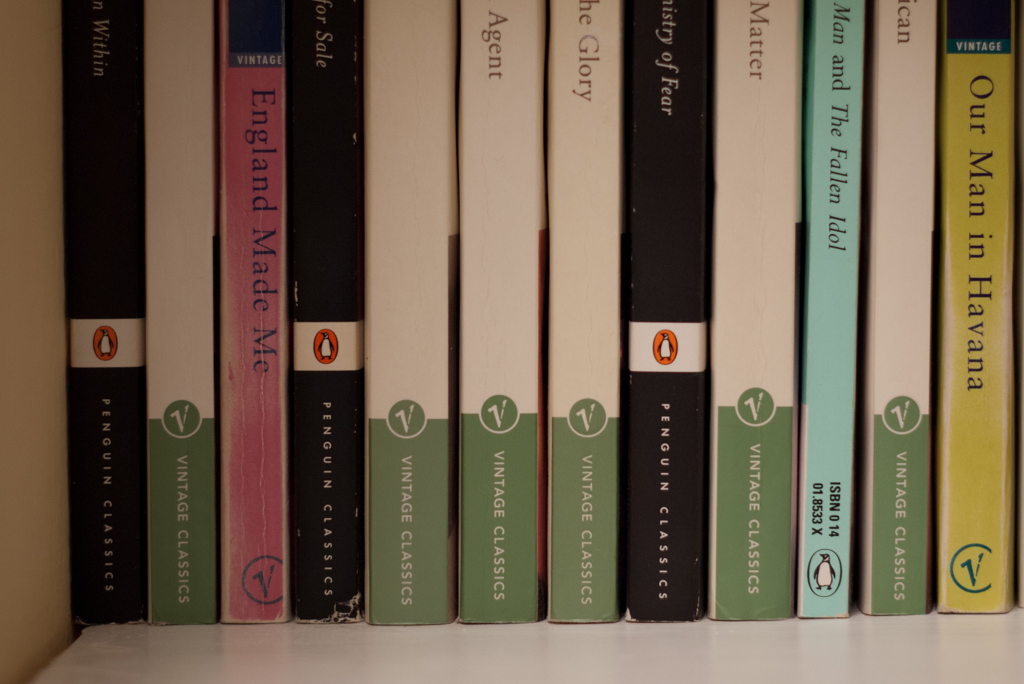
This last one is done with a tripod. It's a very clear image. If I have the time and all to set up a tripod, it obviously gives the best results without image stabilization or bright lighting (e.g., a flash). However, I think the best balance between image quality and most convenient method in low lighting may be to use a flash bracket like I did in the third photo above.
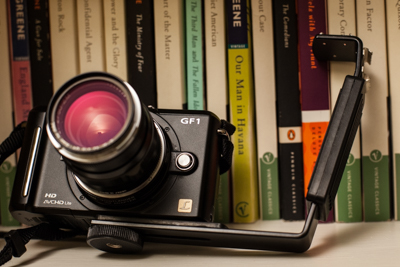
Above is a shot of the camera with the small flash bracket I used. It's not very big, but it is appropriate for the size of the camera and it widens the base enough to minimize the results of my hands shaking slightly. It seems awkward looking, having a flash bracket without a flash attached, but the results are better and it's easier to handle the camera even when not shooting.
As an alternative, I can set the ISO very high, but that leads to too much noise in the images. Another alternative is to use a flash when indoors, but that's not always desirable. Plus, a flash won't always have much of an effect outdoors. The best way to eliminate camera shake, of course, is to use a tripod. However, that's not always a convenient choice.
Watching the news recently, I saw a politician surrounded by reporters and photographers. One of the photographers held up his camera with two hands over the reporters in front of him to take a picture of the politician. He had a flash bracket attached to the bottom of his camera, without a flash. He was using the flash bracket as a handle. It was on the screen for less than a second, but it caught my attention. It occurred to me that it would help to steady the camera.
Tonight I decided to test this theory. Below are four shots of books on my bookcase. The lighting is just from a single halogen light bouncing off of the ceiling--no flash. The lens is the Zeiss ZM f/2 50mm lens, with the aperture set to f/2. Since I'm photographing these book spines at a perpendicular angle, I don't have to worry about depth of field. The shutter for all four shots is 1/25 of a second and the ISO is at 200.
This first shot is done with me holding the camera in front of me, using the LCD screen to focus and frame the shot. You can see that there's plenty of camera shake.
This second shot above is using the electronic view finder (EVF), holding the camera up against my face. There's still camera shake, but it's much better bracing it as one does with the EVF. However, the viewing through the EVF is not very pleasant after several photos.
This third one is done using a small hand bracket and holding the camera in front of me, using the LCD screen for focusing and framing. It's a close call between using an EVF and a flash bracket. However, I think the bracket is a bit steadier. I've tried multiple times to shoot this photo under these four basic arrangements--so as to make sure that it was me shaking more one time than the other. The results almost always came out the same: the EVF is always a bit better, but sometimes much better than nothing. And the flash bracket is always much better than nothing, and sometimes noticeable better than the EVF. I did try both the EVF and the flash bracket together, but the combination didn't seem to affect the results.
This last one is done with a tripod. It's a very clear image. If I have the time and all to set up a tripod, it obviously gives the best results without image stabilization or bright lighting (e.g., a flash). However, I think the best balance between image quality and most convenient method in low lighting may be to use a flash bracket like I did in the third photo above.
Above is a shot of the camera with the small flash bracket I used. It's not very big, but it is appropriate for the size of the camera and it widens the base enough to minimize the results of my hands shaking slightly. It seems awkward looking, having a flash bracket without a flash attached, but the results are better and it's easier to handle the camera even when not shooting.


