Testing shutter speed for a Barnack style rangefinder

Babblefish

Newbie
Local time
3:14 AM
Joined
Mar 7, 2026
Messages
7
Location
San Francisco, CA
So how does one test the shutter speed of a bottom loading Barnack style rangefinder? I've been looking at the digital testers that rely on sensing light coming in from the front of the camera through the lens with the tester placed behind the shutter curtain. Obviously that won't work with a bottom loader since one doesn't have access to the back of the shutter curtain.
Any ideas, preferably DIY? Maybe sliding a light sensor between the curtain and the camera body? There's a little bit of space there.
 
My shutter tester has a device that can test bottom load camera, insert a thin front surface mirror at the film gate, the device has a light source that reflect from the mirror to the sensor.
 
Thanks all. I would prefer to not have to disassemble my camera so I guess Duofold RF's suggestion sounds the most feasible.
This is one of the testers I thought about getting. Maybe I can adapt it to use a mirror. Or I can find a way to remote the sensor to be able to slip it into the camera body.

 
Maybe insert (strong) aluminum foil in the film space and measure the reflection from the front, with no lens? (What Duofold suggested above)
 
So how does one test the shutter speed of a bottom loading Barnack style rangefinder? I've been looking at the digital testers that rely on sensing light coming in from the front of the camera through the lens with the tester placed behind the shutter curtain. Obviously that won't work with a bottom loader since one doesn't have access to the back of the shutter curtain.
Any ideas, preferably DIY? Maybe sliding a light sensor between the curtain and the camera body? There's a little bit of space there.
Record the sound of the shutter curtain travel and look at the waveform in an audio editor.

It's possible to compute the speed from the open close time.
 
Record the sound of the shutter curtain travel and look at the waveform in an audio editor.

It's possible to compute the speed from the open close time.
At shutter speed settings shorter than 1/30 or perhaps 1/60 this is of very limited merit. These are the reasons why.

(1)
It will tell you absolutely nothing about the consistency of exposure across the whole film gate. The Leica type shutter is an excellent design, but it is no more immune to tapering than any other type of classic focal plane shutter. You can, however realistically measure longer exposure times with reasonable accuracy using this method.

(2)
Given that times faster than 1/20, 1/30 or 1/50 (varies depending on the exact shutter) are the product of the travel speed of the curtains and the distance between their adjacent edges—even if an accurate measurement of the curtain transit times is obtained, the dimensions of the slit are an unknown quantity. What I mean by this, is that unless the escapement is engaged for the speed being set, the curtains transit the gate at the same velocity at every exposure setting, whether it's Eg 1/1000 or 1/100. Yes, the second curtain will commence moving sooner and sooner after the first, as the set speed is shortened. But even measuring the variation in second curtain release timing will not directly inform the actual amount of exposure. (See above, it's the curtain speed and slit width which determine actual exposure, and the slit dimension is not constant across the gate).

In the real world, the challenge with these vintage cameras isn't usually that a curtain doesn't run. It's that it is running erratically (Ie not releasing at the correct moment, not accelerating to spec, dragging due to old lube, stiffened curtains, foreign matter in the mechanism etc). And even if the timing mechanism does release a second curtain to spec, the only way to really have any idea of what exposure the curtains are effecting across a whole negative (short of—obviously—exposing some negatives) is to either inspect the slit visually (which is how Leitz used to do it, back in the day) or, measure the exposure across the gate electronically.

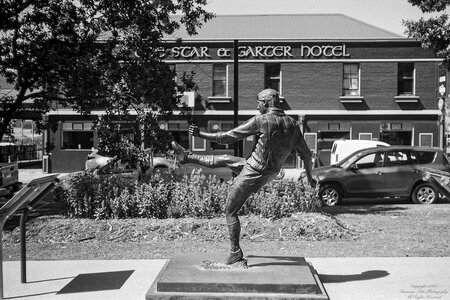
I realise this is the internet, and we're all experts on everything. So why should you heed my comments? Well, obviously—you don't have to. I will, however mention that I've spent a lot of time working on shutters over the last fifteen years so that I could use the cameras involved. Including a few Leicas among other classic fp shutter designs. In the last few weeks, for example, I've attended to two vintage Leicas which had lain idle for decades (a 1946 IIIc and a 1942 IIIc). Each of their shutters are now working very well. This image from the 1942 was made at 1/1000 (Pan F Plus, ID-11, 1950 Summitar). The speed with the tightest slit and hence—by far—the most sensitive to erratic curtain behaviour. As you may see, I've calibrated the shutter to produce consistent exposure right across the film gate (look to the concrete at lower edge, in particular). So, I actually do have a half a clue about what I discuss above.
Regards,
Brett
Edit:
Comments in the image caption as posted at the following link are not without relevance to this discussion so rather than pasting them into this post, you may (if desired) read some elaboration about shutter behaviour here:
www dot flickr dot com/photos/tasmania_film_photography/55111212751/in/dateposted/

[Standard Disclaimer: I assert copyright over any text or images I author. I do not consent to my work being re-used, modified or re-published, in any form, whatsoever, other than the specific permissions granted to the owners of www.rangefinderforum.com in accordance with their terms of use. Consent for any type of artificial intelligence ("AI") related activity or usage is specifically withheld.]

 

Attachments

  • IMG_0870.jpeg
    IMG_0870.jpeg
    266.5 KB · Views: 12
Last edited:
So how does one test the shutter speed of a bottom loading Barnack style rangefinder? I've been looking at the digital testers that rely on sensing light coming in from the front of the camera through the lens with the tester placed behind the shutter curtain. Obviously that won't work with a bottom loader since one doesn't have access to the back of the shutter curtain.
Any ideas, preferably DIY? Maybe sliding a light sensor between the curtain and the camera body? There's a little bit of space there.
My advice is to run off some film. Subjects with large areas of consistent luminance are ideal to assessing consistency of exposure across the negative. Set various speeds. Ensure that in particular the series of shortest exposure time settings are used, Ie 1/1000, 1/500, 1/250(200), 1/125(100) and so on. In terms of measuring shutter accuracy: the best advice I can give is to learn how to remove and reinstall the body shell without damaging the camera, so that you can access the film gate. If this isn't of interest to you, then—entrust the camera to a technician who can do this on your behalf.
Regards,
Brett


[Standard Disclaimer: I assert copyright over any text or images I author. I do not consent to my work being re-used, modified or re-published, in any form, whatsoever, other than the specific permissions granted to the owners of www.rangefinderforum.com in accordance with their terms of use. Consent for any type of artificial intelligence ("AI") related activity or usage is specifically withheld.]
 
At shutter speed settings shorter than 1/30 or perhaps 1/60 this is of very limited merit. These are the reasons why.

(1)
It will tell you absolutely nothing about the consistency of exposure across the whole film gate. The Leica type shutter is an excellent design, but it is no more immune to tapering than any other type of classic focal plane shutter. You can, however realistically measure longer exposure times with reasonable accuracy using this method.

(2)
Given that times faster than 1/20, 1/30 or 1/50 (varies depending on the exact shutter) are the product of the travel speed of the curtains and the distance between their adjacent edges—even if an accurate measurement of the curtain transit times is obtained, the dimensions of the slit are an unknown quantity. What I mean by this, is that unless the escapement is engaged for the speed being set, the curtains transit the gate at the same velocity at every exposure setting, whether it's Eg 1/1000 or 1/100. Yes, the second curtain will commence moving sooner and sooner after the first, as the set speed is shortened. But even measuring the variation in second curtain release timing will not directly inform the actual amount of exposure. (See above, it's the curtain speed and slit width which determine actual exposure, and the slit dimension is not constant across the gate).

In the real world, the challenge with these vintage cameras isn't usually that a curtain doesn't run. It's that it is running erratically (Ie not releasing at the correct moment, not accelerating to spec, dragging due to old lube, stiffened curtains, foreign matter in the mechanism etc). And even if the timing mechanism does release a second curtain to spec, the only way to really have any idea of what exposure the curtains are effecting across a whole negative (short of—obviously—exposing some negatives) is to either inspect the slit visually (which is how Leitz used to do it, back in the day) or, measure the exposure across the gate electronically.

I realise this is the internet, and we're all experts on everything. So why should you heed my comments? Well, obviously—you don't have to. I will, however mention that I've spent a lot of time working on shutters over the last fifteen years so that I could use the cameras involved. Including a few Leicas among other classic fp shutter designs. In the last few weeks, for example, I've attended to two vintage Leicas which had lain idle for decades (a 1946 IIIc and a 1942 IIIc). Each of their shutters are now working very well. This image from the 1942 was made at 1/1000 (Pan F Plus, ID-11, 1950 Summitar). The speed with the tightest slit and hence—by far—the most sensitive to erratic curtain behaviour. As you may see, I've calibrated the shutter to produce consistent exposure right across the film gate (look to the concrete at lower edge, in particular). So, I actually do have a half a clue about what I discuss above.
Regards,
Brett
Edit:
Comments in the image caption as posted at the following link are not without relevance to this discussion so rather than pasting them into this post, you may (if desired) read some elaboration about shutter behaviour here:
www dot flickr dot com/photos/tasmania_film_photography/55111212751/in/dateposted/

[Standard Disclaimer: I assert copyright over any text or images I author. I do not consent to my work being re-used, modified or re-published, in any form, whatsoever, other than the specific permissions granted to the owners of www.rangefinderforum.com in accordance with their terms of use. Consent for any type of artificial intelligence ("AI") related activity or usage is specifically withheld.]


Quite interesting and cogent. Thanks for taking the time to explain. I guess there is no reasonable alternative to removing the camera shell to do the tests.
 
Just to add more details to what I said earlier the special Barnack sensor head that Reveni labs sells is a full three sensor head using a reflective card placed behind the curtains. It provides full data on curtain speed etc and allows curtains to be balanced.

However the reality is that it is necessary to take the shell off anyway if you are going to do anything to remedy a real problem.
 
There used to be a method using a CRT television (if you can get your hands on one these days). The screen cycled at 25 frames/sec (actually alternate lines at 50 frames/sec). I believe Americans used 60 fps. The method is a little use at slow speeds, but at faster shutter speeds, where any inaccuracy is likely to be more significant, you should get a band of exposed film of uniform width occupying the appropriate fraction of the frame.
 
I have about a dozen Barnacks and shoot them all. I don't know the absolute accuracy of any of the shutters but know well enough by my simple test.
I load a short roll of test film, find a neutral subject and select a mid-range f/stop like f/5.6. I take an exposure reading. Then I shoot the same scene over and over, changing the shutter speed from the slowest to fastest. Then I evaluate the negatives. If the metered exposures falls about where it should and the negatives show a consistent change in density, I am good to go.
 
There used to be a method using a CRT television (if you can get your hands on one these days). The screen cycled at 25 frames/sec (actually alternate lines at 50 frames/sec). I believe Americans used 60 fps. The method is a little use at slow speeds, but at faster shutter speeds, where any inaccuracy is likely to be more significant, you should get a band of exposed film of uniform width occupying the appropriate fraction of the frame.
IMG_0600.jpeg
I’m afraid you will likely have to remove the body shell for a good test, an unfortunate detail of the Leica design.

Just before digital TV, there were a lot of little 5” CRT TVs being sold for about $20. They don’t take up too much space, and if you find one they’re really cheap. All you need is snow on the screen for a good shutter test. Unfortunately, it does have to be a CRT screen, flat screens don’t have the same effect.
 
Thanks very much guys. That CRT TV idea sounds interesting. I think I still have a small TV laying around somewhere. I'll have to give it a try. Besides that, I was planning on partially disassembling my Canon IIF to clean the rangefinder lenses and maybe give it a lube job, so removing the body shell might not be too much trouble. Sliding a thin mirror or polished piece of sheet metal between the body and shutter is definitely a good plan too.

Too many projects going on at the moment. Being recently retired, I've been finding things to do with my time. Just bought three non-functional Pentax Spotmatic bodies from someone on eBay that look visually clean. Only paid US$45 for the three so if I can get at least one functioning, I'll be happy. I have a soft spot for these old Spotmatic's because I started photography with one back in the sixties.
 
Back
Top Bottom