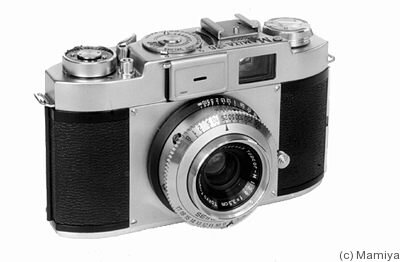
Most elegant rangefinder 35s of the ‘50’s? The Topcon 35-S & 35-L.!
No interchangeable lenses, but their form factor & performance are A+
By Jason Schneider
Tokyo Optical Co., Ltd., historically known as Tōkyō Kōgaku Kikai K.K., is a major Japanese precision equipment manufacturer that today operates as the Topcon Corporation. Founded in 1932, the company earned its reputation as a premier supplier of optics for the Imperial Japanese Army (mirroring Nikon’s role for the Imperial Japanese Navy). In the postwar era, Topcon revolutionized the photography market by introducing such landmark cameras as the 1963 Topcon RE Super (marketed in slightly revised form as the Beseler Topcon Super D in the USA), the first 35mm SLR with built-in through-the-lens (TTL), full-aperture metering. The "Topcon" name was derived from Top Company of Nippon, or Tokyo Optical Co., and the company began making cameras for the international market in 1953. Ironically, the rugged Topcon RE Super bodies, valued for their durability, were adopted by the U.S. Navy in the 1960s, turning the company’s military legacy on its head! Faced with intense competition, Tokyo Optical ceased 35mm camera production in 1980 to focus on specialized industrial and optics, which it still manufactures under the Topcon Corporation brand.

Front view of my Topcon 35-L. I think it's one of the most elegantly understated rangefinder 35s ever, but you're free to disagree.
The Topcon 35-S was released in 1956 and manufactured for only about a year. It features a specially designed Topcor 44mm f/2semi-wide angle and a Seikosha-MX inter-lens leaf shutter with speeds from 1 to 1/500 sec plus B. The lens is a superb Double-Gauss type with 6 elements in 4 groups (1-2-2-1), the same design as the highly regarded 50mm f/2 Topcor-S, and it has a 10-bladed diaphragm for smooth bokeh. The 35-S has an accessory shoe on the top cover and an MX sync terminal on the side of the lens housing. The viewfinder is a reflected Albada-frameline type with automatic parallax compensation over the entire focusing range down to 2.7 feet, and a 1:1 (life-size) magnification. Like the original Leica M3 of 1954, the Topcon’s lever advance mechanism is double stroke, claimed by Topcon to prevent the tearing of sprocket holes in film. At the time of its introduction the Topcon 35-S was priced at $109 in the U.S.A, equal to $1,298 in 2026 dollars!

My very own Topcon 35-L., a great high performance rangefinder 35 with a super 4.4cm f/2 Topcor lens and much more !
The Topcon 35-L (Beseler Topcon-L in North America) replaced the 35-S in 1957. Its specifications are the same as the 35-S; however, it was “upgraded” with a Seikosha-MXL leaf shutter that features the "new" LV (light-value) system that vintage camera shooters (including me) love to hate. Fortunately, it’s easy to bypass the dreaded LV scale (which was used in conjunction with a shoe-mounted selenium meter) by using the front-mounted mounted f/2 to f/16 aperture ring and the shutter speed ring atop the lens barrel. The bad news: The aperture diaphragm in the 35-L has only 5 blades, half as many as in the 35-S. True, you’re unlikely to notice much difference in terms of bokeh between the two models, but as an otherwise happy 35-L owner, it still annoys me. T e Topcon 35-L was sold together with a selenium light meter giving readings in LVs and was priced at about 10% more than the 35-S.

Lens diagram of 4.4cm f/2 Topcor lens, a superb 6-element, 4-group Double Gauss type based on the acclaimed 50mmm f/2 Topcor-S.
There was a third model in the Topcon 35 series. The Topcon 35-JL was released almost simultaneously with the 35-L. It is identical to its sister model, but it’s equipped with a 44mm f/2.8 Topcor and was slightly less expensive. The lens is a Heliar type with 5 elements in 3 groups (2-1-2), the same design as the one used in the 50mm f/2.8 Topcor. The 35-JL was phased out in late 1959 along with the 35-L, marking the end of the short but memorable 35mm rangefinder era at Topcon.

Lens controls from Topcon 35-L manual, Note LV scale highlighted in yellow. Yes, it's easy to set f/stops and shutter speeds separately.
Hands-on with my Topcon 35-L
I seldom wax poetic about the form factor of cameras. However, compared to other noninterchangeable-lens rangefinder 35s of the ‘50s and ‘60s, the Topcon 35-L (and its nearly identical predecessor, the 35-S) are drop dead gorgeous—minimalist masterpieces of understated style. Weighing in at a hefty 25.4 ounces (720 grams) the diecast all-metal bodied 35-L feels very solid and well balanced, and its roundish ends nestle comfortably in average-sized hands. Measuring a moderate-sized 5.2 x 3.1 x 2.5 inches (139 x 79 x 64mm) W x H X D, you can easily shoot for long stretches without undue strain, and the controls are logically (and conventionally) placed. The sole exception is the aperture scale on the front of the lens, which on the 35-L (but not the 35-S) requires a slight backward tilt of the camera to see and set properly.

Two-stroke wind levers of Topcon 35-L and 35-S are ergonomically contoured, have very smooth action, but are not as fast as single-stroke levers.

Lens barrel of my Topcon 35-L. Front aperture ring is hard to set without tilting the camera back a bit so you can see the f/stops.
The short throw left-handed focusing tab operates with silky smoothness and turns only 90∘ to cover the entire focusing range, which is marked to 2.7 feet but gets down to about 2.6 feet (unmarked). The beautifully contoured two-stroke wind lever is ratcheted and advances the film in one long 180∘ stroke and one shorter stroke of about 140∘. It too operates with consummate smoothness and there’s a distinctive low-pitched “clunk” at the end of the second stroke as the shutter is cocked and the subtractive coaxial frame counter counts down one notch. Of course, as with all two-stroke winding systems (e.g. the one on the first run of Leica M3s and all Konica IIIAs) it’s not as fast as a single stroke system, so the Topcon 35-S and 35-L are not ideal for shooting fast action or sports. The shutter release requires moderate finger force, and its action is so smooth and predictable it reminds me of the release on my mid ‘60s Leica M3. Another M3-like feature is the lift-and turn rewind knob, which measures about ¾ of an inch in diameter. This makes rewinding faster than with an M3 but still not as fast as a crank.

Topcon 35-L with box, manual, accessory selenium meter with LV readouts. A kit in this condition is very hard to find and likely to see you back $500 plus.
Perhaps the nicest and most defining feature of the Topcon 35-L (and the other two models in the series) its big, bright 1:1 (life-size) range/viewfinder with reflected (Albada-type) parallax compensating frame line. With an actual and effective base length (EBL) of about 58mm, the rangefinder provides sufficient accuracy to focus the 4.4cm (44mm) f.2 Topcor lens while permitting fast focusing that covers the entire focusing range in a ¼ turn of the focusing ring. The yellowish rectangular focusing patch is well defined and it’s easy to bring the moving and stationary images of the coincident image rangefinder into perfect alignment. The yellowish parallax-compensating frame line at the extreme outer edges if the finder is hard to see in its entirety, especially fi\or eyeglass wearers, and achieving precise composition may require moving your eye around to determine all four borders of the frame. Once you get used to it, it’s not as bad as it sounds. However, it’s noteworthy that one of the Topcon’s archrivals, the Konica IIIA, has a much easier to see projected viewfinder frame line system that not only compensates for parallax error but also shrinks the filed if view as you focus closer to compensate for the increase in effective focal length that narrows the field of view. Of course, the Konica IIA has its own issues, like an idiosyncratic two-stroke vertical film wind lever perched on the front of the camera that I’ve never learned to love. Chacun à son goût.

Topcon 35-S outfit with boxes, fitted leather case. Orginal 1956 U.S. selling price, $109!
Despite its imperfections and quirks, the Topcon 35-L is one of my very favorite walk-around cameras and its on-film performance, even at the widest apertures, is just shy of spectacular. I’d love to have a Topcon 35-S, which has no accursed LV ring and doeshave a 10-bladed lens diaphragm, but I haven’t been able to find a clean one without issues at an attractive price. Speaking of prices, you can snag a reasonably clean working Topcon 35-L or 35-S for about $150, and a near mint one for $300 to $350, but the vast majority are offered by Japanese sellers that now add a hefty shipping charge that includes prepaid customs duties for U.S. buyers only.
User reviews of the Topcon 35-L
(most of the following comments also apply to the Topcon 35-S)
Topcon 35-L rangefinder camera: users praise its excellent build quality and outstanding lens. However, some users note its heavy weight and quirky design, which may make it less suitable for everyday use.
Key Takeaways from User Reviews
Build Quality: The camera is widely described as being "built like a tank," with a very solid, all-metal construction and smooth operation. The internal mechanics, such as the film advance, are often noted for their precision and durability, comparable to more well-known high-end brands like Leica, Nikon.
Optics: The noninterchangeable Topcor 4.4cm f/2 (or 44mm f/2) lens receives high acclaim for its optical quality. Topcor lenses in general have a strong reputation among collectors and users for producing sharp images with good contrast and color rendition.
Viewfinder: The original 35-L features a bright 1:1 Albada viewfinder with automatic parallax correction. A later, modified version of the finder is brighter overall but has less eye relief, which may be an issue for eyeglass wearers. The rangefinder patch itself is functional but may not be exceptionally bright.
Handling & Ergonomics:
Pros: Users appreciate the smooth, predictable action of the shutter release, that reduces camera shake. The double-stroke film winding mechanism is praised as sturdy and smooth.
Cons: The camera is heavy and bulky ("a brick") compared to many contemporaries. Its unique design can be quirky and awkward for some users, making it more of a "change of pace" camera than a daily user.
Reliability & Repair: While durable, these cameras are vintage, so finding fully functional models can be a challenge (e.g., shutters may be slow, or focusing stiff). Given their relative rarity and the general scarcity of repair parts and specialists, repairs can be difficult or uneconomical.
Historical Context & Value: The Topcon 35-L is considered a "forgotten gem" or an "under the radar" classic. Because they were vastly outsild by rivals like Nikon, Konica, and Canon they can sometimes be found at lower prices than comparable competitor models, offering good value for collectors and enthusiasts.
Overall: users who appreciate a robust, well-engineered mechanical camera and high-quality vintage optics tend to be very satisfied with the Topcon 35-L, provided they can overlook its substantial size and ergonomic quirks. (I agree!) You can view sample photos taken with the camera on the Lomography site.
A site for hard core nerds who want to know more about the Topcon 35-S
To find out more than you ever wanted to know about the Topcon 35-S go to the Oreate AI Blog (oreateai.com) and find Yoshio Oze’s Analysis of The Topcon 35-S Camera Technology From Tokyo Optical (1956). It’s comprehensive all right but fair warning, a PhD in physics really helps!
No interchangeable lenses, but their form factor & performance are A+
By Jason Schneider
Tokyo Optical Co., Ltd., historically known as Tōkyō Kōgaku Kikai K.K., is a major Japanese precision equipment manufacturer that today operates as the Topcon Corporation. Founded in 1932, the company earned its reputation as a premier supplier of optics for the Imperial Japanese Army (mirroring Nikon’s role for the Imperial Japanese Navy). In the postwar era, Topcon revolutionized the photography market by introducing such landmark cameras as the 1963 Topcon RE Super (marketed in slightly revised form as the Beseler Topcon Super D in the USA), the first 35mm SLR with built-in through-the-lens (TTL), full-aperture metering. The "Topcon" name was derived from Top Company of Nippon, or Tokyo Optical Co., and the company began making cameras for the international market in 1953. Ironically, the rugged Topcon RE Super bodies, valued for their durability, were adopted by the U.S. Navy in the 1960s, turning the company’s military legacy on its head! Faced with intense competition, Tokyo Optical ceased 35mm camera production in 1980 to focus on specialized industrial and optics, which it still manufactures under the Topcon Corporation brand.
Front view of my Topcon 35-L. I think it's one of the most elegantly understated rangefinder 35s ever, but you're free to disagree.
The Topcon 35-S was released in 1956 and manufactured for only about a year. It features a specially designed Topcor 44mm f/2semi-wide angle and a Seikosha-MX inter-lens leaf shutter with speeds from 1 to 1/500 sec plus B. The lens is a superb Double-Gauss type with 6 elements in 4 groups (1-2-2-1), the same design as the highly regarded 50mm f/2 Topcor-S, and it has a 10-bladed diaphragm for smooth bokeh. The 35-S has an accessory shoe on the top cover and an MX sync terminal on the side of the lens housing. The viewfinder is a reflected Albada-frameline type with automatic parallax compensation over the entire focusing range down to 2.7 feet, and a 1:1 (life-size) magnification. Like the original Leica M3 of 1954, the Topcon’s lever advance mechanism is double stroke, claimed by Topcon to prevent the tearing of sprocket holes in film. At the time of its introduction the Topcon 35-S was priced at $109 in the U.S.A, equal to $1,298 in 2026 dollars!
My very own Topcon 35-L., a great high performance rangefinder 35 with a super 4.4cm f/2 Topcor lens and much more !
The Topcon 35-L (Beseler Topcon-L in North America) replaced the 35-S in 1957. Its specifications are the same as the 35-S; however, it was “upgraded” with a Seikosha-MXL leaf shutter that features the "new" LV (light-value) system that vintage camera shooters (including me) love to hate. Fortunately, it’s easy to bypass the dreaded LV scale (which was used in conjunction with a shoe-mounted selenium meter) by using the front-mounted mounted f/2 to f/16 aperture ring and the shutter speed ring atop the lens barrel. The bad news: The aperture diaphragm in the 35-L has only 5 blades, half as many as in the 35-S. True, you’re unlikely to notice much difference in terms of bokeh between the two models, but as an otherwise happy 35-L owner, it still annoys me. T e Topcon 35-L was sold together with a selenium light meter giving readings in LVs and was priced at about 10% more than the 35-S.
Lens diagram of 4.4cm f/2 Topcor lens, a superb 6-element, 4-group Double Gauss type based on the acclaimed 50mmm f/2 Topcor-S.
There was a third model in the Topcon 35 series. The Topcon 35-JL was released almost simultaneously with the 35-L. It is identical to its sister model, but it’s equipped with a 44mm f/2.8 Topcor and was slightly less expensive. The lens is a Heliar type with 5 elements in 3 groups (2-1-2), the same design as the one used in the 50mm f/2.8 Topcor. The 35-JL was phased out in late 1959 along with the 35-L, marking the end of the short but memorable 35mm rangefinder era at Topcon.
Lens controls from Topcon 35-L manual, Note LV scale highlighted in yellow. Yes, it's easy to set f/stops and shutter speeds separately.
Hands-on with my Topcon 35-L
I seldom wax poetic about the form factor of cameras. However, compared to other noninterchangeable-lens rangefinder 35s of the ‘50s and ‘60s, the Topcon 35-L (and its nearly identical predecessor, the 35-S) are drop dead gorgeous—minimalist masterpieces of understated style. Weighing in at a hefty 25.4 ounces (720 grams) the diecast all-metal bodied 35-L feels very solid and well balanced, and its roundish ends nestle comfortably in average-sized hands. Measuring a moderate-sized 5.2 x 3.1 x 2.5 inches (139 x 79 x 64mm) W x H X D, you can easily shoot for long stretches without undue strain, and the controls are logically (and conventionally) placed. The sole exception is the aperture scale on the front of the lens, which on the 35-L (but not the 35-S) requires a slight backward tilt of the camera to see and set properly.
Two-stroke wind levers of Topcon 35-L and 35-S are ergonomically contoured, have very smooth action, but are not as fast as single-stroke levers.
Lens barrel of my Topcon 35-L. Front aperture ring is hard to set without tilting the camera back a bit so you can see the f/stops.
The short throw left-handed focusing tab operates with silky smoothness and turns only 90∘ to cover the entire focusing range, which is marked to 2.7 feet but gets down to about 2.6 feet (unmarked). The beautifully contoured two-stroke wind lever is ratcheted and advances the film in one long 180∘ stroke and one shorter stroke of about 140∘. It too operates with consummate smoothness and there’s a distinctive low-pitched “clunk” at the end of the second stroke as the shutter is cocked and the subtractive coaxial frame counter counts down one notch. Of course, as with all two-stroke winding systems (e.g. the one on the first run of Leica M3s and all Konica IIIAs) it’s not as fast as a single stroke system, so the Topcon 35-S and 35-L are not ideal for shooting fast action or sports. The shutter release requires moderate finger force, and its action is so smooth and predictable it reminds me of the release on my mid ‘60s Leica M3. Another M3-like feature is the lift-and turn rewind knob, which measures about ¾ of an inch in diameter. This makes rewinding faster than with an M3 but still not as fast as a crank.
Topcon 35-L with box, manual, accessory selenium meter with LV readouts. A kit in this condition is very hard to find and likely to see you back $500 plus.
Perhaps the nicest and most defining feature of the Topcon 35-L (and the other two models in the series) its big, bright 1:1 (life-size) range/viewfinder with reflected (Albada-type) parallax compensating frame line. With an actual and effective base length (EBL) of about 58mm, the rangefinder provides sufficient accuracy to focus the 4.4cm (44mm) f.2 Topcor lens while permitting fast focusing that covers the entire focusing range in a ¼ turn of the focusing ring. The yellowish rectangular focusing patch is well defined and it’s easy to bring the moving and stationary images of the coincident image rangefinder into perfect alignment. The yellowish parallax-compensating frame line at the extreme outer edges if the finder is hard to see in its entirety, especially fi\or eyeglass wearers, and achieving precise composition may require moving your eye around to determine all four borders of the frame. Once you get used to it, it’s not as bad as it sounds. However, it’s noteworthy that one of the Topcon’s archrivals, the Konica IIIA, has a much easier to see projected viewfinder frame line system that not only compensates for parallax error but also shrinks the filed if view as you focus closer to compensate for the increase in effective focal length that narrows the field of view. Of course, the Konica IIA has its own issues, like an idiosyncratic two-stroke vertical film wind lever perched on the front of the camera that I’ve never learned to love. Chacun à son goût.
Topcon 35-S outfit with boxes, fitted leather case. Orginal 1956 U.S. selling price, $109!
Despite its imperfections and quirks, the Topcon 35-L is one of my very favorite walk-around cameras and its on-film performance, even at the widest apertures, is just shy of spectacular. I’d love to have a Topcon 35-S, which has no accursed LV ring and doeshave a 10-bladed lens diaphragm, but I haven’t been able to find a clean one without issues at an attractive price. Speaking of prices, you can snag a reasonably clean working Topcon 35-L or 35-S for about $150, and a near mint one for $300 to $350, but the vast majority are offered by Japanese sellers that now add a hefty shipping charge that includes prepaid customs duties for U.S. buyers only.
User reviews of the Topcon 35-L
(most of the following comments also apply to the Topcon 35-S)
Topcon 35-L rangefinder camera: users praise its excellent build quality and outstanding lens. However, some users note its heavy weight and quirky design, which may make it less suitable for everyday use.
Key Takeaways from User Reviews
Build Quality: The camera is widely described as being "built like a tank," with a very solid, all-metal construction and smooth operation. The internal mechanics, such as the film advance, are often noted for their precision and durability, comparable to more well-known high-end brands like Leica, Nikon.
Optics: The noninterchangeable Topcor 4.4cm f/2 (or 44mm f/2) lens receives high acclaim for its optical quality. Topcor lenses in general have a strong reputation among collectors and users for producing sharp images with good contrast and color rendition.
Viewfinder: The original 35-L features a bright 1:1 Albada viewfinder with automatic parallax correction. A later, modified version of the finder is brighter overall but has less eye relief, which may be an issue for eyeglass wearers. The rangefinder patch itself is functional but may not be exceptionally bright.
Handling & Ergonomics:
Pros: Users appreciate the smooth, predictable action of the shutter release, that reduces camera shake. The double-stroke film winding mechanism is praised as sturdy and smooth.
Cons: The camera is heavy and bulky ("a brick") compared to many contemporaries. Its unique design can be quirky and awkward for some users, making it more of a "change of pace" camera than a daily user.
Reliability & Repair: While durable, these cameras are vintage, so finding fully functional models can be a challenge (e.g., shutters may be slow, or focusing stiff). Given their relative rarity and the general scarcity of repair parts and specialists, repairs can be difficult or uneconomical.
Historical Context & Value: The Topcon 35-L is considered a "forgotten gem" or an "under the radar" classic. Because they were vastly outsild by rivals like Nikon, Konica, and Canon they can sometimes be found at lower prices than comparable competitor models, offering good value for collectors and enthusiasts.
Overall: users who appreciate a robust, well-engineered mechanical camera and high-quality vintage optics tend to be very satisfied with the Topcon 35-L, provided they can overlook its substantial size and ergonomic quirks. (I agree!) You can view sample photos taken with the camera on the Lomography site.
A site for hard core nerds who want to know more about the Topcon 35-S
To find out more than you ever wanted to know about the Topcon 35-S go to the Oreate AI Blog (oreateai.com) and find Yoshio Oze’s Analysis of The Topcon 35-S Camera Technology From Tokyo Optical (1956). It’s comprehensive all right but fair warning, a PhD in physics really helps!
Last edited: