The Look: Darren Aronofsky’s PI and Seijun Suzuki's Tokyo Drifter

Guy Pinhas

Well-known
Local time
6:18 AM
Joined
Mar 25, 2016
Messages
235
Location
Amsterdam
Hello all!

Not sure where to post this so mod, if you feel like this needs to go into a different section, by all means.

I am curious about a certain look obtained in two movies that have been long time favorites of mine: Darren Aronofsky’s PI and Seijun Suzuki's Tokyo Drifter. I looked a bit online and I couldn’t find too much about it and even though film and still photography are different, there are quite a few common methods to achieve certain results. As least I think so as my motion picture experience in a big fat zero 🙂

Darren Aronofsky’s PI was shot on 16mm but it can’t be just that. I have seen enough movies shot on 16mm and none had that look. So what is it? What gives it that look?

Seijun Suzuki's Tokyo Drifter's opening sequence is what I am really interested in. Same question, what is it that gives it that underexposed overdeveloped look. It can’t be just that.

Any theories?

Thanks for taking the time to respond.

Guy.
 
The camera, lenses, film format, film stock (or digital camera and emulation), processing, scanning, grading all have a great effect on how a film looks. The DP is probably the main factor though since their eye is in the camera and they are often making the decisions on all the variables above.
Phil Forrest
 
Yeah, I figured that there is a lot going but maybe there are a few cinematographers and/or DP's in our midst that could chime in. Thanks for chiming in Phil 🙂

The camera, lenses, film format, film stock (or digital camera and emulation), processing, scanning, grading all have a great effect on how a film looks. The DP is probably the main factor though since their eye is in the camera and they are often making the decisions on all the variables above.
Phil Forrest
 
Hello

Tokyo Drifter is a great film, but Branded to Kill is my favourite Suzuki film, and features great B&W cinematography and also super cool music.

But regarding the intro of Tokyo Drifter I think it may have been shot on blue sensitive title matting film stock.
Which would explain the very high contrast, and dark skintones.
 
The specifics for Pi:
https://shotonwhat.com/pi-1998
I couldn't find production specifics on Tokyo Drifter.
You may want to ask these questions on a cinematography forum.
As for the look of Pi, it looks to me to be the lighting, stock, filtration, and grading used.
Just watching the Pi trailer makes me want to go out and shoot some 16mm so bad. I am chomping at the bit to stretch the legs of my "new" (to me) Bolex.
Phil Forrest
 
If you are interested in shooting in B&W on a Bolex [ brave ! ]
Then definately check out the Mark Jenkin films, including Bait
https://www.youtube.com/watch?v=ZmydSyiR59o

Where he prcocesses Kodak Double X in cafenol developer.
Quite a different look to the OP's refs, but quite interesting.
And an usual film, which is all post-synced dialogue, giving it an odd
b-movie feel.

For stills the look you are after would have been Fuji HR-II, which was
a 'copy' film for technical records and micro film.
ISO 6, very high contrast, and no anti-halide backing.
Sadly long discontinued.
 
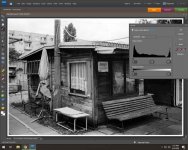
If you are talking about still photography I suggest using Fomapan 400 at full speed or 1/2 stop more; it gives the histogram you are looking for. Use Rodinal and don't dilute too much (the enclosed photo is not mine):
 

Attachments

  • Screenshot (4) copy.jpg
    Screenshot (4) copy.jpg
    39.1 KB · Views: 0
Thank you all. Just so we're clear, I'm not looking to replicate the look of those films, I am just reminded every time I watch those specific film that there are not many films out there that a similar look. I guess Begotten is another one
https://www.youtube.com/watch?v=qTSNWfQ8k-E

Tonyc: I like both those films. Been getting more and more into Japanese film after seeing an insane double feature last year of Hara Kiri and Woman In The Dunes. Different ball game but I still see a common thread, style wise.
https://www.imdb.com/title/tt0058625/
https://www.imdb.com/title/tt0056058/?ref_=nv_sr_srsg_1

Also thanks for turning me on to Mark Jenkins. Never heard of the guy but I will deffo check him out. I am always happy to hear of new and offbeat stuff. Experimenting is fun!

Phil: Thank you for the PI link. Great site full of info.

Again, thanks everyone for chiming in!
 
Thank you all. Just so we're clear, I'm not looking to replicate the look of those films, I am just reminded every time I watch those specific film that there are not many films out there that a similar look. I guess Begotten is another one
https://www.youtube.com/watch?v=qTSNWfQ8k-E

Tonyc: I like both those films. Been getting more and more into Japanese film after seeing an insane double feature last year of Hara Kiri and Woman In The Dunes. Different ball game but I still see a common thread, style wise.
https://www.imdb.com/title/tt0058625/
https://www.imdb.com/title/tt0056058/?ref_=nv_sr_srsg_1

Also thanks for turning me on to Mark Jenkins. Never heard of the guy but I will deffo check him out. I am always happy to hear of new and offbeat stuff. Experimenting is fun!

Phil: Thank you for the PI link. Great site full of info.

Again, thanks everyone for chiming in!
I am pretty much into Japanese movies too so if you are getting into them here are a few random thoughts. Woman in the Dunes freaked me out when I saw it years ago - such as strange premise. (Isn't there a spider that traps its victims in a conical shaped hole in the sand?) But it was interesting, so it stuck in my mind for years till eventually I managed to get a copy of it. I have not seen the 1961 version of Harakiri you linked, but I do have a later version of the same story made a few years ago. I will keep an eye out for the older version - in general I prefer the older Japanese movies especially the black and white ones.

If you have not already done so, try any of Director, Akira Kurisawa's films. They are all worth a viewing and some are absolutely superb (and include a number that were based on Shakespeare plays). One that everyone knows I guess, is Seven Samurai a movie in which the cultural exchange went the other way - to Hollywood where the movie was remade as "The Magnificent Seven" .(I much prefer Akira's telling of it) The movie Ran is also worth seeing if just for the Castle attack scene in the middle of the movie - its like a dream (or nightmare) in slowmo. I have never seen a single scene from any movie that is as powerful. It's based very loosely on King Lear by the way.https://www.youtube.com/watch?time_continue=16&v=w-VxyEjPlRU&feature=emb_logo

Another old film I really enjoyed is the 1961 version of the film Chushingura which recounts the story of the Forty Seven Ronin and was released in the west under that name. (Not to be confused with the stupidly dumb Hollywood extravaganza ("stupidly"; "dumb"; "Hollywood" and "extravaganza".... sorry to be tautological) and CGI fest of a few years ago). It is in color though from memory - not watched it for a few years now. It is a very Japanese move - a straightforward retelling of the events that led up to the climax.

I have grown particularly fond of movies directed by Yasujirō Ozu as well, though they are very much an acquired taste - very slow, very little happens, very mellow and usually about some arcane aspect of everyday Japanese family life and Japanese traditional attitudes and culture in the 1950s and earlier. Never the less these movies are something to savour slowly. I have written about him before in another thread at RFF in part because so much of his film photography is excellent. He learned his trade in the silent era and kept up a similar style of cinematography till he died in 1963. As such, he seldom moves the film camera (as with old silent films - no panning for example) so his films sometimes look almost like a succession of photographs with its characters moving into, out of and within a set frame. Very unusual.

Here are two short video articles on him and his style. BTW he started shooting in the silent film era so most of his 50+ movies are in black and white but towards the end he made a few color films.
https://www.youtube.com/watch?v=0Ra0xEQ8yaU
https://www.youtube.com/watch?v=ujAldDnOYWQ
 
The opening scene of Tokyo Drifter was shot on an expired black and white negative stock.

Pi was shot on Kodak 7666, their 16mm Tri-X reversal stock, which has a native ASA of 160 in tungsten lighting and 200 in daylight. Because the visual style was inspired by Frank Miller’s Sin City comics and Tetsuo: Iron Man, cinematographer Matthew Libatique combined the reversal stock with high contrast lighting for an image with limited greyscale.
 
Pi - The lab I worked at did most of the post production work on this film (I myself didn't do any work on it as I only worked on old films and not new productions). From what I remember it was all shot on Tri-X 16mm, pushed 2 stops, and then optically blown up to 35mm to give it Black and White only look. Prints were over exposed too as they wanted the whites to really blow out and glow. They did this in part because they didn't want the look of "Clerks" which was mostly gray toned.
 
The opening scene of Tokyo Drifter was shot on an expired black and white negative stock.


That is an interesting observation, but do you have a source for this information ?
It seems hard to believe there existed any expired-stock at Nikatsu in 1966.
Seijun alone was making nearly 4 feature films a year at this time. As with other studios in this period, movies were shot, edited and released at an amazing rate.
 
peterm1: Thank you for the tips. I am familiar with both Kurosawa and Ozu and you are right about the latter: the static camera is very special, you need to get used to it but if you have some experience with old silent movie then i think you're good to go. I have not seen Chushingura so it is now added to my list. I won't go into the whole Hollywood thing but generally speaking, when it decides to remake something, well, you better watch the original first as the remake tends to be limp. And I do love Hollywood but as of the last 2-3 decades it has really dropped the ball. O well, ebb and flow bla bla 🙂

Filmtwit: Tri-X 16mm pushed two stops must be nuts. I mean you can already tell with 35mm when it is pushed and processed properly, there is some serious mid tone crunching going on. With 16mm? Man, there is nothing left. And on top of that overexposing? Yeah, goodbye greys!

Judge Holden: Tetsuo Iron Man! Haven't though of that one in ages. Saw it at the Laemmle five theatre on Sunset in LA upon its release. Great weird movie. I need to watch that one again. Thanks for the reminder 🙂

charjohncarter: I love Foma 400. I need to go through some bulk of XX and Orwo 74 but once I am done, back to Fomapan. I give it a two stop push and with my pre asph, 35mm Summilux it is amazing.

Again, thank you all for chiming in!
 
Thanks Guy for starting this thread and thanks Helen and other for the supplied links.

It is interesting and I'll spoend some time to look, know and learn something about these japanese movies, I already know a few of the directors (Ozu, Kurosawa) but absolutely dis not have any idea aboiut the others.

And sorry but no answers for the questions, only a quick thoughts if I had to replicate a similar look in my photos i would try a B&W film and push it 2-3 stops. I guess the lgiht as well must be taken in account.

Interesting threads, thanks to all contributors.
 
That is an interesting observation, but do you have a source for this information ?
It seems hard to believe there existed any expired-stock at Nikatsu in 1966.
Seijun alone was making nearly 4 feature films a year at this time. As with other studios in this period, movies were shot, edited and released at an amazing rate.

The Criterion Collection Blu-ray edition (Region A) has interviews with Suzuki and his AD Masami Kuzuu, which is pretty entertaining. Kuzuu speculates on the meaning of Suzuki’s artistic choices, which are immediately refuted when the interview cuts back to Suzuki saying his choices were made on the fly, purely to experiment with what was on hand. One such choice was opening a very colorful film with a black and white prologue with some expired film the studio had lying around.

My info for Pi came from the digital liner notes on the US DVD.
 
The Criterion Collection Blu-ray edition (Region A) has interviews with Suzuki and his AD Masami Kuzuu, which is pretty entertaining. Kuzuu speculates on the meaning of Suzuki’s artistic choices, which are immediately refuted when the interview cuts back to Suzuki saying his choices were made on the fly, purely to experiment with what was on hand. One such choice was opening a very colorful film with a black and white prologue with some expired film the studio had lying around.

My info for Pi came from the digital liner notes on the US DVD.

Thanks for the info, I will definitely check out these interviews, I am a big fan of his films and the work of Teshigahara.

[ please forgive my previous message if it sounded disbelieving, I was just hungry for more knowledge ]
 
Back
Top Bottom