That turns up on the web all too frequently and it quite incorrect.
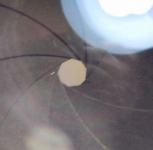
- The shape of the diaphragm opening doesn't have any effect "when wide open" since it is then out of the way and the circular opening in the frame of the diaphragm is effectively the shape of the aperture.
- the shape of the diaphragm opening at other apertures does affect the bokeh to a very small degree. Its major impact is on the shape of small brilliant highlights that are out of focus, which is a small component in the overall bokeh (read: quality of the blur, not quantity)
Yep, this. Some real-world examples, from Fuji GW690. The lens is a 5/4 Gauss-type 90mm f/3.5 with a 5-bladed aperture.
This is challenging scenario for
any lenses quality of out-of-focus areas that will bring out their worst; focused at medium-close distance with dense foliage, small repeating patterns and points of light in the background. The pentagonal aperture shape is plainly noticeable and the fence and trees take on a somewhat "busy" look
This was shot wide-open and despite there being lots of detail in the background, it for the most part is very smooth- some parts take on a nearly perfect guassian blur! Note especially the small points of light on the left side- completely non-angular. Some of this is due to the nature of the background but the difference is there.
As Dwig mentioned, the look of out-of-focus areas is complicated and variable, but shape and number of aperture blades can make a big difference in the settings just below maximum aperture.
I've noticed that many modern lenses have rounded aperture blades at all settings- this is nice to help smooth bokeh at moderate apertures but this robs us of stars on points of light!
This was made on a Nikkor 17-35 at f/16 and around 24-28mm- it's 7-bladed aperture ought to make brilliant 14-point stars at this setting, but they're barely noticeable even on the closest points of light due to the curvature of the blades.
Contrast that to this similar image from a Canon Serenar 28mm with a 6-straight-blade aperture also set at f/16: ignoring the immense ghosting (lens coatings in 1953 were still a work-in-progress
😉 ) and my R-D1's dirty sensor (oops) there are huge stars on every point of light!
Fortunately, some lens designers recently have seem to caught on- I've seen new lenses that have blades designed to make a round aperture at wider settings, and angled at smaller. I just checked my Canon 40mm, and it's aperture is almost perfectly round down to f/5.6- but by f/8 it becomes a heptagon and by f/11 the sides are perfectly straight! Undoubtedly done on purpose, and a nice thoughtful touch- round when wide for smoother bokeh and angular when small for sunstars. Well-done, Canon engineers.