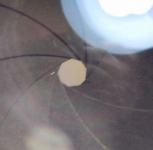
The Shape of the Aperture Opening ?

daveleo

what?
Local time
10:19 PM
Joined
Oct 20, 2010
Messages
3,692
Location
People's Republic of Mass.
I am looking at old lenses to buy. I always look at the shape of the aperture opening, because I think that should tell me something important. I look for either lots of straight blades or curved blades, but my thinking is that the closer to circular, the better. But I am not so sure.

I see aperture openings (like this picture) that are not even symmetrical.

My questions are: what should I be looking for? Is an asymmetric opening good or bad? Is an asymmetric opening designed that way or is it stuck blades or whatever?

Thanks for your comments.
 

Attachments

  • Apertureblades.png
    Apertureblades.png
    77 KB · Views: 0
The diaphragm leaves of my 35/2.8 Summaron form a scalloped appearance at the wider apertures, say about f/4. I assume this is meant to work harmoniously with the lenses' aberrations to obtain the desired rendition. I recall that the 21mm f/4 Super-Angulon has surprising few diaphragm leaves for such a high quality lens. I agree that a nine-bladed diaphragm that forms a perfectly round opening is thought to be ideal, but I don't think we can really tell the best lenses just by looking!
 
A circular opening diaphragm is said to help influence softer bokeh when wide open. In my view the influence is secondary to various optical aberrations which greater effect. Aperture shape is however obvious in some situations. When there is backlighting for example the shape of the aperture can show up in internal reflections. Modern lenses seem less affected due to better coatings.
 
I have read in Ken Rockwell reviews that he likes a 5-bladed diaphragm with 5 distinct points where the blades meet, as they produce good sunstars when desired. (At least, that is my interpretation of what I have read on his site.)

- Murray
 
A circular opening diaphragm is said to help influence softer bokeh when wide open. ....

That turns up on the web all too frequently and it quite incorrect.

  1. The shape of the diaphragm opening doesn't have any effect "when wide open" since it is then out of the way and the circular opening in the frame of the diaphragm is effectively the shape of the aperture.
  2. the shape of the diaphragm opening at other apertures does affect the bokeh to a very small degree. Its major impact is on the shape of small brilliant highlights that are out of focus, which is a small component in the overall bokeh (read: quality of the blur, not quantity)
 
Uneven shapes can show up. For an over-the-top example, check out http://www.diyphotography.net/diy_create_your_own_bokeh/

The same effect happens with blades that are uneven. Its why I sold my Yashica CCN - I found the shape of the bokeh caused by the two blades distracting.

I used a Jupiter 9 that had lopsided blades. The impact was subtle but was visible if you looked for it. The photo from daveleo has even more subtle unevenness. It probably won't be noticeable in most shots but you may see it occasionally. The issue was probably there at the time the lens was manufactured - either slight variation in the shape of the blades or positioning of the mount pins.
 
That turns up on the web all too frequently and it quite incorrect.

  1. The shape of the diaphragm opening doesn't have any effect "when wide open" since it is then out of the way and the circular opening in the frame of the diaphragm is effectively the shape of the aperture.
  2. the shape of the diaphragm opening at other apertures does affect the bokeh to a very small degree. Its major impact is on the shape of small brilliant highlights that are out of focus, which is a small component in the overall bokeh (read: quality of the blur, not quantity)

Yep, this. Some real-world examples, from Fuji GW690. The lens is a 5/4 Gauss-type 90mm f/3.5 with a 5-bladed aperture.

This is challenging scenario for any lenses quality of out-of-focus areas that will bring out their worst; focused at medium-close distance with dense foliage, small repeating patterns and points of light in the background. The pentagonal aperture shape is plainly noticeable and the fence and trees take on a somewhat "busy" look

UvhUgMT.jpg


This was shot wide-open and despite there being lots of detail in the background, it for the most part is very smooth- some parts take on a nearly perfect guassian blur! Note especially the small points of light on the left side- completely non-angular. Some of this is due to the nature of the background but the difference is there.

D6NGkDZ.jpg


As Dwig mentioned, the look of out-of-focus areas is complicated and variable, but shape and number of aperture blades can make a big difference in the settings just below maximum aperture.

I've noticed that many modern lenses have rounded aperture blades at all settings- this is nice to help smooth bokeh at moderate apertures but this robs us of stars on points of light!

This was made on a Nikkor 17-35 at f/16 and around 24-28mm- it's 7-bladed aperture ought to make brilliant 14-point stars at this setting, but they're barely noticeable even on the closest points of light due to the curvature of the blades.

AgmPwpT.jpg


Contrast that to this similar image from a Canon Serenar 28mm with a 6-straight-blade aperture also set at f/16: ignoring the immense ghosting (lens coatings in 1953 were still a work-in-progress 😉 ) and my R-D1's dirty sensor (oops) there are huge stars on every point of light!

qlBaDID.jpg


Fortunately, some lens designers recently have seem to caught on- I've seen new lenses that have blades designed to make a round aperture at wider settings, and angled at smaller. I just checked my Canon 40mm, and it's aperture is almost perfectly round down to f/5.6- but by f/8 it becomes a heptagon and by f/11 the sides are perfectly straight! Undoubtedly done on purpose, and a nice thoughtful touch- round when wide for smoother bokeh and angular when small for sunstars. Well-done, Canon engineers.

 
The aperture shape is very important when you shoot against the light, especially on longer lenses and at wider apertures - you see the aperture shape in the reflected points of light. In fact, this is why I like to have several lenses of the same FL with different max aperture, to shoot them wide open. Some of the older lenses will have anywhere from 10 to 20 aperture blades, what makes the aperture virtually circular at any f stop. An example of a perfect aperture is Elmar 90/4. In MF, Rolleiflexes and Rolleicorda made before 1954 had a circular 10 blade aperture ( 2.8 C for example).
 
I've found that bokeh in not affected when it is purely a creation of shooting wide open. That is to say that the in-focus subject is reasonably near the out-of-focus area treated by the bokeh. One example is the occasional street shot where the out of focus background is not too far behind the subject. However, when the out of focus area is further behind the subject, I notice more instances where the bokeh appears to look like the aperture blade opening. I noticed this difference on my Nikkor AF-D 50/1.4 that I used on film for about 10 years. Some of the modern Zeiss ZM lenses like my new c-biogon appear to have eliminated this.
 
How serendipitous that I'd stumble upon this thread ... was out shooting with my Leica M 240 yesterday, trying out some vintage glass. In this case it was the Jupiter-12 35mm F2.8, supposedly a copy of the Zeiss Biogon.

The lens is multicoated and has a 5-blade aperture, but I find the J-12 tends to flare easily. This photo was taken at about F8, you can obviously see the pentagonal flare. Whether or not this is aesthetically desirable is arguable, but in this case I thought it looked kind of cool.

21119929309_e113cb9395_c.jpg
 
I bought an Auto Rikenon 50mm 1.7 lens at a thrift store for about $5.00 a few years back...upon further inspection I found one of six of its aperture blade sticks out a little more than the other ones...you start to see this around f/4 to f/5.6 but at f/8 and beyond you can really see the difference...it bothered me to the point where I was just about to open up this lens to have a crack at fixing it...I thought about it and came to the conclusion that it would probably have a very little effect on the final outcome...it's a very sharp lens and for five bucks I can live with it's uniqueness...
 
Zeiss used/uses a triangular aperture on many of their motion picture primes. They're fantastic and very expensive.

I have two Zeiss lenses for Rollei 35mm SLR that have three aperture blades for a special OOF effect for triangular shaped "doughnuts". The Planar 85/1.4 and the Distagon 35/1.4. I use both ;enses with M4/3 cameras (until one day I will get a FF digital camera such as the Leica M 240 or Sony A7.
 
Back
Top Bottom