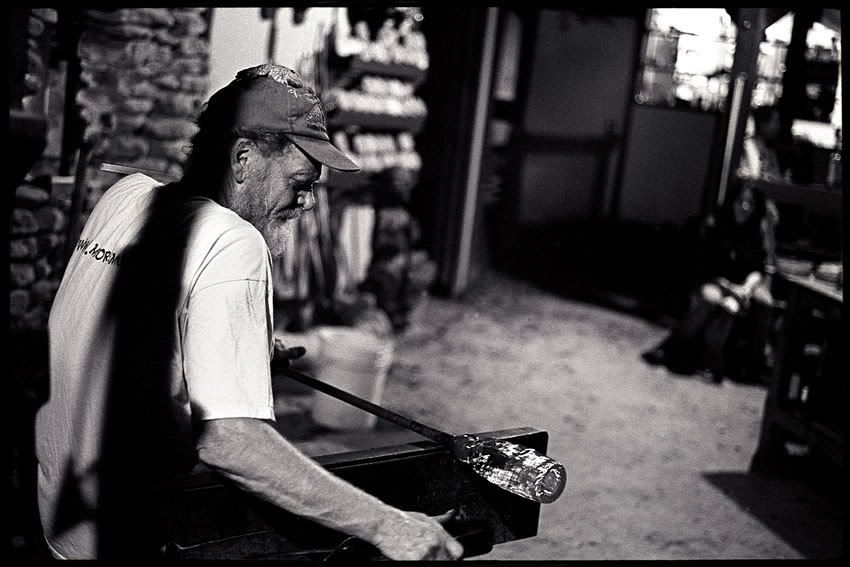
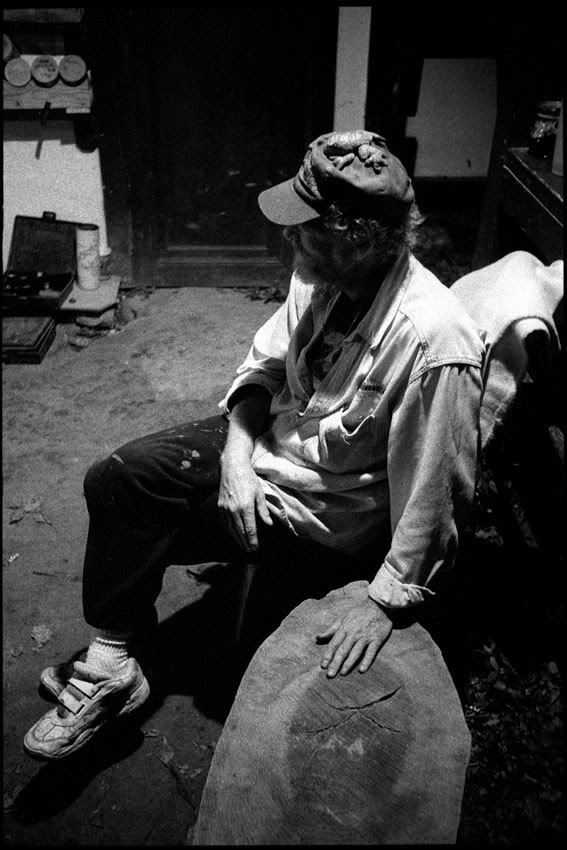
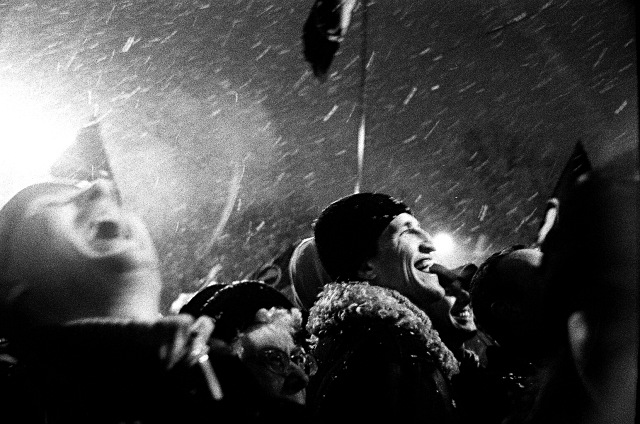
TMax P3200 - Neopan 1600

mw_uio

Well-known
Local time
5:50 PM
Joined
Nov 6, 2005
Messages
514
Location
UIO, 1787 miles south of MIA
On June 13th, I am photographing a group of motorcyclists [8], departing on a trip, [no I am not going] which will be leaving in the early morning 4am-5am. The light will be perhaps some street lights, and their motorcycle lights, and some car lights. I do want to make the best of this oppportunity. I do not have any experience with either films. I know that it will be a fast shoot - 20 minutes maximum, maybe less. I am going to dedicate 5 rolls minimum. I do need to make my desicion on which film and order some this week.

[equipment - 1 x F3HP, 1 x F3HP/MD4 - 85/1.4, 28/2.8, 24/2.8. + Olympus Stylus Epic]

What film do you recommend? I really want to seize this one time opportunity.

Thank you
MArk
Quito, EC
 
True maximum ISO speeds: Fuji 650+, Kodak 1000, Ilford 1250. All are very 'pushable' long-toe films.

For me, Ilford's tonality wins hands down -- but it is the grainiest, as you would expect from the fastest. I've never seen the point of the Fuji film, but others will sing its praises loudly.

Cheers,

Roger
 
Roger - on this forum, you bet there will be some praise-singing of NP1600 🙂

I would go for the TMZ, which I am coming to like more and more for this type of stuff. For more atmospheric stuff, when I want a feel of grain, I shoot Delta. But TMZ has tighter grain.
 
I'd use Tri-X @ 1600 developed in Diafine - very nice tones, and a way to tame the contrasty lights you will have to use according to your gig's description.
 
Tmax 3200. I have used it expensively for available light night photography with excellent results:

rodeo2007-3.jpg


rodeo2007-8.jpg


fiesta-2006-7.jpg


All shot with TMZ at EI 1600, developed in Tmax Developer 1+4, 75 degrees, 8.5 minutes. All handheld, Olympus OM-4T, various Zuiko lenses.
 
Chris- those are great. I haven't used T-max dev in years, but I might give that combo a look after seeing these. Normally, I'd shoot HP5 or Tri-X pushed to 1600 and run in Microphen if I need the speed.

BTW- what is you avatar from? It really looks like the painting style of a friend of mine who went to I.U. a few years back....
 
Drew,

The avatar is a self-portrait that I painted when I was an art student at Indiana University at Fort Wayne. One of the painting professors there was Dr. Audrey Ushenko (PhD in art history, which she also taught), and she painted in that style...it tended to rub off on her students. I was a photo major and had never touched a paintbrush before I took that class so I think I did pretty good, but if I was a painter i'd probably have found my own style. Which IU campus did your friend go to? If it was Fort Wayne I might know him.

I think TMZ in Tmax Dev. is real nice, I use it a lot. I wish they made it in 120 size, but I recently tried the Ilford 3200 in 120 and it came out nice too.
 
True maximum ISO speeds: Fuji 650+, Kodak 1000, Ilford 1250. All are very 'pushable' long-toe films.

For me, Ilford's tonality wins hands down -- but it is the grainiest, as you would expect from the fastest. I've never seen the point of the Fuji film, but others will sing its praises loudly.

Cheers,

Roger

I pretty much agree with your 'true' speeds but not with your conclusion.

NP1600 is a strange beast and certainly nothing like 1600 to judge from shadow detail (or lack of it). It's sharp and fine-grained and capable of good results when rated at 800 or less but is inherently rather contrasty. In my experience you can get better shadow detail out of pushed Tri-X.

D3200 is the "anti Neopan" i.e. grainy and flat. I mean it really is very flat and shows little micro-contrast. Great for photographing night scenes, where contrast is a problem. Can be safely rated at up to 1600.

TMZ is about as grainy as D3200 but gives more normal contrast. It may be a bit slower but in my opinion gives the most pleasing tonal values under most conditions. Can also be rated at up to 1600 (just).

The nice thing about these films is that they each have their own characteristics but there are currently really only two ultra high speed films: D3200 and TMZ. This was also the case in the early 70s when I was at college, the contenders then being Kodak Recording Film and Agfapan 1000.
 
I pretty much agree with your 'true' speeds but not with your conclusion.

Well, tonality is a matter of opinion, which is why all such questions as this have a large subjective element. A very great deal depends on developer, too: Delta 3200 may (just) exceed ISO 1300 but there is no real limit to its minimum speed. I've not found it lacking in microcontrast, and I find the curve shape vastly preferable to Kodak's: mich nicer highlight differentiation.

The ISO speeds I quoted are to ISO standards of shadow detail and contrast. Anyone can check them if they have the equipment to do so.

I don't, but taking Ilford's stated maximum ISO speeds (for their own products and those of others) and Kodak's stated maximum ISO speeds for TMZ, I can do adequate comparisons of the relative speeds. Delta is about 1/3 stop faster than TMZ and Neopan is about 1/2 stop slower, and it seems likely that both Ilford and Kodak are telling the truth about their own actual speeds (though Fuji is rather reticent).

Cheers,

Roger
 
Neopan 1600 probably has the finest grain, but I've found to have very little tolerance for underexposure. It looks good developed in T-Max developer.

TMZ has decent grain at 1600, especially when developed in Xtol (stock or 1:1), and probably has some more flexibility in terms of exposure. At EI 1600 or 3200, I always have best results metering it with an incident meter (for some reason).

Whatever you choose, shoot and develop some *before* the big day, so that you'll have an idea how it works.
 
Neopan 1600 probably has the finest grain . . . Whatever you choose, shoot and develop some *before* the big day, so that you'll have an idea how it works.
Dear Chuck,

Well, yes, it's slowest. Delta 3200 is fastest, and has the biggest grain.

I completely agree about the importance of tests beforehand.

Cheers,

Riger
 
Here's expired Delta 3200 at 6400

298223402_GaFMc-L.jpg

298223435_xcCVw-L.jpg


The good news. If you're taking pictures of subject matter which occupies at least 1/4 of your image, you should still be in business.

The bad news. Pretty self explanatory. No fine detail whatsoever.
 
You should not use any of those films expired, unless you just fool around. They pick up base fog like nothing else.

I read Roger's conclusions on their speed some years ago, and they certainly match my experience. However as he says tonality is subjective: I prefer TMZ look over Delta (despite having shot much more of the latter), partially because its tighter grain looks less intrusive for me. That said both are very fine films and I could live with any of them.

This was Delta 3200 rated at 3200:
U1177I1164801620.SEQ.0.jpg


This was TMZ pushed to around EI 10,000, very close to what I feel is its limit:
U1177I1211273371.SEQ.0.jpg
 
Neopan 1600 probably has the finest grain, but I've found to have very little tolerance for underexposure. It looks good developed in T-Max developer.

TMZ has decent grain at 1600, especially when developed in Xtol (stock or 1:1), and probably has some more flexibility in terms of exposure. At EI 1600 or 3200, I always have best results metering it with an incident meter (for some reason).

Whatever you choose, shoot and develop some *before* the big day, so that you'll have an idea how it works.

Neopan would take less than 5 mins to develop in T-Max standard solution even at box speed. I actually tried this combination, but it is hard to get consistent results. Do you have a strarting point for more diluted T-Max? There is only one row in the big dev chart for NP1600.
 
Neopan would take less than 5 mins to develop in T-Max standard solution even at box speed. I actually tried this combination, but it is hard to get consistent results. Do you have a strarting point for more diluted T-Max? There is only one row in the big dev chart for NP1600.

Nope. I've only developed it in TMax 1:4.
 
Back
Top Bottom