Tri-x rating

Please, don't be an idiot. Shoot your Tri-X at box speed (400) and hand it over the counter. Don't give any instructions whatsoever. Then pickup the negs, scan and print.

Seriously, most of these guys can't even remember their last names never mind what film is in their cameras. Or for that matter what developer, time and temperature they used. It's mostly in their drunken afterhours imagination.
Who are 'these guys'? And after what hours?

Cheers,

R.
 
For roll film I just shoot box speed. Over the course of the 37 shots the lighting conditions are not going to be constant. For handheld shooting the benefits of a faster shutter speed to me is more important.
 
A vast amount depends on how you meter.

Yes, indeed. I set my meter to 400, but I expose more for the shadows. So the "effective" metering might be the same as shooting at 200 but doing more of an average reading. This is something everyone really needs to figure out for themselves.
 
Tom Abrahamsson shoots it at 320 and develops ten minutes in D76 with gentle agitation (I believe 5 seconds every thirty, which is more than I would do... check out his Tri-X and D76 thread in his forum.) Elsewhere Chris Crawford, another rff member, discusses his own procedures and if you search around he's posted tons of stuff online (his website I believe) on film, developers, and scanning. He's particularly smart about scanning and post-processing. I'd search out those discussions. The point if you're scanning, I gather, is to hold down the contrast somewhat for purposes of better scans, then up the contrast again in post. Your lab sounds good: tell them the outcome you're after and see what they recommend. I shoot some at 320 and some at 400, all with the intention of developing in Xtol with precise timing and agitation, and sometimes I manage this, but mainly since I'm often so wildly behind in developing film (i must have forty rolls lying around right now) I end up doing a bunch of stuff, even unmatching stuff, stand developed in rodinal 1 hour with very minimal agitation at 30 minutes. I usually (but not always) like the results and you can't stupid-proof it any better than that.

 
Stepheniphoto, did you happen to notice that your pictures came out with clothes and flowers for heads? It's just that is you use rodinal, they come out naked and wearing sunglasses at night.

Like, duh.

ps, I rate it at 325.
 
I think, he intends to say, the tonality of your photograph could be better...

true, it could be better but thats not what he was saying at all. i've been developing film for the past 6 months.. not very long compared to other people here but i know what im doing. i dont usually take stuff online seriously but i hate people that talk **** behind a monitor when they wouldnt have the balls to call someone out in the street.

also i guess it wouldnt hurt to ask exactly what OP wanted to shoot with the tri-x he bought. i mainly do street so i use 800 to get a faster shutter speed. not saying thats the best for all situations but its what works for me in my situation.
 
true, it could be better but thats not what he was saying at all. i've been developing film for the past 6 months.. not very long compared to other people here but i know what im doing. i dont usually take stuff online seriously but i hate people that talk **** behind a monitor when they wouldnt have the balls to call someone out in the street.

Steven,

Let me assure you I do not hide behind my CRT. I use my real name and location on line so people can seek me out if necessary... and they do ! Furthermore I do have the balls to call people out on the street and on scene. Typically I can be found during the hours of darkness shooting flashbulb images on the street with a Baby Speed below 23rd Street. Events at the Chelsea Hotel, Gershwin Hotel and after-hours clubs are my specialty. I can defuse most bad situations instantaneously without error.

Please, don't call me on the carpet.

And don't hate or challenge me... make me your friend.

George

BTW: I checked out your blog and I'm clueless as to your location. Color me not too smart.
 
It's a fairly flat neg I'm after which I guess I should have said in the first place. Final output will be for high res scanning with a Minolta Multi Pro. Style of shooting will be mainly daytime street which will entail a lot of "in shade" images which is par for the course over here with everyone cowering from the sun. Conversely, I'm inclined to shoot low key style so deep shadows appeal to me. Training the highlights is the priority.

So, from what I can gather it seems that 320 ISO might be the best for me and instruct my lad accordingly.

Thanks to all for a very informative thread and I'll post the results in the future for critique.
 
It's a fairly flat neg I'm after which I guess I should have said in the first place. Final output will be for high res scanning with a Minolta Multi Pro. Style of shooting will be mainly daytime street which will entail a lot of "in shade" images which is par for the course over here with everyone cowering from the sun. Conversely, I'm inclined to shoot low key style so deep shadows appeal to me. Training the highlights is the priority.

So, from what I can gather it seems that 320 ISO might be the best for me and instruct my lad accordingly.

Thanks to all for a very informative thread and I'll post the results in the future for critique.

It depends on what developer they use, but I've found 320 works for most popular developers with Tri-X developed for normal contrast. That'll work great for work in the shade, since shaded scenes do not have very large differences in brightness between the darkest and lightest parts of the scene. If you shoot in the sunlight, contrast will be very high, and shooting at 160 and asking the lab to develop it for 25% less time will lower contrast enough to make controlling the light tones easier.

The speed recommendations I give assume your meter is accurate, your technique is good, and your lab uses the right developing time with a standard developer like D-76, Tmax Developer, or Xtol. Some developers reduce speed of Tri-X, like PMK, which I just used to develop some Tri-X shot at 200, because that developer causes some speed loss.
 
Tom Abrahamsson shoots it at 320 and develops ten minutes in D76 with gentle agitation (I believe 5 seconds every thirty, which is more than I would do... check out his Tri-X and D76 thread in his forum.) Elsewhere Chris Crawford, another rff member, discusses his own procedures and if you search around he's posted tons of stuff online (his website I believe) on film, developers, and scanning. He's particularly smart about scanning and post-processing. I'd search out those discussions. The point if you're scanning, I gather, is to hold down the contrast somewhat for purposes of better scans, then up the contrast again in post. Your lab sounds good: tell them the outcome you're after and see what they recommend. I shoot some at 320 and some at 400, all with the intention of developing in Xtol with precise timing and agitation, and sometimes I manage this, but mainly since I'm often so wildly behind in developing film (i must have forty rolls lying around right now) I end up doing a bunch of stuff, even unmatching stuff, stand developed in rodinal 1 hour with very minimal agitation at 30 minutes. I usually (but not always) like the results and you can't stupid-proof it any better than that.


Vince, thanks for the thumbs up! My tech info is here:
http://chriscrawfordphoto.com/technical/index.php
 
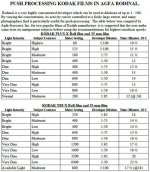
I want to share this table that I found in a BW forum. I had no way to test it but it looks interesting.
Best regards

S.
 

Attachments

  • Rodinal-tri-x.jpg
    Rodinal-tri-x.jpg
    99.6 KB · Views: 0
Yes, indeed. I set my meter to 400, but I expose more for the shadows. So the "effective" metering might be the same as shooting at 200 but doing more of an average reading. This is something everyone really needs to figure out for themselves.

Yes, the old phrase was 'favouring' the shadows. These things are probably better explained today, on the internet, than they were 40 years ago in books. For me, in my 'teens and early 20s, the biggest problems were (i) assuming I was doing something wrong if I didn't set the ASA speed on my meter; (ii) a blind faith in the meter without really knowing how to use it; and (iii) not knowing what a technically good picture looked like anyway.

Cheers,

R.
 
Back
Top Bottom