Triumph of the Triplet: The 3-element lens that changed the world!
Dennis Taylor’s Cooke Triplet of 1893 launched the modern optical era
By Jason Schneider
The Cooke Triplet was an ingenious and transformational lens invented in 1893 by Harold Dennis Taylor, then optical manager for the British firm T. Cooke & Sons of York. It was patented in 1893-1894 as an innovative lens design that corrected key aberrations using three simple, air-spaced lens elements. Taylor designed the triplet to flatten the field in photographic lenses, and to minimize aberrations including coma, astigmatism, and spherical aberration. The design consists of a negative (double concave) lens element placed in between two positive l(convex) lens elements, a configuration that allows for excellent correction of several aberrations at once. It was named to honor the contribution Cooke & Sons, the company for which Taylor worked, but the commercial licensing and manufacturing was handled by the legendary British optical form of Taylor, Taylor & Hobson (T, T, & H) of Leicester, in the East Midlands region of the UK. Note: It is said that T. Cooke & Sons were reluctant to manufacture the lens because of the difficulty in grinding the strong negative (concave) surfaces of the central element, but at the time the company was primarily known as a high-end cutting-edge telescope maker.

H. Dennis Taylor, portrait by Herbert Speedm and diagram of his 100mm Cooke Triplet. Image courtesy of Lomography.com
An abbreviated biography of Harold Dennis Taylor, 1862-1943
Harold Dennis Taylor was born in Huddersfield, England and attended St. Peter’s School, York. He joined T. Cooke & Sons, telescope makers in York, and eventually became their optical manager. In 1892 he patented a three-element apochromatic telescope objective (Brit. Pat. 17994/92), and in 1893 designed has famous Triplet photographic objective (Brit. Pats. 1991/93 and 22,607/93). But as Cooke did not wish to make photographic lenses, he offered the design to Taylor, Taylor, & Hobson (no relation) in Leicester, who undertook to manufacture it. In 1896 Taylor noticed that a tarnished (oxidized) lens transmits more light than a freshly polished one, thus laying the foundation for antireflection coating. In 1906, Taylor wrote a famous book, A System of Applied Optics. He was awarded the Progress Medal of the Royal Photographic Society in 1935.
The designer’s view of the Cooke Triplet
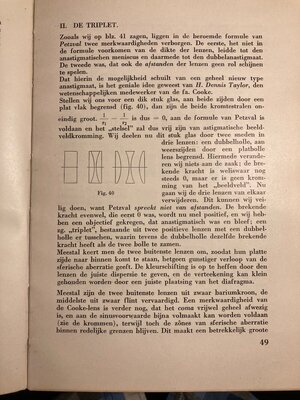
According to Dennis Taylor, the lens design was derived by considering a cemented achromatic doublet consisting of one thin negative element and one thin positive element, both of equal power; such a doublet would result in a compound lens with zero net power but also a flat imaging field. However, by separating the elements, the resulting air gap would act as an additional lens element, giving the system a positive overall power while retaining the flat-field characteristic. To correct the oblique aberrations, Taylor recommended splitting one element into two and mounting them on either side of the remaining element; although he patented versions in which either the negative or positive element was split, but bin his preferred arrangement, the positive element was split.
A Cooke triplet comprises a negative flint glass element in the center with a positive crown glass element on each side. In this design, the Petzval sum is zero, so the plane of focus is flat. In other words, the negative lens can be as strong as that of the outer two elements combined, when one measures in diopters (units of light-bending power), yet the lens will converge light, because the rays strike the middle element close to the optical axis. The curvature of field is thus determined by the sum of the diopters, but the focal length is an independent factor.

Cooke Triplet lens variations from page 104, A History of the Photographic Lens, by Rudolf Kingslake.
Impact and production
At the time, the Cooke triplet was a major advancement in lens design. For one wavelength, the design can correct, using only three elements, spherical aberration, coma, astigmatism, field curvature, and distortion. However, as renowned optical expert Dr. Rudolf Kingslake noted, "there is no symmetry to help the designer, and there is no control over distortion", leading to a trial-and-error design process. That’s why the Cooke Triplet and its variants were surpassed by later lens designs in high-end cameras including the double Gauss design, but is still widely used in inexpensive cameras, including variations using aspheric elements, particularly in cellphone cameras.

Close-up of Kodak 3A Autographic Model C 3-1/4 x 5-/1/2-inch postcard format camera with a Taylor, Taylor & Hobson Cooke Anastigmat triplet lens.
The Cooke Triplet design was used, with relatively minor modifications, by virtually every major optical company on the face of the earth and it has been the de facto formula for the standard lenses fitted to countless low-end and moderately priced cameras. The Cooke Triplet also became the foundation of many subsequent designs, including such landmarks as the Zeiss Tessar (1902) and Voigtlander Heliar (1902-1903). The Tessar substituted a cemented doublet for the Cooke Triplet’s rear element to achieve better correction across the field at wider apertures, and the Heliar used two cemented doublets flanking the central concave element to achieve even better correction along with a distinctive smooth, natural rendition described at the time as “sunlike,” hence the name “Heliar” a variant of helios, the Ancient Greek word for sun. The classic 4-element, 3-group Zeiss Tessar has certainly been widely copied but the humble Cooke Triplet reigns supreme as the most imitated and influential optical design for over 130 years!
My favorite triplets: A concise compendium based on hands-on use
There are literally hundreds Cooke Triplet-derived lenses that have been produced and sold over the past century, and a few notable examples that are still in production. Some are permanently mounted on cameras, while others are available used in a huge variety of interchangeable mounts for 35mm format rangefinder cameras and 35mm and medium format SLRs. There’s no way we can cover them all here, but we can provide a handy guide to some of the best based on my personal hands-on shooting experience and reviews by trusted experts. While there are inevitably a few rotten apples in every barrel the overwhelming preponderance of triplets out there will give you imaging performance ranging from the dreaded “satisfactory” to very impressive indeed. And virtually all of them capture images with that undefinable “vintage look” and have smooth, natural bokeh. While few triplet lenses are critically sharp at the edges and corners of the field at their widest apertures, most can capture excellent detail across the field at moderate apertures in the f/5.6 to f/11 range.

Uncoated 10 cm f/4.5 Meyer Trioplan triplet lens in Compur shutter from a prewar Welta 6 x 9 cm camera. The Trioplan is surely one if the best triplets!
The Meyer Trioplan: Meyer-Optik, founded in Görlitz, the easternmost town in Germany, in 1896, introduced the Trioplan triplet lens in 1916. Meyer went on to produce a plethora of uncoated Trioplan lenses before WW II and numerous coated versions including the 50mm f/2.9 and 100mm f/2.8 during the ‘50s through the ‘70s. Renowned for their central sharpness, natural rendition, and “soap bubble” bokeh, vintage versions are frequently found in Exakta, M42 (Pentax screw), and Altix mounts and modern versions such as the Meyer Optik Görlitz 100mm f/2.8 II ($999.00) and 50mm f/2.8 II ($599.00) are available in Leica-M, Nikon Z, and Canon RF mounts. Many vintage look enthusiasts (including yours truly) rate the Meyer Trioplans as among the best triplets out there in terms of their overall imaging performance, and based on overwhelmingly positive user reviews, the more expensive current Trioplans uphold the tradition. You can sometimes snag a good used vintage Trioplan online for $100 to $200, but many pristine ones go for $300 to $450.

Welta 6 x 9cm folding camera of the late '30s with excellent uncoated 10.5 cm f/4.5 Meyer Trioplan triplet lens.
The Steinheil Cassar: The venerable German optical firm Steinheil München (Munich)introduced the Cassar, a series of classic Cooke-style triplet lenses for cameras, starting around 1925 although some sources give the date as 1924. The Cassar line became well-known both as a camera and an enlarging lens starting around 1935 and continued (in coated form) well into the postwar era. A movie version, the Cine-Cassar was also introduced, and in the mid 1950s Steinheil brought forth a refined version known as the Cassarit that was claimed to provide better color correction. Specific examples of the Steinheil Cassar include: the 50mm f/2.8 Cassar on the mid-level Realist B rangefinder 35, the 45mm f/2.8 Cassar VL on the Braun Paxette rangefinder 35, and the acclaimed 105mm f/3.8 Cassar on medium format roll film cameras such as the 6 x 9 c. Adox Sport. Interchangeable Cassar lenses were also available in Exakta and M42 screw mount, and some older versions such as the 75mm f/2.9 Cassar for the 6 x 6cm format, have been adapted for Leica M-mount. Ancient uncoated Cassar lenses such as the 12cm f/3.5 in Ibsor shutter occasionally turn up on online auction sites.

Uncoated 15cm f/3.5 Steinheil Cassar triplet lens of the 1920s most likely used on a 9 x 12 cm sheet film and film pack camera.
Based on user reviews, Steinheil Cassar lenses generally deliver above-average performance in the triplet class, and some examples, such as the 105mm f/3.8 Cassar are outstanding, stunningly sharp and crisp in the center of the field, with beautiful vintage rendition and smooth natural bokeh. Verdict: Any Steinheil Cassar is worthy of consideration for vintage look enthusiasts, especially the older uncoated versions designed for medium format cameras. Used Cassar lenses and cameras fitted with Cassar lenses are widely available at moderate prices in the $50 to $200 range.

Uncoated prewar 10.5 cm f/3.8.Steinheil Cassar lens in Prontor II shutter. This lens delivers extraordinary image quality for a simple triplet design!
The Zeiss Novar and Triotar: Carl Zeiss Jena introduced the Triotar lens around 1914, and the Novar lens in the late 1920s. Both are classic triplet anastigmats and were frequently used it on “budget friendly” Zeiss and Zeiss-Ikon cameras. Novar lenses were fitted to various Nettar and Ikonta folding cameras, rangefinder cameras, and twin-lens Ikoflexes from the ‘30s through the ‘50s. Triotars were also installed on mid-century Rolleicords (types I, Ia and II), the Rollei B35, and were available in Exakta mount. Based on my personal shooting experience, the Novar lenses on 6 x 6 cm and 6 x 9 cm folding roll film cameras deliver classic vintage performance parameters---sharp in the center, soft off axis at the widest apertures, very good sharpness and detail across the field, by f/8, smooth vintage rendition, and pleasing natural bokehl. Zeiss roll film cameras, Ikoflex TLRs and Ikoflex 35s. with Novar lenses are widely available at prices in the $50 to $150 range. Based on user reviews, and my own experience with a Rolleicord II fitted with a 75mm f/3.5 Zeiss Triotar lens, I conclude that the Zeiss Triotar generally performs on a par with a comparable Novar. Verdict: both are good choices for vintage shooters, though perhaps having a tad less “character” than a Meyer Trioplan or a Steinheil Cassar. Note: Zeiss also offered 3-element Pantar triplet lenses, mostly with interchangeable front components, that were fitted to entry-level Contaflex and Contina models. Regarded as sharp with reasonable contrast, and pleasant rendition, they’re not avidly sought by vintage look enthusiasts.

Zeiss Ikon Nettar 6 x 9cm folding camera of the '50s with coated 10.5 cm f/4.5 Novar triplet lens, an excellent performer with lots of vintage character.

Gorgeous Art Deco Rolleicord I of the mid '30s with 7.5 cm f/4.5 Zeiss Triotar triplet lens is a collector's prize.

Elegant pocketable Zeiss Tenax of the '30s provided a 24 x 24mm format on 35mm film. This one sports an uncoated 3.5cm f.3.5 Novar triplet lens
The Schneider Radionar: Schneider-Kreuznach introduced the Radionar, a 3-element Cooke triplet-type lens, in the mid ‘30s. It was initially fitted to cameras like the 6 x 6 cm Kochmann Korelle Reflex, the 35mm Balda Baldinette, and the 6 x 9 cm Certo Certosport, and later appeared in coated form as the 80mm f/2.9 Radionar on the Franka Solida III 6 x 6 cm folder and the 45mm f/2.8 Radionar L on the Adox Pronto-LK 35.

Uncoated 10.5 cm f/4.5 Schneider Radionar triplet lens from unknown prewar folding camera. A tad less character than some triplets, but still very nice.
User reviews of the Schneider Radionar lens are generally positive, describing it as a surprisingly capable vintage lens, particularly when used for portraiture, black and white photography, or when mounted on a modern digital camera, While known for being sift wide-open, especially in the corners, the Radionar sharpens up nicely at smaller apertures (f/8 or so) and offers a unique, nostalgic rendering. Highly recommended for portraiture, flower photography, and general street shooting, some versions feature a 10-or 15-bladed diaphragm, which enhances the pleasing bokeh. Overall, it yields a nice, classic, and "painterly" image character and is an affordable way to experience vintage, German-engineered glass. On the minus side, the Radionar is soft in the corners, especially at wide apertures (f/2.8 - f/3.5), isprone to flare, and its lack of contrast, may require post-processing to achieve a "modern" look.Used and vintage cameras with Schneider Radionar lenses are widely available at prices ranging from under $50 to around $300. Interchangeable Radionar lenses in Akarette, Robot, and Reflex- Korelle mounts occasionally show up online but are far less common.
The Voigtländer Voigtar and Vaskar: Voigtländer, the oldest German optical company, based in Braunschweig (Brunswick) since 1849, introduced the Cooke-triplet type Voigtar lens in the early 1930s, featuring it prominently on the Voigtländer Brillant (a TLR-style focusing box camera with a large, bright, non-focusing reflex finder on top) starting around 1932. The Vaskar lens, a post-war, budget-friendly coated triplet alternative, appeared in the late 1940s, frequently appearing on cameras like the Bessa 66 (Baby Bessa) between 1948 and 1950.Both are competent triplet lenses that were designed for budget-conscious photographers that demand high value along with good overall performance.

Coated 105mm f/4.5 Voigtlander Vaskar from a '50's Voigtlander 6 x 9 cm folding roll film camera. It's a fine performer with good contrast
Voigtar lenses often feature maximum apertures of f/6.3, f/4.5, or f/3.5while the Vaskar typically provides maximum apertures of f/4.5 and f/2.8. Both the Voigtar and the Vaskar are considered decent alternatives to Voigtländer’shigher-end 4-element, 3-goup Skopar, and even the renowned 5-element, 3-group Heliar. As triplets, they are known for being sharp in the center but soft in the corners when shot wide open, and having "distinctive" bokeh, and “old-timey” rendition, making them popular today for capturing a vintage look.Many user reviews note that the Vaskar delivers superior contrast compared to the uncoated or single-coasted Voigtar, but both have their charms. Voigtländercameras with Voigtar lenses tend to be older and clean working examples are readily available at prices in the $50 to $150 range. Roll film cameras with coated Vaskar lenses run a bit more, up to $250, but you can snag some scale-focusing 35mm models like the Vitoret for under 50 bucks.
The Rodenstock Trinar: Rodenstock GmbH was founded in 1877 by Josef Rodenstock in Würzburg Germany, but the company moved to Munich in 1884 to better establish itself as a hub of science and technology. Known for pioneering innovations like the first German progressive eyeglass lenses (1950s) and UV-protective sunglasses (1899), the company also produced cameras, and camera lenses, including the 3-element, 3-group Trinar based in the Cooke triplet, which they introduced in the 1930s. Popular on 6 x 9 cm roll film folding cameras (such as the Rodenstock Vario 6 x 9 cm folding camera), variations, including the 7.5cm f/3.5 Trinar, were produced into the mid-‘40s and fitted by camera makers including Altiflex (in the Altiflex Eho TLR), Welta (many models) and TDC (in the TDC Stereo Colorist).

Uncoated 10.5 cm f/6.3 Rodenstock Trinar lens in dial set Pronto shutter similar to the one shown on Voigtlander Inos camera below.
Trinar lens reviews: Rodenstock Trinar lenses (such as 50mm f/2.8 and 50mm f/3.5 Trinars on 35mm cameras) are highly regarded vintage triplets praised for their sharp central definition, high contrast, and pleasing bokeh. Frequently compared to Zeiss Triotars, they’re often used for macro work, enlarging, or adapted to mirrorless cameras. Known for producing crisp images with good contrast and saturation, they are often described as having a "classic" rendering with a “vintage glow" and some swirl/soap-bubble bokeh when used wide open, bur sharpen up significantly when stopped down.

Voigtlandere Inos of the '30s with an unusual 10.5 cm f/6.3 Rodenstock Trinar lens. Most were fitted with Voigtlander Skopar or Heliar lenses.
As with all classic triplets, corner performance might be limited due to the simple triplet construction. They are versatile for both black-and-white and color photography.While they might not provide extensive coverage for large format camera movements, they are excellent, affordable, and compact lenses for general, close-up, and creative, vintage photography. Specifically, the 75mm f/4.5 Trinar for 6 x 6 cm cameras earns kudos for its high contrast and detail on axis, though its corner performance is not as high as more complex designs.Overall, the Rodenstock Trinar is considered a strong, reliable performer with lots of character particularly when it’s used in situations that take advantage of its unique, vintage rendering. Cameras with Rodenstick Trinar lenses, such as the Rodenstock Vario folding camera, the Wirgin Reflex TLR, the Balda Gloria 6 x 9, the Franka Solida III, the 35mm Regula III, and the ZEH Primus Deppelformat 6 x 9 folder are readily available on the leading online auction sites at prices in the $75 to $150 range. Rodenstock Trinar lenses in leaf shutters are harder to find, but Rodenstock Trinar enlarging lenses (which are often mounted on digital cameras) are readily available at $35-$75 a pop.
The E. Ludwig Meritar: Produced by Ernst Ludwig,an independent optical manufacturer in Lausa (near Dresden), which later merged with Weixdorf in 1938 and was eventually absorbed into VEB Pentacon in 1980.While some Meritar lenses existed prior to WWII (longer focal lengths for medium format roll film cameras), the 50mm f/2.9 version relaunched in 1949, was an economical, three-element, three-group Cooke triplet type design that succeeded another triplet, the Victar.This budget-friendly East German triplet lens was produced from 1949 to 1968, is known for its distinctive, classic, and slightly soft vintage, film-like character, and was made in Exakta and M42 (Pentax screw) mounts, serving as a lower-cost alternative to Zeiss lenses.
Three main variations of the interchangeable 50mm f/2.9 Meritar were made, all in aluminum:a simple manual diaphragm (early/conical shape); apre-set diaphragm (bulbous shape); andpre-set diaphragm (beehive shape, the most common version).The Meritaris known for its "vintage look," producing soft, artistic, and sometimes dreamy images with distinct, often “busy” bokeh (which is sometimes compared to that of the Meyer Optik Trioplan).It features a 5-bladed diaphragm, with a maximum aperture of f/2.9 and a minimum of f/16, simple, lightweight construction, and (usually)a 35.5mm filter thread.It was often supplied as a kit lens for early Exakta cameras. Due to its low cost and distinctive character, it is popular today for use with mirrorless cameras via adapters.
User reviews: Users generally agree that the lens produces a "vintage" feel,” taking the edge off” modern digital sensors. It is considered very sharp in the center when stopped down to f/8 or f/11, but soft and hazy at wider apertures (f/2.9 to f/4). The Meritar is often recommended for portraiture where a soft, dreamy look is desired, or for macro photography. It is also praised for its performance in ultraviolet (UV) photography.The 50mm Meritaris a small, lightweight "zebra" or silver metal lens with a simple construction featuring a "preset" aperture mechanism, which many modern users find awkward, requiring them to focus wide open and then manually close the lens down to the desired aperture before shooting.Thebokeh can be "edgy" or "busy" rather than creamy and is generally considered inferior to Zeiss, Meyer, or Steinheil alternatives, but reasonable considering its low price point. In short, the Meritar has some merit for those who want to capture specialized, artsy shots on a budget. The 50mm f/2.9 Meritar lens in Exakta M42 screw, M39 (LTM), Altix, and other mounts (all 3 versions) is widely available sat online selling sites at prices in the $50 to $150 range. Cameras with Meritar lenses such as the 6 x 9 cm Belfoca and Beier Beirax, and the 35mm Beirette and Welta Welti are also readily available at prices in the $75-$150 range.
Enna triplet lenses: Enna München (Enna Werk) produced several lenses based on the classic three-element Cooke Triplet formula, which are often sought today for their unique vintage character and distinctive bokeh. While the company transitioned to more complex designs for its faster and wider lenses, its early standard and telephoto options frequently utilized the triplet construction.

Franka Solida 6 x 6 cm folding camera of the '50s with 7.5cm f/3.5 Ennagon, a well made, competent triplet lens.
Telephoto Triplet lenses are among the most common Enna triplets found in the vintage market, often praised for a "soft" character that improves when stopped down. Examples: the 240mm f/4.5 Tele-Ennalyt in M42 screw mount, a lightweight at only 10.6 ounces, that “exhibits significant chromatic aberration and halation wide open, but improves considerably when stopped down; the 95mm f/2.8 Ennalyt in M42 screw mount (sold for $350 in pristine condition online); and the 135mm f/3.5 Tele-Ennalyt, available in fixed mount or “Enna socket mount” variants. Enna also used the triplet formula to standard focal lengths and rebranded models including the Enna München Ennagon series, the 50mm f/3.5 Enna München Ennar, a basic triplet often found on consumer cameras like the Kodak Retinette, the 35mm f/3,5 Sandmar (an Enna clonenoted for its exceptional UV transmission capabilities, and the 50mm f/4.5 Enna München Ennatar, another basic 3-element design used as a budget option by various camera manufacturers.
Many of these Enna München lenses, particularly the telephotos, feature a 10-bladed diaphragm, which helps maintain a circular aperture for smoother bokeh despite the simple optics.Interchangeable Enna lenses are most often found in M42 screw or Exakta mount, making them easy to adapt to modern mirrorless cameras.Reviewers often describe these lenses as "technical failures" but "artistic successes," noting that they produce a swirly or dreamy effect due to uncorrected spherical aberrations. The good news for vintage look fans: Enna triplet interchangeable lenses are readily available used in clean working shape at prices in the $35 to $75 range.
Isco Isconar lenses: Isco Göttingen was established in 1936 as a subsidiary of Schneider-Kreuznach Optik. The company produced Isconar lenses as part of their 1950s/60s lineup of affordable to mid-range triplets for German cameras (e.g. in Exakta, M42 mounts). Known for decent sharpness and color rendering, these lenses (often in focal lengths from 50mm to 135mm) complemented its premium lens lines, the Westromat and Westron.
in 1936 Isco Göttingen was a second production site for Schneider, primarily manufacturing lenses for German aerial reconnaissance cameras during WW II. After the war, the factory was dismantled but later resumed, producing cinema projection lenses before entering the consumer camera lens market in 1951. Isconar lenses are generally 3-element (Cooke triplet) designs, positioned as budget-friendly alternatives to the company’s higher-end lenses, though a few were 4-element Tessar types. Common focal lengths include 50mm, 85mm, 90mm, 100mm, and 135mm. Interchangeable Isconar lenses were widely used on various German cameras of the 1950s/60s, including Exaktas and M42-mount Prakticas. As the German camera industry declined, Isco pivoted back to specializing in cinema projection lenses, eventually becoming part of Schneider Kreuznach once again. Today Isconar lenses are recognized by vintage photo enthusiasts for their decent performance, often delivering good color contrast and sharpness, particularly in portrait focal lengths like the 100mm or 135mm versions.
The Isco-Göttingen Isconar triplet lenses (commonly found as 100mm f/4 or 135mm f/4, often in M42 or Exakta mount) are generally regarded as affordable, well-built vintage lenses that offer unique character, particularly for portraiture and, with extension tubes, close-up photography. As a simple triplet design, they are prized more for their rendering and bokeh than for clinical sharpness.
User reviews of Isconar triplets: Generally considered decent to good in terms of sharpness and detail, particularly when stopped down to f/5.6 or f/8. Wide open (f/4), they may show some softness or a "glow." Bokeh is described as "buttery" or "smooth", often creating a "painterly" or dreamy, soft-focus feel, especially in portraits. Users also note surprisingly good, saturated color rendering and nice contrast for lenses of this age and are often described as having a "vintage" look, with a propensity for flare when shooting against the light.
They are praised as compact, often featuring metal barrels (in older versions) and simple, reliable, front-element focusing. Many versions feature a 10-blade to 16-blade diaphragms, which contributes to smooth, circular bokeh even when stopped down. A common criticism is the long minimum focusing distance (MFD), which limits their use for close-ups without extension rings.
The 100mm/135mm focal lengths paired with the soft rendering at wider apertures make them ideal for classic retro-style portraits, and they perform well on mirrorless cameras (Sony A7, etc.) and APS-C bodies, and they’re often used with adapters for creative, "non-digital" looking results. These are considered excellent "bang-for-your-buck" lenses and are often favored by collectors and users looking for a budget alternative to more expensive German glass. Overall, Isconar triplets are highly recommended for vintage lens enthusiasts who enjoy the "character" of lenses with smooth, non-clinical rendering over modern sharpness. Isconar triplet lenses in interchangeable mounts are readily available in clean working condition at prices ranging from $75 to $200 the major online selling sites. Clean functional cameras with built-in Isconar triplets run from about $30 to $75 depending on model.

Coated 85mm f/4.5 Agfa Agnar triplet lens in Vario shutter from unknown 6 x 6 cm Agfa roll film camera.
As noted, there are literally scores, if not hundreds, of other worthy Cooke triplet type lenses out there, but covering even a fraction of them in detail is not possible here. Indeed, it would require a tome. Examples include the Agfa Agnar and Apotar, Argus Cintar, Corfield Lumar, Kodak Anaston and some Kodak Anastigmats, Piesker Piconar, early Plaubel Anticomar, and Schact Travenar. To get an idea just how vast the catalog of triplet and triplet-derived lenses is, google “List of classic triplets and derivatives” which will take you to 2014 posting of an excerpt from Photographic Optics a seminal book by the late, great optical expert Arthur Cox. Since the main object of acquiring and shooting with triolet lenses is having creative fun with photography there are really no wrong choices, but if you’re looking for something akin to instant gratification, pick a lens from the brand listed above—and Good Shooting!
Many thanks to George Eastman House, Todd Gustavson, and Bill Moretz camera repairman extraordinaire for providing images for this article.
Dennis Taylor’s Cooke Triplet of 1893 launched the modern optical era
By Jason Schneider
The Cooke Triplet was an ingenious and transformational lens invented in 1893 by Harold Dennis Taylor, then optical manager for the British firm T. Cooke & Sons of York. It was patented in 1893-1894 as an innovative lens design that corrected key aberrations using three simple, air-spaced lens elements. Taylor designed the triplet to flatten the field in photographic lenses, and to minimize aberrations including coma, astigmatism, and spherical aberration. The design consists of a negative (double concave) lens element placed in between two positive l(convex) lens elements, a configuration that allows for excellent correction of several aberrations at once. It was named to honor the contribution Cooke & Sons, the company for which Taylor worked, but the commercial licensing and manufacturing was handled by the legendary British optical form of Taylor, Taylor & Hobson (T, T, & H) of Leicester, in the East Midlands region of the UK. Note: It is said that T. Cooke & Sons were reluctant to manufacture the lens because of the difficulty in grinding the strong negative (concave) surfaces of the central element, but at the time the company was primarily known as a high-end cutting-edge telescope maker.
H. Dennis Taylor, portrait by Herbert Speedm and diagram of his 100mm Cooke Triplet. Image courtesy of Lomography.com
An abbreviated biography of Harold Dennis Taylor, 1862-1943
Harold Dennis Taylor was born in Huddersfield, England and attended St. Peter’s School, York. He joined T. Cooke & Sons, telescope makers in York, and eventually became their optical manager. In 1892 he patented a three-element apochromatic telescope objective (Brit. Pat. 17994/92), and in 1893 designed has famous Triplet photographic objective (Brit. Pats. 1991/93 and 22,607/93). But as Cooke did not wish to make photographic lenses, he offered the design to Taylor, Taylor, & Hobson (no relation) in Leicester, who undertook to manufacture it. In 1896 Taylor noticed that a tarnished (oxidized) lens transmits more light than a freshly polished one, thus laying the foundation for antireflection coating. In 1906, Taylor wrote a famous book, A System of Applied Optics. He was awarded the Progress Medal of the Royal Photographic Society in 1935.
The designer’s view of the Cooke Triplet
According to Dennis Taylor, the lens design was derived by considering a cemented achromatic doublet consisting of one thin negative element and one thin positive element, both of equal power; such a doublet would result in a compound lens with zero net power but also a flat imaging field. However, by separating the elements, the resulting air gap would act as an additional lens element, giving the system a positive overall power while retaining the flat-field characteristic. To correct the oblique aberrations, Taylor recommended splitting one element into two and mounting them on either side of the remaining element; although he patented versions in which either the negative or positive element was split, but bin his preferred arrangement, the positive element was split.
A Cooke triplet comprises a negative flint glass element in the center with a positive crown glass element on each side. In this design, the Petzval sum is zero, so the plane of focus is flat. In other words, the negative lens can be as strong as that of the outer two elements combined, when one measures in diopters (units of light-bending power), yet the lens will converge light, because the rays strike the middle element close to the optical axis. The curvature of field is thus determined by the sum of the diopters, but the focal length is an independent factor.
Cooke Triplet lens variations from page 104, A History of the Photographic Lens, by Rudolf Kingslake.
Impact and production
At the time, the Cooke triplet was a major advancement in lens design. For one wavelength, the design can correct, using only three elements, spherical aberration, coma, astigmatism, field curvature, and distortion. However, as renowned optical expert Dr. Rudolf Kingslake noted, "there is no symmetry to help the designer, and there is no control over distortion", leading to a trial-and-error design process. That’s why the Cooke Triplet and its variants were surpassed by later lens designs in high-end cameras including the double Gauss design, but is still widely used in inexpensive cameras, including variations using aspheric elements, particularly in cellphone cameras.
Close-up of Kodak 3A Autographic Model C 3-1/4 x 5-/1/2-inch postcard format camera with a Taylor, Taylor & Hobson Cooke Anastigmat triplet lens.
The Cooke Triplet design was used, with relatively minor modifications, by virtually every major optical company on the face of the earth and it has been the de facto formula for the standard lenses fitted to countless low-end and moderately priced cameras. The Cooke Triplet also became the foundation of many subsequent designs, including such landmarks as the Zeiss Tessar (1902) and Voigtlander Heliar (1902-1903). The Tessar substituted a cemented doublet for the Cooke Triplet’s rear element to achieve better correction across the field at wider apertures, and the Heliar used two cemented doublets flanking the central concave element to achieve even better correction along with a distinctive smooth, natural rendition described at the time as “sunlike,” hence the name “Heliar” a variant of helios, the Ancient Greek word for sun. The classic 4-element, 3-group Zeiss Tessar has certainly been widely copied but the humble Cooke Triplet reigns supreme as the most imitated and influential optical design for over 130 years!
My favorite triplets: A concise compendium based on hands-on use
There are literally hundreds Cooke Triplet-derived lenses that have been produced and sold over the past century, and a few notable examples that are still in production. Some are permanently mounted on cameras, while others are available used in a huge variety of interchangeable mounts for 35mm format rangefinder cameras and 35mm and medium format SLRs. There’s no way we can cover them all here, but we can provide a handy guide to some of the best based on my personal hands-on shooting experience and reviews by trusted experts. While there are inevitably a few rotten apples in every barrel the overwhelming preponderance of triplets out there will give you imaging performance ranging from the dreaded “satisfactory” to very impressive indeed. And virtually all of them capture images with that undefinable “vintage look” and have smooth, natural bokeh. While few triplet lenses are critically sharp at the edges and corners of the field at their widest apertures, most can capture excellent detail across the field at moderate apertures in the f/5.6 to f/11 range.
Uncoated 10 cm f/4.5 Meyer Trioplan triplet lens in Compur shutter from a prewar Welta 6 x 9 cm camera. The Trioplan is surely one if the best triplets!
The Meyer Trioplan: Meyer-Optik, founded in Görlitz, the easternmost town in Germany, in 1896, introduced the Trioplan triplet lens in 1916. Meyer went on to produce a plethora of uncoated Trioplan lenses before WW II and numerous coated versions including the 50mm f/2.9 and 100mm f/2.8 during the ‘50s through the ‘70s. Renowned for their central sharpness, natural rendition, and “soap bubble” bokeh, vintage versions are frequently found in Exakta, M42 (Pentax screw), and Altix mounts and modern versions such as the Meyer Optik Görlitz 100mm f/2.8 II ($999.00) and 50mm f/2.8 II ($599.00) are available in Leica-M, Nikon Z, and Canon RF mounts. Many vintage look enthusiasts (including yours truly) rate the Meyer Trioplans as among the best triplets out there in terms of their overall imaging performance, and based on overwhelmingly positive user reviews, the more expensive current Trioplans uphold the tradition. You can sometimes snag a good used vintage Trioplan online for $100 to $200, but many pristine ones go for $300 to $450.
Welta 6 x 9cm folding camera of the late '30s with excellent uncoated 10.5 cm f/4.5 Meyer Trioplan triplet lens.
The Steinheil Cassar: The venerable German optical firm Steinheil München (Munich)introduced the Cassar, a series of classic Cooke-style triplet lenses for cameras, starting around 1925 although some sources give the date as 1924. The Cassar line became well-known both as a camera and an enlarging lens starting around 1935 and continued (in coated form) well into the postwar era. A movie version, the Cine-Cassar was also introduced, and in the mid 1950s Steinheil brought forth a refined version known as the Cassarit that was claimed to provide better color correction. Specific examples of the Steinheil Cassar include: the 50mm f/2.8 Cassar on the mid-level Realist B rangefinder 35, the 45mm f/2.8 Cassar VL on the Braun Paxette rangefinder 35, and the acclaimed 105mm f/3.8 Cassar on medium format roll film cameras such as the 6 x 9 c. Adox Sport. Interchangeable Cassar lenses were also available in Exakta and M42 screw mount, and some older versions such as the 75mm f/2.9 Cassar for the 6 x 6cm format, have been adapted for Leica M-mount. Ancient uncoated Cassar lenses such as the 12cm f/3.5 in Ibsor shutter occasionally turn up on online auction sites.
Uncoated 15cm f/3.5 Steinheil Cassar triplet lens of the 1920s most likely used on a 9 x 12 cm sheet film and film pack camera.
Based on user reviews, Steinheil Cassar lenses generally deliver above-average performance in the triplet class, and some examples, such as the 105mm f/3.8 Cassar are outstanding, stunningly sharp and crisp in the center of the field, with beautiful vintage rendition and smooth natural bokeh. Verdict: Any Steinheil Cassar is worthy of consideration for vintage look enthusiasts, especially the older uncoated versions designed for medium format cameras. Used Cassar lenses and cameras fitted with Cassar lenses are widely available at moderate prices in the $50 to $200 range.
Uncoated prewar 10.5 cm f/3.8.Steinheil Cassar lens in Prontor II shutter. This lens delivers extraordinary image quality for a simple triplet design!
The Zeiss Novar and Triotar: Carl Zeiss Jena introduced the Triotar lens around 1914, and the Novar lens in the late 1920s. Both are classic triplet anastigmats and were frequently used it on “budget friendly” Zeiss and Zeiss-Ikon cameras. Novar lenses were fitted to various Nettar and Ikonta folding cameras, rangefinder cameras, and twin-lens Ikoflexes from the ‘30s through the ‘50s. Triotars were also installed on mid-century Rolleicords (types I, Ia and II), the Rollei B35, and were available in Exakta mount. Based on my personal shooting experience, the Novar lenses on 6 x 6 cm and 6 x 9 cm folding roll film cameras deliver classic vintage performance parameters---sharp in the center, soft off axis at the widest apertures, very good sharpness and detail across the field, by f/8, smooth vintage rendition, and pleasing natural bokehl. Zeiss roll film cameras, Ikoflex TLRs and Ikoflex 35s. with Novar lenses are widely available at prices in the $50 to $150 range. Based on user reviews, and my own experience with a Rolleicord II fitted with a 75mm f/3.5 Zeiss Triotar lens, I conclude that the Zeiss Triotar generally performs on a par with a comparable Novar. Verdict: both are good choices for vintage shooters, though perhaps having a tad less “character” than a Meyer Trioplan or a Steinheil Cassar. Note: Zeiss also offered 3-element Pantar triplet lenses, mostly with interchangeable front components, that were fitted to entry-level Contaflex and Contina models. Regarded as sharp with reasonable contrast, and pleasant rendition, they’re not avidly sought by vintage look enthusiasts.
Zeiss Ikon Nettar 6 x 9cm folding camera of the '50s with coated 10.5 cm f/4.5 Novar triplet lens, an excellent performer with lots of vintage character.
Gorgeous Art Deco Rolleicord I of the mid '30s with 7.5 cm f/4.5 Zeiss Triotar triplet lens is a collector's prize.
Elegant pocketable Zeiss Tenax of the '30s provided a 24 x 24mm format on 35mm film. This one sports an uncoated 3.5cm f.3.5 Novar triplet lens
The Schneider Radionar: Schneider-Kreuznach introduced the Radionar, a 3-element Cooke triplet-type lens, in the mid ‘30s. It was initially fitted to cameras like the 6 x 6 cm Kochmann Korelle Reflex, the 35mm Balda Baldinette, and the 6 x 9 cm Certo Certosport, and later appeared in coated form as the 80mm f/2.9 Radionar on the Franka Solida III 6 x 6 cm folder and the 45mm f/2.8 Radionar L on the Adox Pronto-LK 35.
Uncoated 10.5 cm f/4.5 Schneider Radionar triplet lens from unknown prewar folding camera. A tad less character than some triplets, but still very nice.
User reviews of the Schneider Radionar lens are generally positive, describing it as a surprisingly capable vintage lens, particularly when used for portraiture, black and white photography, or when mounted on a modern digital camera, While known for being sift wide-open, especially in the corners, the Radionar sharpens up nicely at smaller apertures (f/8 or so) and offers a unique, nostalgic rendering. Highly recommended for portraiture, flower photography, and general street shooting, some versions feature a 10-or 15-bladed diaphragm, which enhances the pleasing bokeh. Overall, it yields a nice, classic, and "painterly" image character and is an affordable way to experience vintage, German-engineered glass. On the minus side, the Radionar is soft in the corners, especially at wide apertures (f/2.8 - f/3.5), isprone to flare, and its lack of contrast, may require post-processing to achieve a "modern" look.Used and vintage cameras with Schneider Radionar lenses are widely available at prices ranging from under $50 to around $300. Interchangeable Radionar lenses in Akarette, Robot, and Reflex- Korelle mounts occasionally show up online but are far less common.
The Voigtländer Voigtar and Vaskar: Voigtländer, the oldest German optical company, based in Braunschweig (Brunswick) since 1849, introduced the Cooke-triplet type Voigtar lens in the early 1930s, featuring it prominently on the Voigtländer Brillant (a TLR-style focusing box camera with a large, bright, non-focusing reflex finder on top) starting around 1932. The Vaskar lens, a post-war, budget-friendly coated triplet alternative, appeared in the late 1940s, frequently appearing on cameras like the Bessa 66 (Baby Bessa) between 1948 and 1950.Both are competent triplet lenses that were designed for budget-conscious photographers that demand high value along with good overall performance.
Coated 105mm f/4.5 Voigtlander Vaskar from a '50's Voigtlander 6 x 9 cm folding roll film camera. It's a fine performer with good contrast
Voigtar lenses often feature maximum apertures of f/6.3, f/4.5, or f/3.5while the Vaskar typically provides maximum apertures of f/4.5 and f/2.8. Both the Voigtar and the Vaskar are considered decent alternatives to Voigtländer’shigher-end 4-element, 3-goup Skopar, and even the renowned 5-element, 3-group Heliar. As triplets, they are known for being sharp in the center but soft in the corners when shot wide open, and having "distinctive" bokeh, and “old-timey” rendition, making them popular today for capturing a vintage look.Many user reviews note that the Vaskar delivers superior contrast compared to the uncoated or single-coasted Voigtar, but both have their charms. Voigtländercameras with Voigtar lenses tend to be older and clean working examples are readily available at prices in the $50 to $150 range. Roll film cameras with coated Vaskar lenses run a bit more, up to $250, but you can snag some scale-focusing 35mm models like the Vitoret for under 50 bucks.
The Rodenstock Trinar: Rodenstock GmbH was founded in 1877 by Josef Rodenstock in Würzburg Germany, but the company moved to Munich in 1884 to better establish itself as a hub of science and technology. Known for pioneering innovations like the first German progressive eyeglass lenses (1950s) and UV-protective sunglasses (1899), the company also produced cameras, and camera lenses, including the 3-element, 3-group Trinar based in the Cooke triplet, which they introduced in the 1930s. Popular on 6 x 9 cm roll film folding cameras (such as the Rodenstock Vario 6 x 9 cm folding camera), variations, including the 7.5cm f/3.5 Trinar, were produced into the mid-‘40s and fitted by camera makers including Altiflex (in the Altiflex Eho TLR), Welta (many models) and TDC (in the TDC Stereo Colorist).
Uncoated 10.5 cm f/6.3 Rodenstock Trinar lens in dial set Pronto shutter similar to the one shown on Voigtlander Inos camera below.
Trinar lens reviews: Rodenstock Trinar lenses (such as 50mm f/2.8 and 50mm f/3.5 Trinars on 35mm cameras) are highly regarded vintage triplets praised for their sharp central definition, high contrast, and pleasing bokeh. Frequently compared to Zeiss Triotars, they’re often used for macro work, enlarging, or adapted to mirrorless cameras. Known for producing crisp images with good contrast and saturation, they are often described as having a "classic" rendering with a “vintage glow" and some swirl/soap-bubble bokeh when used wide open, bur sharpen up significantly when stopped down.
Voigtlandere Inos of the '30s with an unusual 10.5 cm f/6.3 Rodenstock Trinar lens. Most were fitted with Voigtlander Skopar or Heliar lenses.
As with all classic triplets, corner performance might be limited due to the simple triplet construction. They are versatile for both black-and-white and color photography.While they might not provide extensive coverage for large format camera movements, they are excellent, affordable, and compact lenses for general, close-up, and creative, vintage photography. Specifically, the 75mm f/4.5 Trinar for 6 x 6 cm cameras earns kudos for its high contrast and detail on axis, though its corner performance is not as high as more complex designs.Overall, the Rodenstock Trinar is considered a strong, reliable performer with lots of character particularly when it’s used in situations that take advantage of its unique, vintage rendering. Cameras with Rodenstick Trinar lenses, such as the Rodenstock Vario folding camera, the Wirgin Reflex TLR, the Balda Gloria 6 x 9, the Franka Solida III, the 35mm Regula III, and the ZEH Primus Deppelformat 6 x 9 folder are readily available on the leading online auction sites at prices in the $75 to $150 range. Rodenstock Trinar lenses in leaf shutters are harder to find, but Rodenstock Trinar enlarging lenses (which are often mounted on digital cameras) are readily available at $35-$75 a pop.
The E. Ludwig Meritar: Produced by Ernst Ludwig,an independent optical manufacturer in Lausa (near Dresden), which later merged with Weixdorf in 1938 and was eventually absorbed into VEB Pentacon in 1980.While some Meritar lenses existed prior to WWII (longer focal lengths for medium format roll film cameras), the 50mm f/2.9 version relaunched in 1949, was an economical, three-element, three-group Cooke triplet type design that succeeded another triplet, the Victar.This budget-friendly East German triplet lens was produced from 1949 to 1968, is known for its distinctive, classic, and slightly soft vintage, film-like character, and was made in Exakta and M42 (Pentax screw) mounts, serving as a lower-cost alternative to Zeiss lenses.
Three main variations of the interchangeable 50mm f/2.9 Meritar were made, all in aluminum:a simple manual diaphragm (early/conical shape); apre-set diaphragm (bulbous shape); andpre-set diaphragm (beehive shape, the most common version).The Meritaris known for its "vintage look," producing soft, artistic, and sometimes dreamy images with distinct, often “busy” bokeh (which is sometimes compared to that of the Meyer Optik Trioplan).It features a 5-bladed diaphragm, with a maximum aperture of f/2.9 and a minimum of f/16, simple, lightweight construction, and (usually)a 35.5mm filter thread.It was often supplied as a kit lens for early Exakta cameras. Due to its low cost and distinctive character, it is popular today for use with mirrorless cameras via adapters.
User reviews: Users generally agree that the lens produces a "vintage" feel,” taking the edge off” modern digital sensors. It is considered very sharp in the center when stopped down to f/8 or f/11, but soft and hazy at wider apertures (f/2.9 to f/4). The Meritar is often recommended for portraiture where a soft, dreamy look is desired, or for macro photography. It is also praised for its performance in ultraviolet (UV) photography.The 50mm Meritaris a small, lightweight "zebra" or silver metal lens with a simple construction featuring a "preset" aperture mechanism, which many modern users find awkward, requiring them to focus wide open and then manually close the lens down to the desired aperture before shooting.Thebokeh can be "edgy" or "busy" rather than creamy and is generally considered inferior to Zeiss, Meyer, or Steinheil alternatives, but reasonable considering its low price point. In short, the Meritar has some merit for those who want to capture specialized, artsy shots on a budget. The 50mm f/2.9 Meritar lens in Exakta M42 screw, M39 (LTM), Altix, and other mounts (all 3 versions) is widely available sat online selling sites at prices in the $50 to $150 range. Cameras with Meritar lenses such as the 6 x 9 cm Belfoca and Beier Beirax, and the 35mm Beirette and Welta Welti are also readily available at prices in the $75-$150 range.
Enna triplet lenses: Enna München (Enna Werk) produced several lenses based on the classic three-element Cooke Triplet formula, which are often sought today for their unique vintage character and distinctive bokeh. While the company transitioned to more complex designs for its faster and wider lenses, its early standard and telephoto options frequently utilized the triplet construction.
Franka Solida 6 x 6 cm folding camera of the '50s with 7.5cm f/3.5 Ennagon, a well made, competent triplet lens.
Telephoto Triplet lenses are among the most common Enna triplets found in the vintage market, often praised for a "soft" character that improves when stopped down. Examples: the 240mm f/4.5 Tele-Ennalyt in M42 screw mount, a lightweight at only 10.6 ounces, that “exhibits significant chromatic aberration and halation wide open, but improves considerably when stopped down; the 95mm f/2.8 Ennalyt in M42 screw mount (sold for $350 in pristine condition online); and the 135mm f/3.5 Tele-Ennalyt, available in fixed mount or “Enna socket mount” variants. Enna also used the triplet formula to standard focal lengths and rebranded models including the Enna München Ennagon series, the 50mm f/3.5 Enna München Ennar, a basic triplet often found on consumer cameras like the Kodak Retinette, the 35mm f/3,5 Sandmar (an Enna clonenoted for its exceptional UV transmission capabilities, and the 50mm f/4.5 Enna München Ennatar, another basic 3-element design used as a budget option by various camera manufacturers.
Many of these Enna München lenses, particularly the telephotos, feature a 10-bladed diaphragm, which helps maintain a circular aperture for smoother bokeh despite the simple optics.Interchangeable Enna lenses are most often found in M42 screw or Exakta mount, making them easy to adapt to modern mirrorless cameras.Reviewers often describe these lenses as "technical failures" but "artistic successes," noting that they produce a swirly or dreamy effect due to uncorrected spherical aberrations. The good news for vintage look fans: Enna triplet interchangeable lenses are readily available used in clean working shape at prices in the $35 to $75 range.
Isco Isconar lenses: Isco Göttingen was established in 1936 as a subsidiary of Schneider-Kreuznach Optik. The company produced Isconar lenses as part of their 1950s/60s lineup of affordable to mid-range triplets for German cameras (e.g. in Exakta, M42 mounts). Known for decent sharpness and color rendering, these lenses (often in focal lengths from 50mm to 135mm) complemented its premium lens lines, the Westromat and Westron.
in 1936 Isco Göttingen was a second production site for Schneider, primarily manufacturing lenses for German aerial reconnaissance cameras during WW II. After the war, the factory was dismantled but later resumed, producing cinema projection lenses before entering the consumer camera lens market in 1951. Isconar lenses are generally 3-element (Cooke triplet) designs, positioned as budget-friendly alternatives to the company’s higher-end lenses, though a few were 4-element Tessar types. Common focal lengths include 50mm, 85mm, 90mm, 100mm, and 135mm. Interchangeable Isconar lenses were widely used on various German cameras of the 1950s/60s, including Exaktas and M42-mount Prakticas. As the German camera industry declined, Isco pivoted back to specializing in cinema projection lenses, eventually becoming part of Schneider Kreuznach once again. Today Isconar lenses are recognized by vintage photo enthusiasts for their decent performance, often delivering good color contrast and sharpness, particularly in portrait focal lengths like the 100mm or 135mm versions.
The Isco-Göttingen Isconar triplet lenses (commonly found as 100mm f/4 or 135mm f/4, often in M42 or Exakta mount) are generally regarded as affordable, well-built vintage lenses that offer unique character, particularly for portraiture and, with extension tubes, close-up photography. As a simple triplet design, they are prized more for their rendering and bokeh than for clinical sharpness.
User reviews of Isconar triplets: Generally considered decent to good in terms of sharpness and detail, particularly when stopped down to f/5.6 or f/8. Wide open (f/4), they may show some softness or a "glow." Bokeh is described as "buttery" or "smooth", often creating a "painterly" or dreamy, soft-focus feel, especially in portraits. Users also note surprisingly good, saturated color rendering and nice contrast for lenses of this age and are often described as having a "vintage" look, with a propensity for flare when shooting against the light.
They are praised as compact, often featuring metal barrels (in older versions) and simple, reliable, front-element focusing. Many versions feature a 10-blade to 16-blade diaphragms, which contributes to smooth, circular bokeh even when stopped down. A common criticism is the long minimum focusing distance (MFD), which limits their use for close-ups without extension rings.
The 100mm/135mm focal lengths paired with the soft rendering at wider apertures make them ideal for classic retro-style portraits, and they perform well on mirrorless cameras (Sony A7, etc.) and APS-C bodies, and they’re often used with adapters for creative, "non-digital" looking results. These are considered excellent "bang-for-your-buck" lenses and are often favored by collectors and users looking for a budget alternative to more expensive German glass. Overall, Isconar triplets are highly recommended for vintage lens enthusiasts who enjoy the "character" of lenses with smooth, non-clinical rendering over modern sharpness. Isconar triplet lenses in interchangeable mounts are readily available in clean working condition at prices ranging from $75 to $200 the major online selling sites. Clean functional cameras with built-in Isconar triplets run from about $30 to $75 depending on model.
Coated 85mm f/4.5 Agfa Agnar triplet lens in Vario shutter from unknown 6 x 6 cm Agfa roll film camera.
As noted, there are literally scores, if not hundreds, of other worthy Cooke triplet type lenses out there, but covering even a fraction of them in detail is not possible here. Indeed, it would require a tome. Examples include the Agfa Agnar and Apotar, Argus Cintar, Corfield Lumar, Kodak Anaston and some Kodak Anastigmats, Piesker Piconar, early Plaubel Anticomar, and Schact Travenar. To get an idea just how vast the catalog of triplet and triplet-derived lenses is, google “List of classic triplets and derivatives” which will take you to 2014 posting of an excerpt from Photographic Optics a seminal book by the late, great optical expert Arthur Cox. Since the main object of acquiring and shooting with triolet lenses is having creative fun with photography there are really no wrong choices, but if you’re looking for something akin to instant gratification, pick a lens from the brand listed above—and Good Shooting!
Many thanks to George Eastman House, Todd Gustavson, and Bill Moretz camera repairman extraordinaire for providing images for this article.
Last edited: