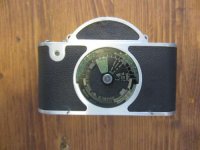
Univex Mercury II or Universal Mercury CX or Universal Mercury II

Hello,

My name is Pascal and I live in the South of France . Excuse my mistakes vocabulary or grammar.
I am French and fan of Mercury. I have two copies : two Mercury ii.
I also have the rangefinder , the flash bulb but I think I miss the sync cord to the flash. I 'm not sure.
I do not know what more you need to use batteries for the flash. Or even the camera settings with this flash. I started in the film.
You see I have some questions. Maybe you can help me ?
Is that you have used your mercury with an electronic flash. I saw that it was possible, especially with a Canolite D (after some minor adjustments). I refrence to this site : http://www.cosmonet.org/camera/mercury1_e.htm
Is what we can only use the speed 1/20s with Mercury and an electronic flash? It requires use of a tripod ? Did you know ?
Using another electronic flash?
It seems complicated to use Canolite. Perhaps you find you easier ?

I love this camera so special !

Thank you for listening and your answers.
Happy New Year 2014!
 
Dear Pascal,

It's great to hear of another enthusiast having discovered the beauty of this remarkable camera! To answer at least some of your questions:

The original Mercury Flash Unit uses standard "Penlite" (AA Size) batteries, available everywhere today. As the Mercury was the first camera on earth fitted with a "hot shoe", no sync cable is required. The unit connects to the camera via the round contact in the middle of the front accessory shoe. There are no special camera settings required for flash operation - the rotary shutter is automatically synchronized at all "speeds" (i.e. rotor opening positions) via a special cam attached to the rotor).

However, using the Flash Unit today would require supply of the "press type" flash bulbs it is designed for. These bulbs were very expensive in the 1940's, and surviving unused examples are collectible, so firing one is literally a waste of money. Of course, these are single-use bulbs - each one fires once and is thrown away afterwards.

Using a modern electronic flash on the Mercury requires the use of a simple adapter aligning the ancient Mercury "hot shoe" contact with the slightly different position of a modern standard hot shoe. However, the "timing" of a modern flash differs from that of the old "press type" bulbs. If the contact is closed, a modern electronic flash fires immediately and lights up for a very short time. The old bulbs needed some fractions of a second to light, but burned significantly longer. As the built in synchronization arrangement of the Mercury is adjusted to these bulb parameters, a modern flash will light up too early at most speed settings - the flash fires before the slit in the rotating shutter reaches the film plane, and does not last long enough to illuminate the whole exposure. Therefore it will work only at 1/20s, as at this "speed", the rotor is fully opened, avoiding the described effect.

In my opinion, the best workaround is adapting a more modern condensator bulb flash to the Mercury - the small Philips flashbulbs are easily found on eBay, and there were types similar in parameters to the old "press type" bulbs, so this should work (I have not tried it myself so far with a Mercury, but successfully with other classic cameras).

Regards,

Accursius
 
I recently acquired a Mercury II in "typical" condition. The metal is oxidized like they all are, but all of the cosmetics including the rear exposure disc and the film reminder are in excellent shape. The lens is in good shape and both the focus and aperture rings turn smoothly. I was able to remove the front glass of the viewfinder and clean inside and now the viewfinder is pristine.

After opening the rear film compartment and test firing the shutter a couple of times to see if it worked, I initially thought my shutter was bad because it moved very slowly.

But then I read this thread that the orientation of the camera can affect the shutter speed, so I made it a point to hold the camera upright (rather than pointing the lens down like you would while looking inside the film compartment), sure enough the shutter moves freely. I tested all the speeds and they look accurate (to the naked eye that its), even B and T worked as intended.

So my question is, is this just a characteristic of this camera? If I feel confident that the shutter speeds are accurate while holding the camera in a normal way, is it worth tearing it down to clean the mechanics of it? Or does the slow shutter while pointing down indicate a looming problem with using this camera?

Question two, I have found a ton of info saying that the Mercury II was introduced in 1945 after WWII, but nothing saying how long they were sold for. The serial number on mine is 86334. Does anyone know if there is a way to date these cameras by the serial number, or at the very least, estimate when they stopped making them?

Im pretty excited to begin shooting wiht this camera. Part me of wants to fully restore it, polish out all the metal and re-leather it, but on the other hand, I think the oxidations gives it a cool rustic look!
 
Probably no need to do any disassembly if your shutter is basically working ok. If you take off the lens and hold open the shutter on the T setting you can easily brush some lighter fluid onto the easily accessible gears.

There is a very good book on the Universal Camera Corporation by Cynthia A. Repinski. I got mine on ebay for 25 bucks and the first page was signed by the author. She says that the Mercury II was first marketed in December of 1945. "Approximately 150,000 Mercury II cameras were sold the world over during the period 1946 through 1952."
 
Probably no need to do any disassembly if your shutter is basically working ok. If you take off the lens and hold open the shutter on the T setting you can easily brush some lighter fluid onto the easily accessible gears.

There is a very good book on the Universal Camera Corporation by Cynthia A. Repinski. I got mine on ebay for 25 bucks and the first page was signed by the author. She says that the Mercury II was first marketed in December of 1945. "Approximately 150,000 Mercury II cameras were sold the world over during the period 1946 through 1952."

Thanks for both pieces of info. I will try taking a stab at getting some Ronsonol on the gears with the shutter open.

Based on the info in your book, if there were approx 150,000 sold, and mine is numbered 86,334, its not a stretch to think that mine was made a little more than halfway through the production run. So a broad guesstimate would be that mine could have been made around 1949.
 
Unfortunately, it is not possible to estimate the date using your method, as the Mercury II serial numbers did not start with "000001". The situation is somewhat more complicated:

When Universal introduced the original Univex Mercury (CC) in 1937, the serial numbers started with "00,001". Early examples in the 00,05x range are known to exist in collections. Until the end of production in 1942, about 45.000 were made, being numbered consecutively.

In 1939, the famous, short-lived Mercury CC-1500 appeared, being introduced by Universal at the New York World Fair. These spectacular cameras (less than 3.000 were made) were given separate serial numbers beginning with 100,001. Examples with 102,xxx numbers are known to exist.

The Mercury II (CX) was first shown by Universal in several 1944 newspaper ads, but not made in relevant quantities until the end of WWII in mid-1945. The CX prototype shown in the CX user manual bears the serial number 046,000; the earliest CX production examples known to exist are in the 046,4xx range. When numbering reached 99,999, Universal left out the numbers given to CC-1500 cameras and continued with 103,xxx. The last CX cameras made in 1952 had numbers in the 190,000 range.

Additionally, it must be considered that during the first production years (1945 - 1948) more CX cameras were made and sold than in the later period until 1952, as Universal was slowly getting into financial trouble.

Your CX 86,334 is, therefore, quite an early example, possibly made in 1946 or 1947. You may verify this by examining the bottom of the camera - on early CX examples, you will notice a flat surface with several circular insertions, while on late examples, the bottom shows three little "feet".
 
Just looked at mine, and the Serial # is 62308.

Ekmanmj, the shutter spins at a single constant speed. What determines the length of exposure is how wide the shutter vanes are set apart. So even if the speeds look good enough, there could be some drag on the mechanism that would then make all the speeds slow. This occurs when the trap lever actuator starts backing out of it's mounting hole, which it is just pushed into like a stave. The shutter vanes then drag on the lever. Old grease on the gears also can slow down the shutter. I used some white lithium to relube mine, but if I ever fix another one I'll use Super Lube.

PF
 
I would recommend to use ball bearing lubrication grease instead (this is what I use myself). Liquid lubrication fluid tends to be spread by the shutter rotor inside the whole camera, including the back element of the lens (not recommendable, especially if you have one of the rare types mounted, i.e. the Hexar f2/35 or the Telecor).
 
The Mercury has interchangeable screw mount lenses, so filter size depends on the lens you are referring to, of course. The most common standard lens (Universal Tricor 2.7/35) has an E25.4mm filter thread (1.0 inch, in other words). The filters sold by Universal themselves for this lens are A27mm clip-on filters, however. The same applies to hoods. Third party E25.4 screw-in filters and lens hoods are rather common, as the same size was used by Kodak and several other camera makers as well. On my "everday use" CX, I use a modern Hoya E25.4 UV filter to protect the lens.

The less common Universal Tricor 3.5/35 should be the same size, I think, as the lens barrel is the same.

The pre-war Wollensak Tricor and Hexar lenses do not have any filter thread, so only clip-on filters may be used. The Telecor does have one, but I am not shure about the diameter.
 
Unfortunately, it is not possible to estimate the date using your method, as the Mercury II serial numbers did not start with "000001". The situation is somewhat more complicated:

When Universal introduced the original Univex Mercury (CC) in 1937, the serial numbers started with "00,001". Early examples in the 00,05x range are known to exist in collections. Until the end of production in 1942, about 45.000 were made, being numbered consecutively.

In 1939, the famous, short-lived Mercury CC-1500 appeared, being introduced by Universal at the New York World Fair. These spectacular cameras (less than 3.000 were made) were given separate serial numbers beginning with 100,001. Examples with 102,xxx numbers are known to exist.

The Mercury II (CX) was first shown by Universal in several 1944 newspaper ads, but not made in relevant quantities until the end of WWII in mid-1945. The CX prototype shown in the CX user manual bears the serial number 046,000; the earliest CX production examples known to exist are in the 046,4xx range. When numbering reached 99,999, Universal left out the numbers given to CC-1500 cameras and continued with 103,xxx. The last CX cameras made in 1952 had numbers in the 190,000 range.

Additionally, it must be considered that during the first production years (1945 - 1948) more CX cameras were made and sold than in the later period until 1952, as Universal was slowly getting into financial trouble.

Your CX 86,334 is, therefore, quite an early example, possibly made in 1946 or 1947. You may verify this by examining the bottom of the camera - on early CX examples, you will notice a flat surface with several circular insertions, while on late examples, the bottom shows three little "feet".

Wow, thanks for all of the good info!

I looked at the bottom of mine, and there are definitely no "feet". I do have 3 circular things, all on the side of the camera with the rewind knob and film counter.

It's good to know that mine is an early-ish model, as my collection is rather short of 40s cameras. I have a bunch from the 1950s, and I like telling people that this camera is from the 1940s! 🙂

As for shutter speed accuracy. See the new thread I started with some pictures. I shot everything using Sunny 16. and the exposures look accurate to me. If they're off, its such a small amount, it makes no difference outdoors.
 
I cleaned-up my Mercury II last evening, and got the shutter running pretty-good.

Will probably run a roll through it next week... I kind of miss those 12 exposure rolls of 135... 😉
 
Hi everyone, I'm new to the group. I've been collecting cameras for a few years now. I have a Universal Mercury II CX serial number 43126. I have a second Mercury II CX that has leather in place of a back plate, so there is no serial number available. This one has the three "feet" on the bottom of the camera. I'm trying to figure out when the "feet" were added to determine the possible serial number run it may be part of. Any suggestions?
 
Hi everyone, I'm new to the group. I've been collecting cameras for a few years now. I have a Universal Mercury II CX serial number 43126. I have a second Mercury II CX that has leather in place of a back plate, so there is no serial number available. This one has the three "feet" on the bottom of the camera. I'm trying to figure out when the "feet" were added to determine the possible serial number run it may be part of. Any suggestions?

I haven't been able to find any conclusive evidence regarding when those "feet" started to appear. As a matter of fact, the best information about serial numbers is in this thread by Accursius.

I have the Univex Story by Cynthia Repinski and she doesn't even get into much detail about the serial number history of the Mercury II.

Mine is 86,xxx and it does not have the feet, so the only conclusive info I can give you is that it's after that.

Good luck, and if you ever find anything conclusive, come back here and let us know.
 
Hi everyone, I'm new to the group. I've been collecting cameras for a few years now. I have a Universal Mercury II CX serial number 43126. I have a second Mercury II CX that has leather in place of a back plate, so there is no serial number available. This one has the three "feet" on the bottom of the camera. I'm trying to figure out when the "feet" were added to determine the possible serial number run it may be part of. Any suggestions?

Welcome to the Forum, Brand. Could it be possible that a previous owner just put some leather over the back plate, instead of removing it first? But then leather covering would be an indication of the back plate missing as it would then cover up the screw holes.

PF
 
Hi everyone, I'm new to the group. I've been collecting cameras for a few years now. I have a Universal Mercury II CX serial number 43126. I have a second Mercury II CX that has leather in place of a back plate, so there is no serial number available. This one has the three "feet" on the bottom of the camera. I'm trying to figure out when the "feet" were added to determine the possible serial number run it may be part of. Any suggestions?

Something just occurred to me. Is it possible that you have the Univex Mercury CC (the first model)? The CC had leather on the back part of the "hump" instead of the serial number plate like on the CX. The easiest way to tell the difference between the CC and CX is that the CC has the word "Univex" on the front, and the CX does not.
 

Attachments

  • Univex.jpg
    Univex.jpg
    23.8 KB · Views: 0
Back
Top Bottom