W/NW History

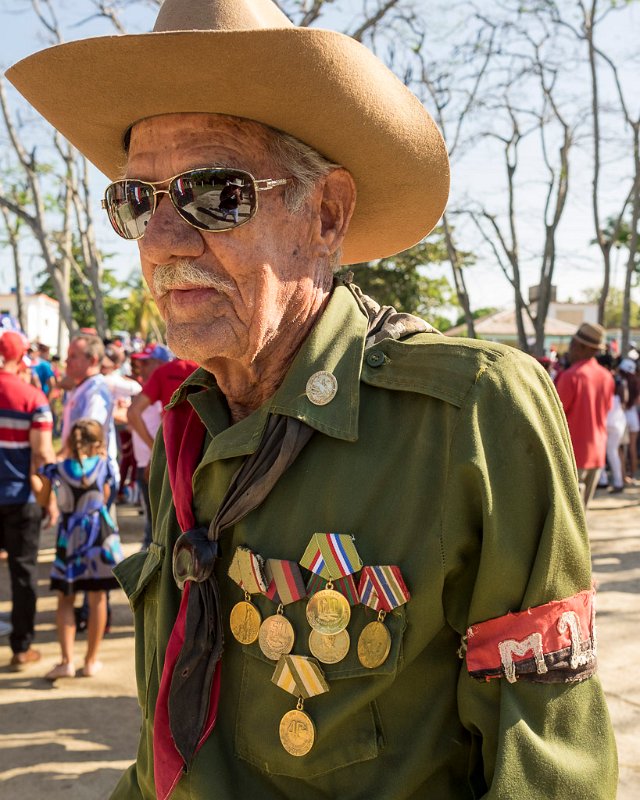
Cueto, Cuba 2019 - living history. Raul Bayarte's homemade armband reads "M-26-7" which was the official designation and uniform for the "26th of July Movement" now referred to as the Castro led Revolution that deposed the dictator, Batista, in 1959.

DSCF3385.jpg
 
A memorial in the Chapel Hill cemetery, Troy Michigan, to the 339th Infantry Regiment (Polar Bears) who were sent to Russia in 1918 as part of an unsuccessful Allied effort to defeat the Russian communists.


The 339th Regiment was created in June 1918, composed mainly of young draftees, for the purpose of fighting on the Western Front in France. Most of the 4,487 men were from Michigan, but some 500 draftees from Wisconsin were included. It was commonly referred to as "Detroit's Own". They were sent to fight the Bolsheviks in Northern Russia. They were nicknamed the "polar bears" because of their service there.


2020-05-25 Chapel Hill FED-2 Colorplus 200 Industar 50-35 000303350015.jpg

FED-2, Industar 50 3.5/50, Kodak Colorplus 200
 
Raul Bayarte - combatant in the 26th of July movement, the official name for the Castro led revolucion that deposed the Cuban dictator Batista in 1959. He fought in the Secundo Frente with Raul Castro (Fidel's brother) as his commander. I cherish the times we spent over some rum with him casually telling me about those times. Sadly he died early this year. To me, this is history.
Raul square.jpg


The Hung King Temple in Saigon has a peculiar colonial history: inaugurated in 1929 under the tutelage of the French administration to remember 12,000 Vietnamese soldiers who died in the trenches 'for the glory of France' during WW I. The French thought it was sufficient to honor the dead with a statue of a French General on horseback in a Saigon square but the Vietnamese thought otherwise. The Hung King Temple became the compromise where Vietnamese family members could honor their dead, instead.
 
Last edited:


Ho Chi Minh is one of the enigmatic men of the 20th Century. As is the problem with enigmatic men, fact and fiction tend to intermingle. For an intriguing and revealing biography have a look at William J. Duiker: "Ho Chi Minh: A Life". Duiker, a former US Foreign Service Officer and Professor of Asian history spent 30 years delving into Vietnamese and European archives, as well as interviewing Minh's surviving colleagues in order to write a definitive biography. Cheers, OtL
 
Last edited:
How about some history in the form of old negatives? Here's a glass plate 4X5 an old friend of mine from New York gave me a few years ago.

It's a view across the Hudson River from the New Jersey side looking towards Manhattan. That's the U.S. Navy's Atlantic Fleet laying at anchor, at least a good portion of it, about a month before the US declared war on Germany.
Atlantic Fleet Hudson River 1917.jpg

Here's a detail from the edge. Looks like November 2, 1917. The US declared war December 7, 1917.
Hudson_Fleet_Detail_web.jpg


And from the same stash of plates is the image below of a group of people. This appears to be the parents of the two younger ladies and their husbands. Could the photographer in this image be the one who snapped the photo of the fleet? Hint: Packard Shutter.
Folks.jpg
 
IMG_4153.jpeg
HERE FORMERLY STOOD

GRIFFINS WHARF

AT WHICH LAY MOORED ON DEC. 16,1773, THREE BRITISH SHIPS WITH CARCOES OF TEA TO DEFEAT KING GEORGE'S TRIVIAL BUT TYRANNICAL TAX OF THREE PENCE A POUND.

ABOUT NINETY CITIZENS OF BOSTON, PARTLY DISGUISED AS INDIANS, BOARDED THE SHIPS THREW THE CARCOES, THREE HUNDRED AND FORTY TWO CHESTS IN ALL, INTO THE SEA, AND MADE THE WORLD RING WITH THE PATRIOTIC EXPLOIT OF THE

BOSTON TEA PARTY

"NO! NEER WAS MINGLED SUCH A DRAUGHT IN PALACE, HALL, OR ARBOR, AS FREEMEN BREWED AND TYRANTS QUAFFED THAT NICHT IN BOSTON HARBOR​
 
This is the northern terminus of The Stevens Carrying Place, Just about a third of a mile down the shore from our house. It opens onto Merrymeeting Bay and accesses the Kennebec and Androscoggin River watersheds, in addition to 3 smaller rivers that empty into the Bay Estuary. This was the entrance to a mile long portage or "carry" that was used by native Americans for probably thousands of years up through the 18th century. It was one of the shortcuts that cut many miles and days out of the water trip from inland Maine and Canada to the midcoast of Maine, a trip that was part of an annual migration to summer and winter areas as the weather and wildlife/fishing changed during the year. The picture was taken at low tide and the tidal channel through the wild rice, known locally as a guzzle, is open in the summer for small boats right up to the landing place on the shore at all tides. In the distance you can see the area where the Kennebec River meets the inland Bay. This was a wonderful place for fishing, hunting and waterfowling, and ancient weirs are still visible at extreme low water

This spot was also thought to be the homestead of one of the original European settlers in the area in the late 1600's, for whom the carry was named by whites, though I am sure the natives called it by their own name. There is a long history of both cooperation and conflict that occurred here and further up the rivers, and this was a chancy place to live for these early pioneers and deaths and capture were common. Some of the history has been looked into by the local Merrymeeting Pioneers Project, and an interesting website exists describing their archeological work at this spot and others around the Bay. Also interesting is the website of Friends of Merrymeeting Bay, an organization that I belong to whose goal is to educate about and conserve this unique estuary.

Later in the 1800's into the early 1900's this spot was homesteaded by a family called the Harrisons, who were part of a community of pre civil war free blacks who settled this whole side of the Bay from Brunswick to the Kennebec River where it exits the Bay at a place called the Chops. Just up the bank at the right is a small overgrown cemetery where the Harrisons are buried. They were relatively well off and even had white servants. The second picture is of the foundation of the house they lived in, and you can see by the size of the trees growing inside that it has been a while since they left for better situations or perhaps just married/blended into the local populace around 1900. Our own house is built on land once owned by a free black family named the Hills, and I have traced them back to a slave named Sandy Hill of one of the early Europeans.

I come here often by boat and trail to enjoy the beauty of the place and to try to imagine who has passed through this spot over the centuries.

Olympus C-750 with WCON-07 wide converter
P7150019.jpg

P7150020.jpg
 
Last edited:
Back
Top Bottom