What is the best non-commercial scanner on the market right now?

jordanatkins

Established
Local time
10:54 AM
Joined
Aug 22, 2012
Messages
108
Location
California
I currently have an Epson V500 which is fine for scanning my grandpas old slides and making DVD slideshows, but I'm looking into going primarily film again and I'd like to have a scanner that can enlarge 35mm to large print sizes in the best quality possible.

I guess I just missed the Nikon coolscan 5000 that was in the classifieds. I would have bought that, but now that I think about it, they are no longer manufactured and who knows how long Nikon will offer support for them.

So, what scanner (short of a drum scanner or other commercial grade scanners) will give me the best quality possible?
 
One of the Plustek would be your best bet. I had one briefly and think it does a good job and is current and runs on current OS and software. Many of the really good scanners are old, hard or impossible to repair and only run on old OS and hardware. Modern machines like the Hassblad are big bucks.

On the Large Format forum there is a fantastic Imacon / Hasselblad 343 for under $3k. I have no connection to the sale but had one for several years and think it one of the best. Hasselblad doesn't currently make that model but they still service them and software is free and excellent and runs on current OS. I have an Imacon 848 and could not be happier.
 
The Nikon 5000 and 9000 have been out of production for a few years now.

If you are looking for new high end scanner you really only have three choices.

If money is not object the Hasselblad X1 and X5 are the ultimate, short of the best drumscanners out there. But they cost as much as a compact car.

After that I would have to say that the Plustek 120 is the current top dog that is priced for mere mortals. I believe they are around $2000

Below that there is a mix of the 135 format scanners from Plustek and a few others.

http://www.filmscanner.info/en/FilmscannerTestberichte.html
 
The Nikon 5000 and 9000 have been out of production for a few years now.

If you are looking for new high end scanner you really only have three choices.

If money is not object the Hasselblad X1 and X5 are the ultimate, short of the best drumscanners out there. But they cost as much as a compact car.

After that I would have to say that the Plustek 120 is the current top dog that is priced for mere mortals. I believe they are around $2000

Below that there is a mix of the 135 format scanners from Plustek and a few others.

http://www.filmscanner.info/en/FilmscannerTestberichte.html

Thanks for the link! Looks like the Plustek 8100 is the way to go right now, it's still available and looks like it slightly outperforms the new 8200. And I never use hardware dust removal anyway.

Still kinda wish a Nikon would come my way though, these scanners look fragile...
 
I can vouch for the Nikons, I have a V and a 5000. The V has been to three continents with me, once in the cargo hold, and twice as carry on (always well protected, of course), and it has yet to skip a beat.

Have not tried any of the plusteks or any other options other than a couple of epson/hp flatbed which were quickly dismissed for 35mm film. I would look at comparisons between the V (which can be had for quite a bit less money than a 5000 and is essentially the same scanner) and the plusteks you are interested in.
 
If I was only using 35mm, I'd probably look at the Pakon scanners, can't vouch for the quality, but the speed is very tempting.

For quality, and current availability, the Plusteks look good.

For me, I shoot mostly medium format, and a bit of 4x5, so the Epson V700 makes sense for me. I don't doubt that Imacon and drum scans are better, maybe significantly better. But if you only keep half the detail from a 4x5 slide, then you still have more detail than you'll know what to do with.

I think, for me, a V700 will do everything I need. If I were to take some amazing shot that I wanted to make the very best of, then I could send it off for a drum scan. I don't shoot enough negs, and certainly don't shoot enough quality negs to justify an investment in a drum scanner or Imacon.
 
If you can get past the irony of using a DSLR to "scan" your film then the rigs are promising... and have been "right around the corner" waiting for their "inventor" for 5-6 years now. I think the problem is that building a decent X-Y-parallel macro rig is $$$ hardware and the market is shrinking for expensive scanning. Still, I think it would be a good professional product for museums, governments, and fussy photographers.

In practical "today" terms, a used Nikon isn't a bad idea since they were built robustly and it's likely you could get another five years out of an average one. I used cheap, disposable Minoltas but over the last decade I could have bought a couple of Nikons and wish that I had, but the used Minoltas make decent scans and have a low cost entry point. One point is that I prefer the look of the Minolta scans, which retain grain structure, to the Nikons which tend to smooth things out so your scans look like DSLR images. But I never spent much time experimenting and I am sure the Nikon is still the better unit.

Feeding the Plustek scanner one at a time would drive me batty and those scanners just look cheap. And that's coming from a Minolta user! ;-p Seriously though you have to judge your workflow and patience, the prior consumer film scanners did batches of strips because you shoot more 35mm than larger formats, and scanning entire rolls one-at-a-time is a recipe for burnout.

Vue-Scan makes old scanners usable with new OSs and works great once you figure it out. The OEM scanner software never won any love, Nikon and Minolta bungled their scanning apps every time.

There is also the opportunity to simply send your film out and having them make scans for you... lots of people like them. There are even cheap offshore places that apparently produce good results with cheap hands-on labor if you really want to get down and dirty.

Keeping an Epson flatbed with a page-sized transparency scanning unit in the lid is a good idea (V700, 750, 4990) because you can scan entire contact sheets to pick the images worth getting better scans for (if any). So even if I had a better scanner, I'd still want my flatbed for proofing.

Finally, for as nice as an Imacon is, they are optimal for medium format and scanning 35mm on them is tedious. Aztek still makes and services drum scanners but then you are talking about lifestyle choices ;-p
 
Thanks for suggestions guys! (except those suggesting the Hasselblad scanners, obviously you didn't fully read my first post very well).

I originally would have liked to step up to an Epson V700/750 because you can put a whole 24 exp. roll on the tray at once. However, I keep reading that the actual resolution these things produce is nothing near the 6400 dpi they tout. More like 2400, where as the newer plusteks are pushing at least 3200. However with those you are stuck scanning 6 frames at a time. Gah!

Also, none of these newer scanners seem to have as good a dmax as they claim on the box. Everything seems to fall flat compared to the old Nikons.

I'd like to get good ~24 megapixel scans from my scanner so I have the freedom to enlarge my images to a decent size.

Man I wish Nikon would come back into the scanner market, or someone as good. I still wouldn't mind having a coolscan, but I'm afraid these babies have a limited life in them, and there's no replacing them once they break.

So many choices...


P.S. - I just realized that I posted this in the wrong forum, sorry mods! There's so many categories I get lost sometimes, lol
 
I still wouldn't mind having a coolscan, but I'm afraid these babies have a limited life in them, and there's no replacing them once they break.

I've opened one up to clean, it's a very simple machine, and unless there is catastrophic failure of one of the components, I'm confident it will keep on chugging along. It feels, sounds, and operates as if it were really built to last. I've also heard Nikon still services them.

Last scan I got was 5616x3728 @ 40mb from a tri-x frame with considerable pp latitude. I've printed these as large as 40x60cm, holding up to close inspection. I'm not sure there's anything out there right now that covers the bases as well, with the same desktop footprint.

I second Frank's suggestion of a flatbed for proofing, if that's a step you want to take.
 
I wouldn't worry about a used Nikon Coolscan from a reputable seller, somebody will fix them if not Nikon. And there is a large user base so at least Vue Scan will continue to run them for many years.

You could proof on a flatbed and send out to a service... offshore places like http://www.scancafe.com/ have a good rep and I think they use Coolscans. Of course the domestic vendors are better to use but if you need to save money....

I wouldn't worry about the resolution specs on scanners at all, or any of their stated specs. I think they make the numbers up and there is no consistency between brands... you pretty much go by word of mouth/reputation/experience. None of them are magic.
 
I originally would have liked to step up to an Epson V700/750 because you can put a whole 24 exp. roll on the tray at once. However, I keep reading that the actual resolution these things produce is nothing near the 6400 dpi they tout. More like 2400

Hello Jordan,

don't know if you had a look at my reviews (in italian but plenty of charts/crops):
http://www.rangefinderforum.com/forums/showthread.php?t=137811

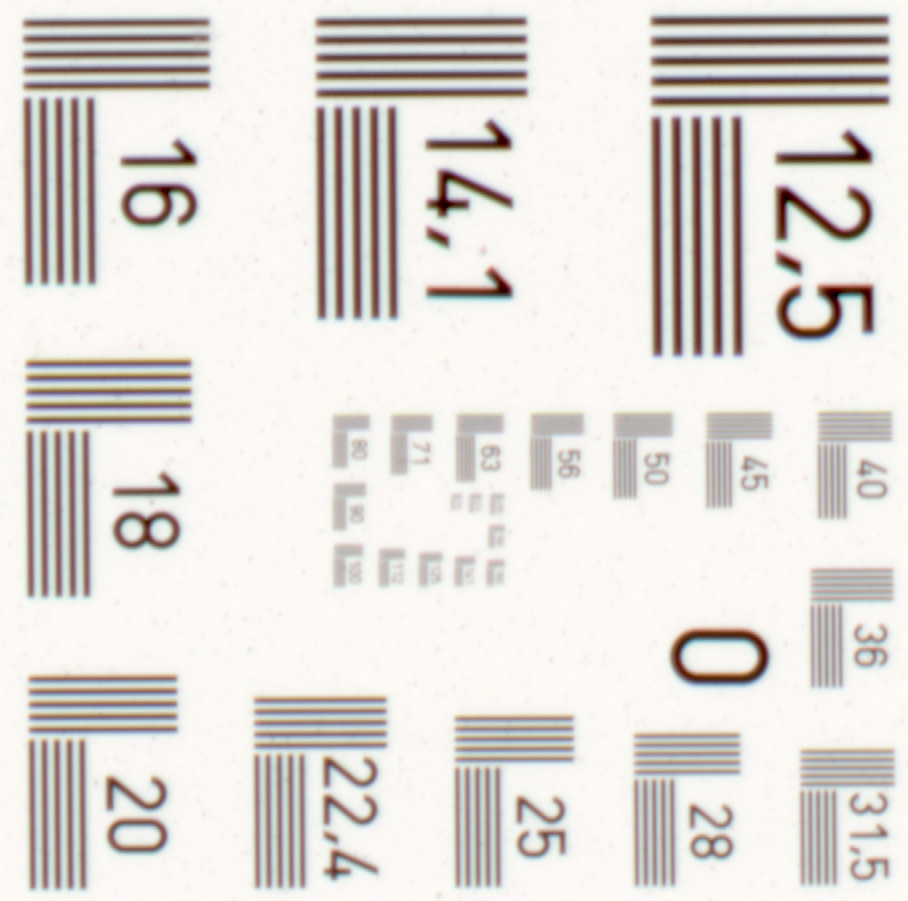
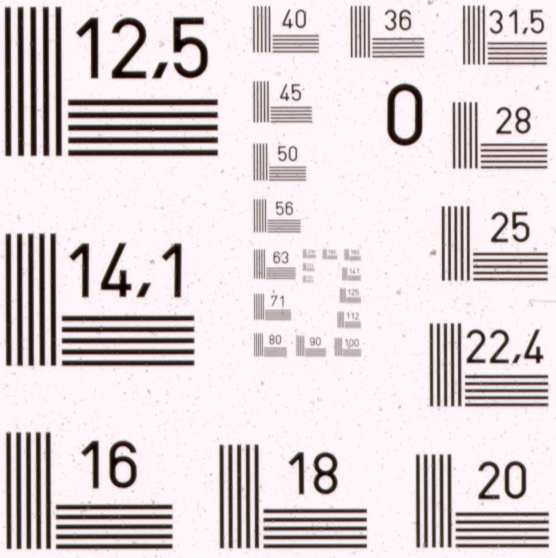
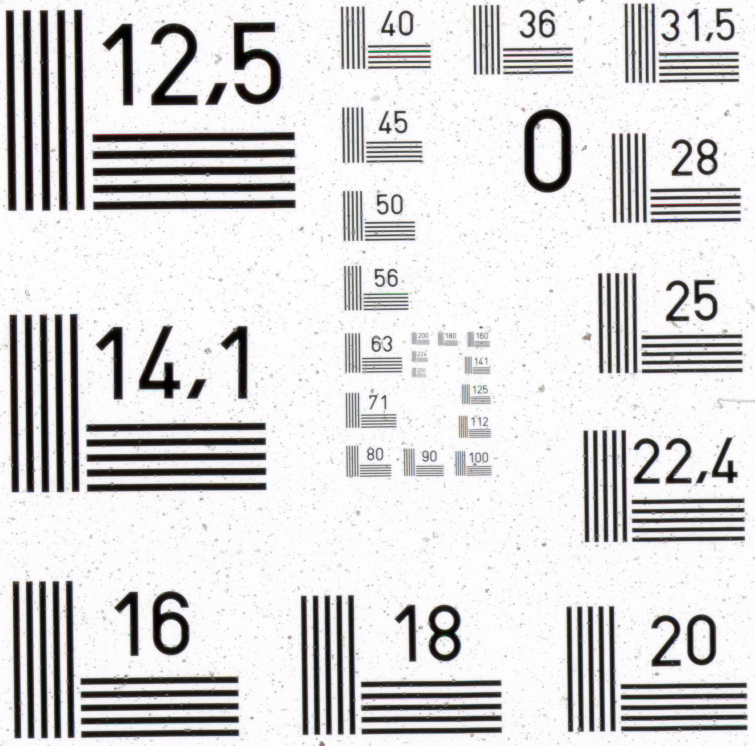
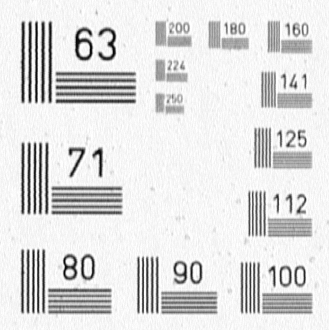
anyway to summarize, this is a resolution chart from the V700 (using adjustable-height holders), at 6400x6400. Numbers indicate resolving power in line pairs/mm (chart is FSR-1T from Danes-Picta)

6400crop-hipowerlens.jpg


This is the same chart, scanned on a Nikon 8000 (same as 9000, resolution-wise):

fsr1-centro-nosharpen.jpg


And now the impressive Minolta 5400:
fsr1-centro-gd-1x-noir.jpg


I'll close with the drum scanner Scanmate ScanView 11000 (center part only), just for reference:

262_516987737024b.jpg


Hope this helps putting things in perspective.
Please disregard the different white balance.

Yes the V700 is interesting: it's cheap, easy to use and quite fast; but I wouldn't consider it for 35mm.
4x5", very good; 120, so and so; 35mm, just for small prints, IMO.

Fernando
 
I'm surprised no one has really mentioned the Minolta Scan Dual series. A Scan Dual III or IV can be had for around $200 and gives quality better than the v700, about equal to the 35mm Plusteks. They are not serviced anymore, but you could buy a spare and still be under the cost of a v700.
 
V750

V750

The wheelbarrow was taken with a Balda Baldini and Heidi was taken with a Nikon FM2. Both scanned on an Epson V750 using just the Epson software and finished up in PS. Nothing spectacular done. Except for 4X5 just got back into small format film and these were just fooling around seeing what I could do. I have a few 120's taken with an Agfa PB20 and my 4X5 scanned and handled the same way but haven't converted them to .jpg yet.
 

Attachments

  • Balda T1004800012.jpg
    Balda T1004800012.jpg
    54.1 KB · Views: 0
  • Heidi-5.jpg
    Heidi-5.jpg
    50.9 KB · Views: 0
If I was only using 35mm, I'd probably look at the Pakon scanners, can't vouch for the quality, but the speed is very tempting.

I just got a Pakon and here is my take on it.

It is insanely fast. You can scan an entire roll of 36 frames in about 2 minutes at 3000x2000. The kodak color science is pretty incredible and the new v3.0 software update will now support real black and white film.

But the scans are only 8 bit.

My take is this. It's genius for making 'digital contact sheets' of large quantities of film or being able to send a client proofs in no time at all. I don't see it as a primary scanner, because it only outputs 8bit images. So, I preview on the Pakon and then make final scans on my Nikons.
 
I just got a Pakon and here is my take on it.

It is insanely fast. You can scan an entire roll of 36 frames in about 2 minutes at 3000x2000. The kodak color science is pretty incredible and the new v3.0 software update will now support real black and white film.

But the scans are only 8 bit.

My take is this. It's genius for making 'digital contact sheets' of large quantities of film or being able to send a client proofs in no time at all. I don't see it as a primary scanner, because it only outputs 8bit images. So, I preview on the Pakon and then make final scans on my Nikons.

I didn't know they were only 8 bit (I assume per channel (!)), but I guess that's enough for simple proofs, as you say.
 
Back
Top Bottom