What lens length is considered 'normal' with a RF camera?

Finder said:
The definition of "normal" is very simple - it is a focal length equal to the diagonal of the image area. In that case, it is 43mm for a 35mm camera regardless of the type of camera.

The 35mm format is ~24mm X 36mm.......a bit of an oddball since it doesn't fit standard paper formats. When you take into account the usable part of the negative to fit 8" X 10" paper, the diagonal of the "usable" image area is ~38mm. That's probably why 35mm lenses are such a good fit as "normal" lenses on 35mm cameras.
 
35 to 50mm

35 gives you what you see, 50mm gives you what you are looking at
(I think Ralph said that once and it has stuck with me.)

I prefer the 50mm lens for at least 90% of my photography. It's narrower field of view allows me to more easily isolate my subjects and to leave out distracting elements from within the frame.
 
ElrodCod said:
The 35mm format is ~24mm X 36mm.......a bit of an oddball since it doesn't fit standard paper formats. When you take into account the usable part of the negative to fit 8" X 10" paper, the diagonal of the "usable" image area is ~38mm. That's probably why 35mm lenses are such a good fit as "normal" lenses on 35mm cameras.

That has nothing to do with the definition of "normal." You can equally say the negative is more important than the paper and print full frame by "wasting" a little paper space. Or you can take a fisheye lens and crop the image down to a 52 degree angle of view and say that is "normal." And what do you do when you post on the web or have a slide show? Do you crop or mask down to 8x10 proportions? Defining normal based on how something is displayed won't work as some folks crop and some don't. "Normal" refers to lens focal length and not based on how someone may or may not display an image. (Just as lens magnification is defined by object to image size at the image plane regardless of printing size as that cannot be known.)

I did not come up with the definition of "normal." If folks perfer using a wide-angle lens like a 35mm for most of their work, that is fine. It can even be a good recommendation. But that does not change the meaning for the term "normal." I understand the poster wanted to know what "normal" meant. The definition is clear.
 
SuitePhoto said:
Now here's the question: does a 35mm SLR and a 35mm RF have the same field of view at a given lens length? I have read that the film plane on a RF camera is generally closer to the lens than a 35mm SLR - does this have any noticeable effect?
For a given focal length, the field of view is the same for an RF as for an SLR. (Thanks to retrofocus design, short focal length lenses may be positioned as far from the film plane as necessary in order for the mirror action to clear the lens. The focal length of a lens is still the distance from the film plane to the rear lens node, but the rear node is an optical position which may be closer to the film plane than the physical lens itself. The field of view is determined only by the focal length and the size of the negative. Many rangefinder lenses are also retrofocus.)

A 'normal' lens for the 35mm format has a focal length of 43.2666153056...mm. 😉

Richard
 
sounds to me like you are worried about distortion. with a fixed focal length lens you will experience much less distortion than you see with your zoom. I personally am a 50mm guy, but often shoot with a 35. like in the othwr thread I think the bessa kit and william's canon 50 is a great kit.
 
SuitePhoto said:
<snip>
I want to be able to use the camera while sitting at a dinner table with friends - not for group shots, but for candid shots of individuals. And my worry is that the 35mm will give that 'warp' feeling that I'm not a fan of.
<snip>
For single individuals round a dinner table I'd guess 75mm to 90mm, depending on the size of your dinner table and how much you want to include around them. With a 50mm you can probably get groups of two, even three people.
Normality, like some other things, is in the eye of the beholder. I think you are on the right track saying what sort of shots you are after. We can suggest what's suitable for the purpose then.
 
So 50mm it is! Thanks for the help!

But now that I've made that decision, I'm starting to look around at 50mm lenses... (the headache continues...) I'm aware that CV makes very good lenses, but unfortunately not exactly what I'm looking for... I'd like something fast, f/2 or faster for night shots, but at the same time small - part of the reason I'm getting this camera is that I'm tired of lugging my 6 lb SLR beast around! The little 50mm f/2.5 is a tad slower than I'd like, but the CV 50mm f/1.5 is bigger than I would like to lug around the city for day.

So that got me looking at older Lecia and Canon lenses on ebay and else where... My main concern is that I will loose the rangefinding ability through the viewfinder (as both the CV 50mm lenses do) by going with an older Lecia such as a 50mm Summicron or Summarit.

And this is my first time buying an older lens - what is acceptable? A 'little haze', or 'slight cleaning marks on the front element'? I will be using this lens, and not really concerned with cosmetic issues as long as it takes good pictures. Are there any known combos of Bessa R and Lecia lenses that work well? Thanks for the help guys!

 
SuitePhoto said:
So that got me looking at older Lecia and Canon lenses on ebay and else where... My main concern is that I will loose the rangefinding ability through the viewfinder (as both the CV 50mm lenses do) by going with an older Lecia such as a 50mm Summicron or Summarit.
Not quite sure what you mean here, but it sounds like you think the CV 50mm lenses are not RF coupled, and worry that older Summicrons and Summarits would also not be rangefinder coupled... Please be assured they all properly couple to the camera's rangefinder, even if they're screw-mount lenses adapted to an M-mount body. Three CV lenses are uncoupled; the 12, 15, and 25mm only.

"Small" and "Fast" are both worthy attributes for a lens, but contradictory. Yet there are some lenses that seem to manage some degree of both, such as the Voigtlander 40mm f/1.4 Nokton, and the 28mm f/2 Summicron. As far as a compact 50mm, if you can handle the f/2.5 aperture, the CV lens is a gem.
 
My main concern is that I will loose the rangefinding ability through the viewfinder (as both the CV 50mm lenses do) by going with an older Lecia such as a 50mm Summicron or Summarit.

The Bessa R uses a standard for lens rangefinder coupling that Leica introduced in the 1930s. Canon, Nikon, and host of other manufacturers have also made lenses and/or camera that met the same standard. Don't worry that the CV lenses use some CV-specific technique to let you find the range through the viewfinder. Any 50mm lens from the past 70 years that purports to be LTM or Leica screw mount will work with your Bessa R for rangefinding through the viewfinder.
 
Great! That sounds like the ticket for me. Now is there one Leica model that is preferable over another?

I've been seeing a lot of the 50mm Summitar f/2, 50mm Summicron f/2, and the 50mm Summarit f/1.5. Any suggestions? Also, what is considered acceptable wear? Is a 'little haze' considered to be ok? Are there models that I should stay away from?
 
what is acceptable? A 'little haze', or 'slight cleaning marks on the front element'? I will be using this lens, and not really concerned with cosmetic issues as long as it takes good pictures. Are there any known combos of Bessa R and Lecia lenses that work well?

"Slight cleaning marks" are usually not a problem, especially if they're on the front, and not the rear. Haze can reduce contrast and make colors less vivid, and it can cause flare to show up a lot more than with a similar clean lens. In particular, strong backlighting can light up the haze and wash across the whole picture. Sometimes this can give a nice soft dreamy effect, but it's best to know about it ahead of time. Also, plain haze can usually be cleaned from a lens, if you like it enough to be worth the trouble.

Any of the 50mm lenses older than a CV Nokton will be suitably small (except maybe a Canon 50mm f/1.4 or f/1.2). Some of them are quite heavy, though. The Nokton is quite light, and seems a lot smaller if you ditch the included hood and cap it with a plain 52mm snap-on cap. The Nokton will still seem small compared to a Canon zoom, in case you want its modern look and good wide-open performance.

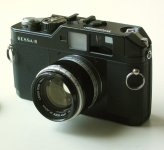
One combo I like especially (for small, light, and pretty fast) is the Bessa R and late black Canon 50 f/1.8 (in the attached picture).
 

Attachments

  • Bessa R and lens.jpg
    Bessa R and lens.jpg
    67.4 KB · Views: 0
Finder said:
That has nothing to do with the definition of "normal." You can equally say the negative is more important than the paper and print full frame by "wasting" a little paper space. Or you can take a fisheye lens and crop the image down to a 52 degree angle of view and say that is "normal." And what do you do when you post on the web or have a slide show? Do you crop or mask down to 8x10 proportions? Defining normal based on how something is displayed won't work as some folks crop and some don't. "Normal" refers to lens focal length and not based on how someone may or may not display an image. (Just as lens magnification is defined by object to image size at the image plane regardless of printing size as that cannot be known.)

I did not come up with the definition of "normal." If folks perfer using a wide-angle lens like a 35mm for most of their work, that is fine. It can even be a good recommendation. But that does not change the meaning for the term "normal." I understand the poster wanted to know what "normal" meant. The definition is clear.

I didn't mean to ruffle your feathers, just pointing out one possible reason why the 35mm lens is a popular choice as a "normal" lens. I disagree that the definition of "normal" is clear. If it was we wouldn't be putting the word in quotation marks or having this discussion. Is it "normal" because it's the diagonal of the format (the fact that most folks don't use the entire negative not withstanding); or is it the "angle of view; or maybe it's just because the manufacturer says it is.

Cheers,
Gary
 
ElrodCod said:
I didn't mean to ruffle your feathers, just pointing out one possible reason why the 35mm lens is a popular choice as a "normal" lens. I disagree that the definition of "normal" is clear. If it was we wouldn't be putting the word in quotation marks or having this discussion. Is it "normal" because it's the diagonal of the format (the fact that most folks don't use the entire negative not withstanding); or is it the "angle of view; or maybe it's just because the manufacturer says it is.

Cheers,
Gary

Normal does have a formal definition in photographic optics. Unfortunately, most amateurs just pick thing up as they go and things get confused. (Boy, doesn't that sound pompous.)

What lens you normally like to use, does not make it a normal lens in terms of photographic technology. I have a similar perference as you do an perfer a slightly wider lens than normal - 75mm on 6x6 and 135mm on 4x5. I would recommend most to start with a moderate wide-angle lens. But they aren't normal. (You may read that anyway you like.) A few on this thread like to go longer (they ain't normal either). But we are simply talking about opinion.

Normal may be an unfortunate term because in common usage it has a very vague meaning (like the word "theory"). But I think to water down the term to mean a focal length of perference makes the term meaningless and if anyone then picks up a book on photographic optics, it becomes confusing. I guess I am sensitive to vague uses of clear terms. I see these terms as the heritage of our craft which should allow us to communicate clearly. Obviously this concept of a normal lens was not clear to the poster.

I am sorry if I came on too strong - could be my writing style.
 
Back
Top Bottom