What's the history of ISO/ASA ratings through the years?

Pirate

Guitar playing Fotografer
Local time
8:12 PM
Joined
Sep 27, 2009
Messages
1,864
Location
Highland, Mi.
I'm looking for what ISO/ASA ratings where available through the 1900's. Such as... "in 1920 they only had 5, 10, and 25 ISO films available."

Anyone know these kinds of statistical histories? I'm googling this stuff too but not getting much in the specific area I'm looking for.

thanks
 
Working backwards, ISO is the latest standard. Before that there was ASA and DIN - I remember those from the '50's - and even earlier there were several different "standards" proposed but as each depended on some form of exposure calculator (no meters then) there isn't a very good correlation as far as I recall. Some of them were extinction devices and some were simple slide rules. In the '50's I seem to remember that 50 ASA was pretty normal and 80 ASA was regarded as a fast film. It was a great day when Ektachrome appeared as 32 ASA and even better when High Speed Ektachrome came out at 64 ASA!
Roger Hicks can probably give a more complete and accurate answer.
 
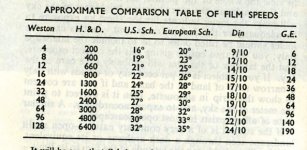
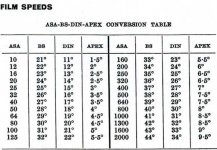
These tables might be of interest - I didn't record the sources unfortunately.
 

Attachments

  • Film speed table 2.jpg
    Film speed table 2.jpg
    43.4 KB · Views: 0
  • Film-Speeds-table-cropped.jpg
    Film-Speeds-table-cropped.jpg
    33.8 KB · Views: 0
The original work on film speeds was done by Hurter and Driffield (as in the H&D curve) and published in 1890: see http://www.rogerandfrances.com/subscription/ps neg density.html. Various systems based on this appeared in the following decades, though the most useful system, based on practical testing and frequent updates, was Watkins. Read http://www.rogerandfrances.com/subscription/w bee.html and at the bottom you'll find a 1931 Bee speed card, '39th year of issue'.

In the 20s or 30s DIN adopted a speed system based on maximum contrast (gamma infinity) and a fixed density, and in the late 1930s Kodak introduced the fractional gradient criterion, based on the point at which contrast in the toes of the D/log E curve became useful, at a fixed gamma (contrast) in the useful printing range: DIN speed negatives were hopelessly contrasty. This was the basis of ASA. When ASA and DIN were merged into ISO they went for a fixed density, fixed gamma system: see http://www.rogerandfrances.com/subscription/ps iso speeds.html.

Because the various systems use different criteria for speed assessments, strict comparisons are impossible, but a very useful idea of comparative speeds can be gained from comparing manufacturers' published speeds (which in pre-ASA/DIN days often owed more to the marketing department than to scientific testing) with one another and with Watkins speeds.

If you can get hold of my A History of the 35mm Still Camera (Focal Press, 1984) you'll find a whole chapter on historical film speeds 1920s - 1967. I know of no other half-comprehensive survey, but old ads (especially in the British Journal of Photography Almanacs) will give you the manufacturers' claimed speeds from when H&D speeds first started being used.

Cheers,

R.

 
Last edited:
... I seem to remember everything getting a stop faster in the early 60s when the manufactures "safety margin" was removed ... but I could be guilty of a faulty memory, I was only 8 or 9
 
... I seem to remember everything getting a stop faster in the early 60s when the manufactures "safety margin" was removed ... but I could be guilty of a faulty memory, I was only 8 or 9

Dear Stewart,

No, you're right, though of course, only for B+W. As far as I know, the change was in 1959-60.

The joke was that in the 50s, amateurs accused manufacturers of conspiring to stop everyone getting the benefit of full film speed, just as today they accuse them of conspiring to say that films are faster than they 'really are'.

These viewpoints are sustainable only if you don't know what you're talking about when it comes to ASA, DIN and ISO standards. Which, of course, the whingers never do.

Cheers,

R.
 
Back
Top Bottom