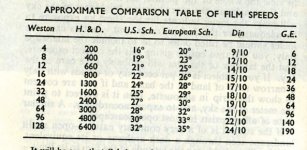
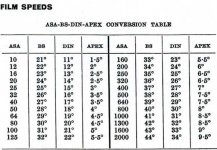
The original work on film speeds was done by Hurter and Driffield (as in the H&D curve) and published in 1890: see
http://www.rogerandfrances.com/subscription/ps neg density.html. Various systems based on this appeared in the following decades, though the most useful system, based on practical testing and frequent updates, was Watkins. Read
http://www.rogerandfrances.com/subscription/w bee.html and at the bottom you'll find a 1931 Bee speed card, '39th year of issue'.
In the 20s or 30s DIN adopted a speed system based on maximum contrast (gamma infinity) and a fixed density, and in the late 1930s Kodak introduced the fractional gradient criterion, based on the point at which contrast in the toes of the D/log E curve became useful, at a fixed gamma (contrast) in the useful printing range: DIN speed negatives were hopelessly contrasty. This was the basis of ASA. When ASA and DIN were merged into ISO they went for a fixed density, fixed gamma system: see
http://www.rogerandfrances.com/subscription/ps iso speeds.html.
Because the various systems use different criteria for speed assessments, strict comparisons are impossible, but a very useful idea of comparative speeds can be gained from comparing manufacturers' published speeds (which in pre-ASA/DIN days often owed more to the marketing department than to scientific testing) with one another and with Watkins speeds.
If you can get hold of my
A History of the 35mm Still Camera (Focal Press, 1984) you'll find a whole chapter on historical film speeds 1920s - 1967. I know of no other half-comprehensive survey, but old ads (especially in the
British Journal of Photography Almanacs) will give you the manufacturers' claimed speeds from when H&D speeds first started being used.
Cheers,
R.