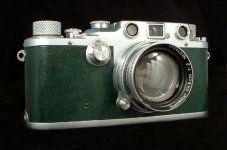
There was something called "digital film" in one magazine some time ago. I don´t know whether it was a hoax (it likely was), but it seemed quite interesting - something what can ad "digital guts" to the film camera utilizing the space for film - usable in virtually any film camera.
There is no reason why a digital back for virtually any old camera (especially those with in-lens shutter) could not be created.
I saw at least two generations of this at photo trade shows. Several things killed it, including the difference in the distance between the film chamber and the sensor position (a non-trivial problem, as soon as you start thinking about it); the size and shape of the film chamber; the difficulty of positioning the sensor in exactly the right place; the difficulty of communication between camera and 'digital film'; and, I think,
in those days storage/download.
Yes, it's possible to build digital backs for almost all cameras, but then you need at least half a dozen different Nikon models, the same for Canon, two for Leica M (M5 and the rest, with baseplate loading makes life even more interesting, to say nothing of shorter flange/film distance on any RF) and so forth. In other words, they'd be semi-custom, like Marty Forscher's Polaroid backs (I still have one in Nikon F fit) and they'd cost a fortune: this is not a way of
saving money.
Also, on a different but related topic, using an optical fibre block to move an image away from the film gate is too difficult because there are always some defective fibres, which equate in a way to dead pixels. One manufacturer spent tens of thousands researching this, and that's why they gave up on that project.
Cheers,
R.