Why do some cameras have mirrored film back and some are black?

68degrees

Well-known
Local time
3:37 AM
Joined
Dec 11, 2012
Messages
882
Location
USA
Im talking about the part that pushes on the film to keep it flat on the inside of the back of the camera. Some cameras have a mirrored metal one and some have a black one. What is the rational behind this, the difference and which is better? Thanks.
 
Im talking about the part that pushes on the film to keep it flat on the inside of the back of the camera. Some cameras have a mirrored metal one and some have a black one. What is the rational behind this, the difference and which is better? Thanks.

You mean "pressure plate". I've never seen a mirrored finish pressure plate, but I have seen some that are quite shiny. I think some of the Contax SLRs had a ceramic pressure plate.

They simply have to be smooth and clean, low friction, to allow the film to move past them smoothly and easily, without scratches to the film base. Color and shininess are unimportant.

G
 
The pressure plate is the name of the part you're thinking of. I've seen the shiny or natural metal finish on older cameras only (not all of them), and I figure the changeover to black (whether an anodized finish or black paint) was done to reduce the possibility of light passing through the anti-halation coating on the film and bouncing back from the pressure plate to the emulsion. Not sure how frequent an occurrence that was but I'm sure it happened often enough to prompt the change.
 
I have a Yashica 24 TLR designed to accept 220 film (24 exposures 6x6). It came with a back that has a black pressure plate. That makes sense because 220 film has no backing paper. A Yashica manufactured replacement back for use with 120 film has a silver colored pressure plate. My assumption is that the 120 back can use the shiny pressure plate because 120 film has backing paper, so light never reaches the pressure plate, and Yashica left it silver as a reminder that the back was only for use with 120 film. I am just guessing, though.
 
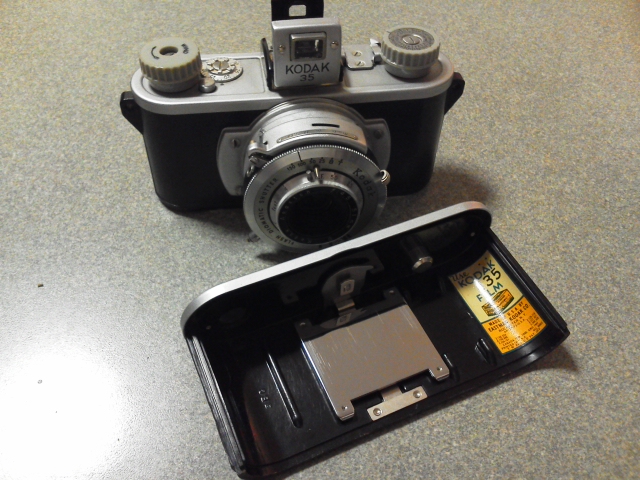
I think the Kodak 35 (non-rangefinder model) has a shiny steel pressure plate.

For what it's worth, Kodak did a lot of things that didn't mnake sense.
 
FWIW, my Diacord L has a bare metal pressure plate. Couldn't tell you why, though. Maybe it was just that much cheaper to put an unpainted part in the camera?
 
Here's the Kodak 35. I wouldn't think a shiny steel plate would be a good idea, although I haven't heard in Internet forums that it caused the film to fog.

Still, it doesn't seem like a good idea.

kodak_35.jpg
 
Cameras that were sold before slide film became popular frequently had silver colored pressure plates. The Bolsey line springs to mind. The M3 DS had a dark glass pressure plate which was considered cutting edge in 1954. Rumor has it that Leitz changed to metal because of static discharge.

David
 
both argoflex EM and kodak signet early models have mirror pressure plates, I am curious what the engineers reason was for that. For 120 film as in the case of the Argoflex you are right the film would never see the plate so maybe it was just cheaper to make the mirror finish since its only requirements are to be super smooth and clean. The signet 35 and that other Kodak 35 has a mirrored one too on the early versions so maybe it did cause some freak problem and was then changed to black to see if that was what was causing the problem. That must be it. I cant think of any other reason for mirror can you?
 
I would guess that it would be easier to produce, because you could eliminate the painting and baking and then simply polish the steel plate.
 
The early Leica M3 and probably the M2 had glass pressure plates. I read it got changed due to static charge build up causing problems with the film( streaks or something like that).
M3 only; not M2. I think they changed the M3 when the M2 came out in '57. Also Periflex.

Yes, I've seen a few chrome ones, but I can't recall which cameras. Polished chrome is obviously slippery and corrosion resistant, and might have looked expensive and 'high tech' to an unsophisticated buyer. You'd think halation would be a problem but presumably it isn't, or dimpled (instead of smooth) pressure plates would be a problem too.

Cheers,

R.
 
Hi,

Beaten by Roger as usual but he's an hour ahead of the UK...

Anyway, the Peiflex had a black glass pressure plate. I thought it as good idea as the thing didn't, or wouldn't, go rusty.

My 1938 Exakta has a shiny metal pressure plate.

Regards, David
 
I have Weltas with what are stainless steel or chromed pressure plates. Both Welti and Weltini. I think my Yashica TL Super may have had but I don't recall.

Those of you referring to glass, was that actually glass or ceramic. I seem to recall some SLR that had ceramic, but I don't think there were more that a couple that did that.
 
I have Weltas with what are stainless steel or chromed pressure plates. Both Welti and Weltini. I think my Yashica TL Super may have had but I don't recall.

Those of you referring to glass, was that actually glass or ceramic. I seem to recall some SLR that had ceramic, but I don't think there were more that a couple that did that.
(At least) one of the Contaxes, I think.

But the glass ones were definitely glass.

Cheers,

R.
 
Back
Top Bottom