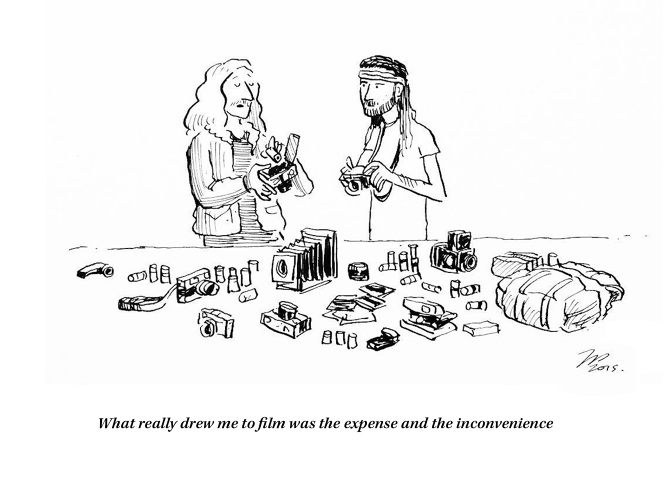
Why film?

After googling a pic of that cartoon (so I can text it to a friend)

I found this variant:

film-cameras_1_670.jpg
 
It would be disingenuous to deny that that mentality doesn't exist among some film aficionados. It is certain true about a segment of the high end audio crowd.
 
...I really don’t care whether a print is silver or pigment. What I do care about is that printing is part the picture taking/making process that directs the viewer to what is important in the picture to the photographer...

Bill,
You just touched a subjet that I´ve been worried about for years...
I don't want to be controversial in any way, and I don't expect anyone to share my opinion, and even less hurt anyone's preferences...
I feel the special treatment of certain parts of the image, is something that's not related to real photography... Please everybody, don't tell me x image by y photographer has done it: I know. Even HCB's printers. I was taught to do it both in the darkroom and in the computer, but I feel it's something more related to a different art: painting... If we start changing parts of an image to direct the viewer or even worse, make them say wow, we end up like Ansel Adams, who was more a painter than a photographer (a darkroom painter with complex diagrams to surprise with a print seriously different from his negative) and I loved him when I was young, and I studied all his books before they were available in Spanish, and I love nature, but his work is horribly cold... As time goes by, I feel the more we keep photography away from painting, the healthier it is... The more we keep the scene untouched (I mean partially), the more we reach a discipline that's apart from painting... It's like being a war photographer and just chase blood and the wildest drama faces... There are better ways to do it, more delicate ones... Why shout always?
Sorry for the comment: I don't consider myself a better photographer than you in any way, and I don't think you haven't considered this before, it's just that when the objective is selling photos for the masses and moving all kinds of people, the bussiness requires procedures because others do it, but, again, only IMO, I think it's philosophically relevant to have the double honesty Winogrand talked about and use the camera for what it's good: reflecting reality, and reflecting it just as it is... "Hey, it's just a little change...", well, we shouldn't because the camera already captured what was real the way it was visible... Well, I won't insist and I won't answer other related comments because this is a little away from the thread... All I meant was, if a good direct print is not enough, there's a problem elsewhere... Maybe I'm just part of the school that says photography ends exactly when you press the shutter...
 
It would be disingenuous to deny that that mentality doesn't exist among some film aficionados. It is certain true about a segment of the high end audio crowd.

Are you guys profiling me? LOL.

I have a pair of 300B meshplate monoblocks running single-ended triode.

The soundstage is incredible.

My gal once said, "Why do the speakers have to be so big?" LOL.

Cal
 
Bill,
You just touched a subjet that I´ve been worried about for years...
I don't want to be controversial in any way, and I don't expect anyone to share my opinion, and even less hurt anyone's preferences...
I feel the special treatment of certain parts of the image, is something that's not related to real photography... Please everybody, don't tell me x image by y photographer has done it: I know. Even HCB's printers. I was taught to do it both in the darkroom and in the computer, but I feel it's something more related to a different art: painting... If we start changing parts of an image to direct the viewer or even worse, make them say wow, we end up like Ansel Adams, who was more a painter than a photographer (a darkroom painter with complex diagrams to surprise with a print seriously different from his negative) and I loved him when I was young, and I studied all his books before they were available in Spanish, and I love nature, but his work is horribly cold... As time goes by, I feel the more we keep photography away from painting, the healthier it is... The more we keep the scene untouched (I mean partially), the more we reach a discipline that's apart from painting... It's like being a war photographer and just chase blood and the wildest drama faces... There are better ways to do it, more delicate ones... Why shout always?
Sorry for the comment: I don't consider myself a better photographer than you in any way, and I don't think you haven't considered this before, it's just that when the objective is selling photos for the masses and moving all kinds of people, the bussiness requires procedures because others do it, but, again, only IMO, I think it's philosophically relevant to have the double honesty Winogrand talked about and use the camera for what it's good: reflecting reality, and reflecting it just as it is... "Hey, it's just a little change...", well, we shouldn't because the camera already captured what was real the way it was visible... Well, I won't insist and I won't answer other related comments because this is a little away from the thread... All I meant was, if a good direct print is not enough, there's a problem elsewhere... Maybe I'm just part of the school that says photography ends exactly when you press the shutter...

I think one of the powers of photography is its believability. That’s lessening for a number of reasons that range from the popularity of programs that apply extreme effects to phone pictures to the current trend in photo galleries for conceptual art that fills their walls with images considerably below the quality of photographers who excelled at this before it became the rage. But I certainly don’t want my more conventional, less conceptual, photography to be thought of as anything but straightforward and believable. In other words, I’m a manipulative old person who doesn’t want to get caught sneaking his opinions into supposedly objective photographs. You’re younger and more honest - or at least less manipulative in both the photographic and human senses of the word.
 
John,

For me you have done matured. The film was just a stepping stone for you, and now you have your own style, which is a great thing.

Thanks Cal. I could always mature once again and go back to film with a renewed passion!

Exploring a medium and moving to a new medium results in growth. As much as I am a film fan presently, digital taught me a lot and made me a better photographer. I love both mediums, but because of the familiar I have a preference for film.

I can understand. As you know I've been in a great place creativity wise for the last 5 years or so. Until that ends, I don't see the reason to change. That might be what also isn't hit upon in this thread. If you are happy, you tend to stick with what is making you happy. If you are not, you continue searching.

Both mediums make me happy, but basically my identity is still old-school, and perhaps I'm a retro-slob. LOL.

Cal

I could be happy with film in larger formats... meaning medium format or larger ... IF I had a project that warranted it. At this point though, the only reason I would use 35mm would be because I miss having a Leica M or a point and shoot such as an Olympus XA or Contax T2.
 
I think one of the powers of photography is its believability. That’s lessening for a number of reasons that range from the popularity of programs that apply extreme effects to phone pictures to the current trend in photo galleries for conceptual art that fills their walls with images considerably below the quality of photographers who excelled at this before it became the rage. But I certainly don’t want my more conventional, less conceptual, photography to be thought of as anything but straightforward and believable. In other words, I’m a manipulative old person who doesn’t want to get caught sneaking his opinions into supposedly objective photographs. You’re younger and more honest - or at least less manipulative in both the photographic and human senses of the word.

Most of the photographers I know often question many photos found on the web, news photos included.

My b+w negs are scanned and when printed, I leave partial sprocket holes showing. I do crop, and when I do, I show any un-cropped sprocket hole side. If the prints are matted (they often are for un-hung gallery storage) they are matted into the edge of the image, obscuring the sprocket hole border. A flip of the mat reveals them. I do this to indicate, although the image was printed digitally, it was made on film. This adds a bit of "I didn't manipulate it" to the viewer. I do normal burn, dodge and typical darkroom stuff with photo software. And,.most have a highly manipulated, extremely small area - that doesn't effect the image in any way, as a hidden watermark. I do the same on personal digital images. I'm into pretty straight forward imagery, as I'm often photographing stuff that is questioned as manipulated.

I haven't taken news photos in many years, but back then, I didn't see the phony images that make their way into major media today.

And, ++ for Juan!
 
So, you use slide film only?

My negatives require development. Even more, I expose them for certain development: it's considered before pressing the shutter, then, part of the image. Of course, my prints are exactly like my negatives: well exposed and well developed, once you get blacks in the base+fog, the print is beautiful.
 
Maybe I'm just part of the school that says photography ends exactly when you press the shutter...

Nope, I don't agree with that at all. I suppose it comes down to personal preference and why you take photos. For me it's mainly for the final image or print, and there's definitely some post work going on, whether in the darkroom or in Lightroom/Photoshop.
 
I do this to indicate, although the image was printed digitally, it was made on film. This adds a bit of "I didn't manipulate it" to the viewer.
Showing the spocket holes on one or more sides tells you nothing about how much or little a scanned negative has been manipulated in software other than it was not cropped on the sprocket hole side. Showing or not showing the spocket holes is purely an aesthetic decision.
 
My negatives require development. Even more, I expose them for certain development: it's considered before pressing the shutter, then, part of the image. Of course, my prints are exactly like my negatives: well exposed and well developed, once you get blacks in the base+fog, the print is beautiful.

I think I must have misunderstood what you meant then.
 
I could be happy with film in larger formats... meaning medium format or larger ... IF I had a project that warranted it.

John,

Dan's thread on 70mm film became an opportunity for me. I fell victim to Linhof Disease by finding a cool Prototype without a serial number, and then I found an entire Linhof kit for "no-money."

Then you know my propensity to make cameras that are "Monsters." LOL. When I learned about that 70mm CINE back you could predict what would happen.

There is also a practical side because if my testing goes well with Rollie 400S in 120, I will then load up on 70mm Rollie 400 S that is sold in 100 foot double perf rolls for less than a dollar a foot. Basically 10-11 6x7's costs about $2.50 a 120 equiv.

You know that I like being ridiculas and shoot lots of film. Also I don't mind the work because it reminds me of art school and college days... Also having 60 plus shots before having to reload is a game changer for me. No need to carry more than one medium format camera to always have a loaded camera handy. For me the firepower is a blessing.

Anyways I figure this is what creative people do. From my gal "Maggie's" blog I learned if you want to stand out, then don't do what other people are doing, and surely walking around Madhattan and NYC I have never seen a Linhof "in the wild" except Christian who we know is a bit ecentric and crazy-good.

Anyways I feel inspired, although some might think I'm just crazy. I'm cool with that. LOL.

Cal
 
I will then load up on 70mm Rollie 400 S that is sold in 100 foot double perf rolls for less than a dollar a foot. Basically 10-11 6x7's costs about $2.50 a 120 equiv.

Another advantage, with no paper backing and a thicker base stock, 70mm tends to be flatter and more consistent in its position in the film back.
 
Showing the spocket holes on one or more sides tells you nothing about how much or little a scanned negative has been manipulated in software other than it was not cropped on the sprocket hole side. Showing or not showing the spocket holes is purely an aesthetic decision.

Well, I can produce a negative if requested. Others that fake the holes or sheet film borders might have trouble showing a negative if questioned. Comparing a negative with a finished print will tell the story. You couldn't extrapolate to that end? My digital images show no holes, making it easy for gallery people to distinguish between the two

I also have a long history of silver b+w printing and dye transfer color printing behind me. So, that helps with my history of being honest.
 
Well, I can produce a negative if requested. Others that fake the holes or sheet film borders might have trouble showing a negative if questioned. Comparing a negative with a finished print will tell the story. You couldn't extrapolate to that end? My digital images show no holes, making it easy for gallery people to distinguish between the two

I also have a long history of silver b+w printing and dye transfer color printing behind me. So, that helps with my history of being honest.
You assume the purchaser cares whether the inkjet print is from a film negative which has been scanned or a digital file. Why should it make any difference?
 
Back
Top Bottom