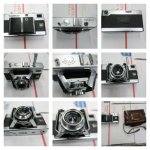
Now as far as early and late types go.
I was very pleased with myself a couple of years ago as I had to do a lot of work on my later Skopar Vitessa but got it working very nicely thanks very much. To my dismay, then, before I could take more than half a dozen shots the wind mechanism crapped itself. On dismantling the camera I found that the tab attached to the bottom of the plunger that drives the mechanism had fractured off. I'm pretty sure I know why.
Prior to working on mine, I'd found just one or two references to this happening to other owners. Because the knob must be unscrewed from the later versions with the smaller opening in the top cover, I think that some repairers have simply twisted the knob against the plunger which is locked in place by the actuating tab. This places unintended and huge stresses on the tab which is not designed to take any twisting force (it is designed to drive the mechanism up and down, in line with the plunger).
In my case the tab has fractured off the side of the shaft perfectly in line with the base of the tab where it was originally welded on. The joint has failed because of stress.
It's frustrating because I did my research and, being aware of the issue, all that was required to avoid this damage was a couple of small pieces of old rubber inner tube. One to grip the knob with, and the other with which to grasp the plunger shaft to prevent it rotating. This completely avoids damaging the mechanism by twisting the plunger against it when the knob is loosened. Unfortunately I assume a previous owner/repairer already did the damage, because, despite my precautions the part later failed, as mentioned above.
I can only assume that Voigtlander modified the plunger and cover design because it's likely to be more effective at excluding dust by virtue of the smaller cover opening. The older version should have a circular fabric seal around the opening that was glued in place. As the plunger slides up and down the seal "wipes" the plunger clean to minimise dust entry to the interior. (If your example does not have said seal, you can easily fabricate one from some suitable felt or even some yarn which may be glued to the underneath of the cover with some contact adhesive, but it is important to have something there as without it you'll be taking the cover off again after a few months to clean the optics again).
Given that the older versions do not require the knob to be removed in order to take off the top cover and set the RF etc. I'm rather inclined to think it's the better of the two designs to seek out today, overall. By not having to loosen the knob, there's no risk of numptys damaging the plunger before you get hold of your Vitessa as happened to me. Of course if you happen to already have a later version in good working condition, keep the plunger parts clean, free of sand and dust, and lubricated, and if you follow the advice above you ought to be OK. It's something to be aware of, though, and isn't a problem I'm inclined to blame on Voigtlander, because to my mind it is poor workmanship not poor design that causes it to break...
Cheers,
Brett
I was very pleased with myself a couple of years ago as I had to do a lot of work on my later Skopar Vitessa but got it working very nicely thanks very much. To my dismay, then, before I could take more than half a dozen shots the wind mechanism crapped itself. On dismantling the camera I found that the tab attached to the bottom of the plunger that drives the mechanism had fractured off. I'm pretty sure I know why.
Prior to working on mine, I'd found just one or two references to this happening to other owners. Because the knob must be unscrewed from the later versions with the smaller opening in the top cover, I think that some repairers have simply twisted the knob against the plunger which is locked in place by the actuating tab. This places unintended and huge stresses on the tab which is not designed to take any twisting force (it is designed to drive the mechanism up and down, in line with the plunger).
In my case the tab has fractured off the side of the shaft perfectly in line with the base of the tab where it was originally welded on. The joint has failed because of stress.
It's frustrating because I did my research and, being aware of the issue, all that was required to avoid this damage was a couple of small pieces of old rubber inner tube. One to grip the knob with, and the other with which to grasp the plunger shaft to prevent it rotating. This completely avoids damaging the mechanism by twisting the plunger against it when the knob is loosened. Unfortunately I assume a previous owner/repairer already did the damage, because, despite my precautions the part later failed, as mentioned above.
I can only assume that Voigtlander modified the plunger and cover design because it's likely to be more effective at excluding dust by virtue of the smaller cover opening. The older version should have a circular fabric seal around the opening that was glued in place. As the plunger slides up and down the seal "wipes" the plunger clean to minimise dust entry to the interior. (If your example does not have said seal, you can easily fabricate one from some suitable felt or even some yarn which may be glued to the underneath of the cover with some contact adhesive, but it is important to have something there as without it you'll be taking the cover off again after a few months to clean the optics again).
Given that the older versions do not require the knob to be removed in order to take off the top cover and set the RF etc. I'm rather inclined to think it's the better of the two designs to seek out today, overall. By not having to loosen the knob, there's no risk of numptys damaging the plunger before you get hold of your Vitessa as happened to me. Of course if you happen to already have a later version in good working condition, keep the plunger parts clean, free of sand and dust, and lubricated, and if you follow the advice above you ought to be OK. It's something to be aware of, though, and isn't a problem I'm inclined to blame on Voigtlander, because to my mind it is poor workmanship not poor design that causes it to break...
Cheers,
Brett