Zeiss Sonnar 50mm f1.5

ekphrasis

Member
Local time
2:48 AM
Joined
Dec 1, 2013
Messages
14
I recently had my leica M3 serviced and decided to start shooting some film.

I shot my first test roll using the 50mm collapsible Summicron that was serviced with the camera. The pictures looked great.

I am not crazy about the form factor of the collapsible Summircon, and I was curious to try out a modern lens for taking pictures of people, so I read several reviews and ended up buying a used Zeiss Sonnar 50mm from a dealer in Japan. The lens arrived in nearly mint condition.

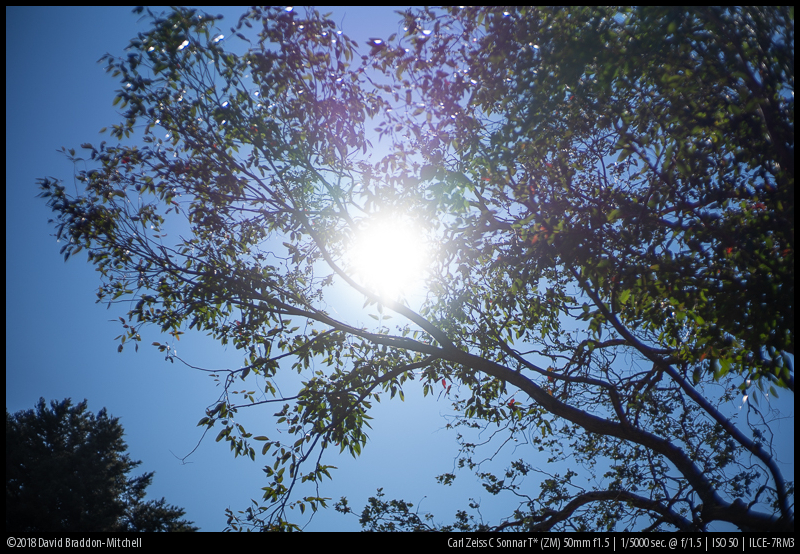
I shot a test roll and was underwhelmed with the results--the reviews I had read set my expectations too high, perhaps. None of the images seemed to have the sharpness/pop of the summicron. But most concerning was that there was a very significant amount of purple fringing in pictures that had some early evening backlighting--more than I've ever seen.

Is this a normal amount of fringing?

Here's a link to a sample image on flickr: https://flic.kr/p/2jFCHRh

https://flic.kr/p/2jFCHRh
 
That seems unusual, I wonder if there's something else going on. What type of film were you shooting on? How did you digitize them?

The Zeiss C-Sonnar ZM is one of my favorite lenses. This is a shot I took on the modern Leica M-mount version. In the fully-sized image I can read the text on the sticker at the back of the boat, that's how sharp it is:
50331915217_c8a0ba1b3c_c.jpg


And this is one I took on my Leica M2 with the vintage (1950s era) Zeiss Opton-Sonnar 1.5, using an Amedeo adapter. Still plenty of pop and sharpness, limited more by the film stock (Kodak ProImage 100, in this case) than the lens I think:
49783781943_cc24a6c47b_c.jpg
 
thanks for the responses. It could be a film issue, I suppose. I was using an old roll of agfa 200 ISO film that I had in my camera bag--at least five years old. Would that affect the coloration of the overexposed segments?

You can see some other samples shot with the same lens and roll of film that I just uploaded to flickr:

https://www.flickr.com/photos/190158316@N03/with/50331811952/

Some have more pop, but they still don't seem as nearly sharp as the image taken with vintage Summicron. The last image on my flickr stream is from the Summicron:

https://www.flickr.com/photos/190158316@N03/50331256788/in/dateposted-public/

It was shot using Portra 400 (a fresh roll that I just purchased).

How would I know if I got a bad copy of the Zeiss Sonnar? I have 30 days to return it--I'm not sure how best to test. I do have an adaptor that I could use to put it on my digital camera.

Also, I'm new to using this forum: how do you embed an image directly in the post? When I tried, it limited me to a very very small image.
 
Also, I'm new to using this forum: how do you embed an image directly in the post? When I tried, it limited me to a very very small image.

Welcome to the forum! I can't help with the ZM 50/1.5 issues as I have no experience with that lens, but this sticky thread has some good instructions about how to post images from Flickr. Post #19 sums it up pretty well, but let us know if you have other questions!
 
Hmm. It could be the film, though someone else might chime in who has surer knowledge of what could be causing that. But it almost looks to me like halation in the highlights from the film stock? Don't know though.

This shot of yours looks pretty sharp to my eye though:
50331808357_0467677375_c.jpg


But the one you tagged from the Summicron is much closer up. I would definitely try to setup a test on digital, on a tripod in good light (but not backlit or strongly side lit) with a static subject at close-to-medium distance. Make sure to focus at the same point and take shots with both lenses at every aperture, then compare. The Sonnar lens (as a result of the Sonnar design) will backfocus or front focus on you at some point in the range. Depending on the year it was made and/or whether someone who once owned the lens sent it to Zeiss, the point of perfect focus might be calibrated to be at f/1.5, f/2, or even f/2.8. I believe Zeiss eventually settled on f/2 as the aperture where focus is spot on (that's what my lens is calibrated for). But other than that, you should be able to get a good sense of the relative qualities from there, and perhaps get a sense of what's going on.

Post the comparison photos here! People here have eagle eyes and will quickly spot if there's anything funky going on with the lens.

(Oh, and as far as embedding in the post, you'll need the link to the actual jpg itself on Flickr––I use the Share button and take the link out of the BBCode––then in the Quick Reply window here you should see a little landscape icon. Click that and post your image link and it should embed)
 
An ancient roll of film and you wonder why. If you can afford the Zeiss Sonnar ZM, you can afford a fresh roll of film, no?
 
Yes it is a ZM lens--relatively new.

I will try some tests using the digital camera that I have and a tripod. I'm still curious to know if old film could be the culprit in terms of the magenta in the backlit areas--another person seemed to suggest that. However, the film looks fine in several other frames.
 
The shot with the fisherman looks like it’s focused on infinity. He is out of focus. The shot with the little pot on the table has a wide aperture and further comment would require knowledge of what it was you focussed on.

It is unlikely you have a bad copy.

It is a fantastic lens and balances well on an M2 or M3.

The very wide apertures, f1.5 and f2, will give very shallow depth of field close up. A patterned shirt, for instance, might look strange and distracting. The young man with the boot could have been a nice shot: what did you focus on? Are you good at keeping the camera still?

Focus shift is a reality with this lens, but some never notice it and others obsess over it and get rid of the lens. It is worth doing your own test of your lens, preferably on digital, as advised above. I initially did tests on film and made notes on each frame but the test wasn’t rigorous enough. I repeated it on the M9 with a very accurate set up and found my lens is optimized for about f2.4. It is only certain subjects and subject distances and of course those wide apertures where this will show up. The intermediate apertures f2.8 to f5.6 are easy to use and give very pleasing effect. I used the C Sonnar almost exclusively for months on an M5 and then an M9. Many of us don’t consider it a “specialist” lens which is sometimes proposed.

Learn the lens and you’ll like it. Zeiss colours are beautiful.

My focus shift test.

https://www.photo.net/discuss/threa...c-sonnar-apparently-optimized-for-1-5.461113/
 
And apologies if I sounded narky. Just that it is almost certain the problem was with that roll of Agfa. Agreed, the ZM Sonnar is a wonderful lens. It just has to be tamed!
 
Your shots look damn good to me overall. You do have a bit of purple fringing at one spot when shot into a severely backlit situation, but that's a hard test of everything and sometimes luck-of-the-draw: film, lens, baffles, hood, and other difficult to anticipate intangibles. Avoid such situations normal use overall is my advice for almost any one unless one is ready accept the intangibles to hopefully achieve a special effect. My dad used to tell me (60 years ago): Keep the Sun behind your back!

I think your lens is a winner, frankly. Nice scenery BTW - I'll bet that river is brimming with trout!
 
The shot with the CA on the trees is about normal. If you want a fast lens that you can shoot wide open at distance like that you have to get into much larger aspherical designs like the Nokton 50mm 1.2 or the summilux asph. Even then you'll still get some CA in that situation.

The ZM sonnar is supposed to be a character lens - the simple optical design means simple optical corrections. Going to a more corrected design usually means bigger, and the loss of the 'character', though there's no hard rules about this.
 
It has taken me a few days, but I created a few sample comparison images between the Sonnar and the collapsible Summicron 50mm lenses to illustrate the purple fringe.

Unlike the original film picture that I posted, these were taken with my Fuji XT3 digital camera, and it isn't a backlit situation like the forrest picture.

These are heavy magnifications to illustrate the purple fringe that I'm seeing. Perhaps, as some have said, this is just a characteristic of the lens design--but I was curious to know your thoughts now that I have a better set of images, and film stock isn't a factor.

Summicron 50mm, F2:
50360257833_7fe56d3603_h.jpg


Sonnar 50mm, F2:
50361121987_31ec89eb28_b.jpg
 
I'll be interested in the comments of others.

Firstly, its only the bright section with the purple so while I suppose that's "fringing" it isnt creating a visual problem.

Which is underscored by the Summicron having green "fringing" at the same location. That hadn't been previously commented on.

If the visual quirk concerns you, change the lens. The Sonnar is a lens with "character," or with predictable faults with artistic value. If the faults don't match your artistic vision, move on.

I'm a fan of the Sonnar (generic) effects, meaning I sold on the only copy I've had that was sharp at all apertures. I didn't own it to be without optical quirks.

The Sonnar design predates colour film. It predates film even seeing red, so in those circumstances this would simply be a bright spot of reflection.

In the fringing difference you are seeing, it is nearly impossible to get all colours of the spectrum to arrive at the same point. The steps required are numerous, the corrections often approximations. Finding purple (or green, or red) edges in some circumstances can be expected. How much and how troubling it is may vary. If purple troubles you more than green then your choice between these 2 lenses is clear.
 
Back
Top Bottom