More on the Pentax film camera project

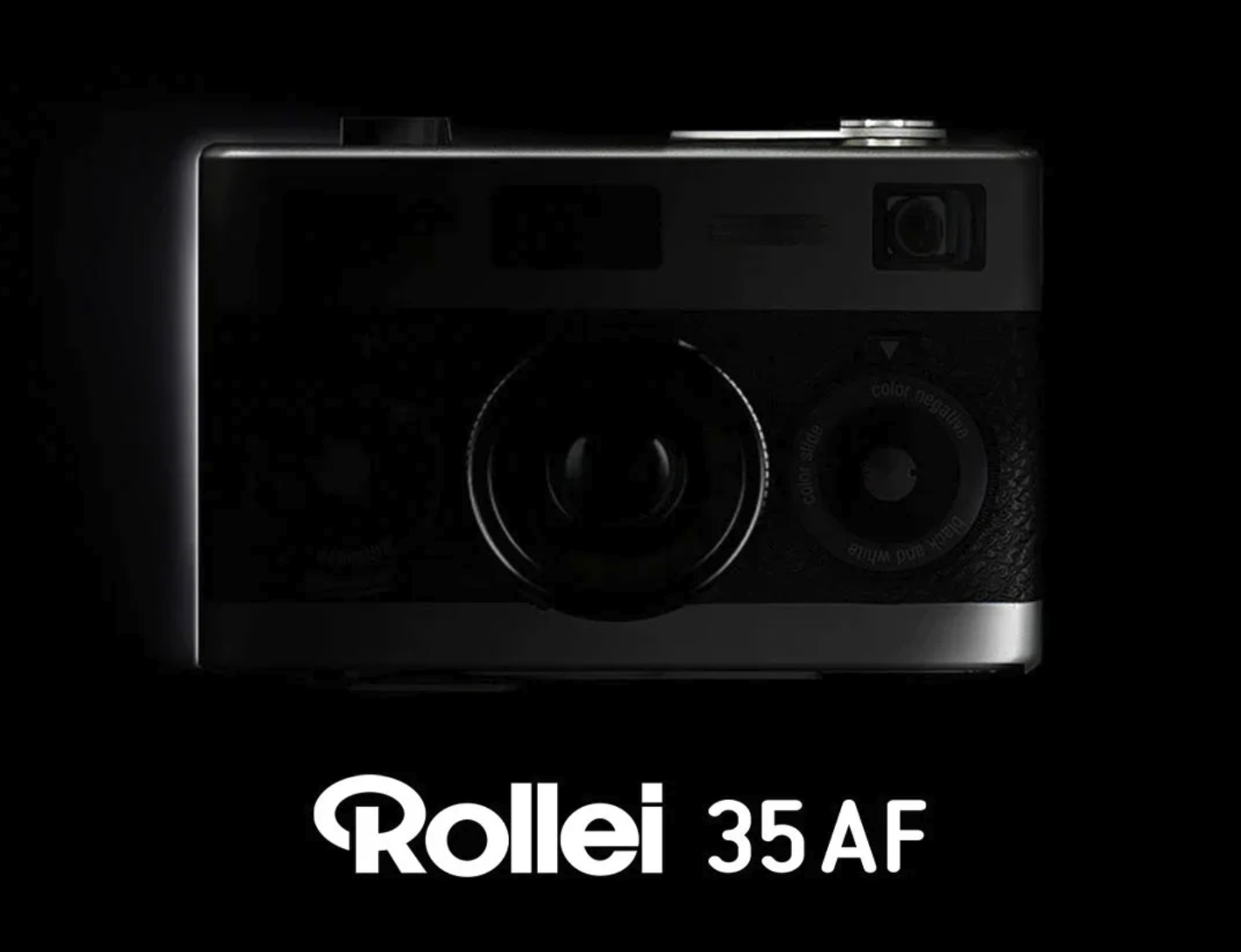
I was just reviewing the Rollei 35AF blog posts and, to your mention of "plasticky", do be aware that the Rolleil 35AF is an all metal camera, just like the Rollei 35S.

G
I do realize that. I may not have been clear but I mainly just meant that Mint doesn't jump out for good build quality. I'd put them a step above Lomography for sure, but a few steps below what we know of Ricoh/Pentax (which, to be fair, is in a totally different league of manufacturing).
 
...Ten rolls of film for one CR2 is a no-no for me, but I rather suspect this may brand me as mean. Sorry if.
...
I am told that this is with 50% flash (CIPA rating), i.e. 5 of those rolls with flash for each frame, i.e. 360 uses of the flash. That's probably a non-typical use of the camera and how much more energy would the flash use than a typical picture? It may be that more typical use results in 20, 30 or 40 rolls per battery (speculation)??
 
I do realize that. I may not have been clear but I mainly just meant that Mint doesn't jump out for good build quality. I'd put them a step above Lomography for sure, but a few steps below what we know of Ricoh/Pentax (which, to be fair, is in a totally different league of manufacturing).
We'll have to agree to disagree. I have and use, what, six MiNT cameras and they're all very nicely built and finished. They're not at Rollei or Voigtländer levels, and maybe not quite at Ricoh/Pentax level but darn close. I have several real (pre-Cosina) Voigtländers and still have my Rollei 35S, had a bunch of Rolleiflex TLRs over the years too ... far better build than Ricoh/Pentax IMO, having had and used both of those professionally too. One of the reasons I stopped using Pentax in 2007-2008 was that I found the cameras' and lenses' build quality to be significantly poorer than Olympus and Nikon. I moved from Pentax to Olympus and was delighted with the improvement and consistency.

G

 
I saw via Bellamy's reveal video that the Mint/rollei 35 has a) plastic in its lens construction and b) no way to manually focus/scale focus.

Personally in a daily/point and shoot camera I prefer scale or manual focus - especially with social photos in low light or the dark. The onyl point and shoot's I've found to be near flawless in those situations are the Hexar AF and the MJU ii with their infrared systems. Even modern $3k mirrorless cameras are poor in that environment without resorting to using their focussing assist lamps which is invasive and slow.
 
I saw via Bellamy's reveal video that the Mint/rollei 35 has a) plastic in its lens construction and b) no way to manually focus/scale focus.

Personally in a daily/point and shoot camera I prefer scale or manual focus - especially with social photos in low light or the dark. The onyl point and shoot's I've found to be near flawless in those situations are the Hexar AF and the MJU ii with their infrared systems. Even modern $3k mirrorless cameras are poor in that environment without resorting to using their focussing assist lamps which is invasive and slow.
Yes, absolutely, unless you have a ‘guided missile’ autofocus mirrorless like a Sony A1 or Canon R3.
 
Eh neither can focus in the dark like the hexar can.
Tracking etc in normal conditions is obsviously on a totally different level.
Sure, but nothing can autofocus in total darkness like a Hexar. Even the MJU ii and other IR focus systems work worse. In low light the better new mirrorless cameras are still pretty amazing. EV-4 to -6 is very dim.

Marty
 
Keep in mind my ZF is actually rated to -10ev. Impressive in digital af terms but honestly still frustrating compared to a scale focus/manual camera I can just set to 2m and f8 and fire a flash. I don't really use it for that purpose because of that.
 
In theory a Lidar-based AF system should work in total darkness. Why would it not?
It would/does, but most lidar systems are too large, slow or currently too expensive to put in a camera. That’s not to say they always will be.

Keep in mind my ZF is actually rated to -10ev. Impressive in digital af terms but honestly still frustrating compared to a scale focus/manual camera I can just set to 2m and f8 and fire a flash. I don't really use it for that purpose because of that.

I found the A1 autofocus worked better in low light than the Zf. What Z lenses do you have? Have your lenses been reliable and are they properly centred? I tested the Zf with a 50/1.8 that had a mechanical problem and was substantially decentred. When you have that much resolution available in the design, you really see any softness. I admit I might have just got a Friday afternoon lens.

Marty
 
Apparently expensive, but not too expensive for an $800 camera. 🙂

MB: The use of lidar technology in the Mint35 is groundbreaking. Can you elaborate on why you chose this technology over traditional autofocus methods?

GH: The search for a suitable autofocus module was the first and foremost task of this project years ago. We were taken aback to discover that "traditional" autofocus modules were no longer being produced, and at one point we were close to calling off the project because of this. In today's digital era, autofocus methods heavily rely on software algorithms, which do not apply to our project since we cannot extract digital information from the scene.

Fortunately, the emergence of Lidar technology provided a solution. Although Lidar technology has been around for a while, it gained popularity in recent years due to its use in smartphones and self-driving cars. The prices of these sensors have become more affordable, making them suitable for our project (although still quite expensive).

Lidar offers several advantages. It is accurate across various environmental conditions, including dark and bright places, and it works on all surfaces. Additionally, it offers a good range. It proved to be the perfect choice at the right time.

I would say the only disadvantage of using Lidar over "traditional" autofocus methods is the cost. It is indeed quite expensive, but we still have to use it.
 
Apparently expensive, but not too expensive for an $800 camera. 🙂

MB: The use of lidar technology in the Mint35 is groundbreaking. Can you elaborate on why you chose this technology over traditional autofocus methods?

GH: The search for a suitable autofocus module was the first and foremost task of this project years ago. We were taken aback to discover that "traditional" autofocus modules were no longer being produced, and at one point we were close to calling off the project because of this. In today's digital era, autofocus methods heavily rely on software algorithms, which do not apply to our project since we cannot extract digital information from the scene.

Fortunately, the emergence of Lidar technology provided a solution. Although Lidar technology has been around for a while, it gained popularity in recent years due to its use in smartphones and self-driving cars. The prices of these sensors have become more affordable, making them suitable for our project (although still quite expensive).

Lidar offers several advantages. It is accurate across various environmental conditions, including dark and bright places, and it works on all surfaces. Additionally, it offers a good range. It proved to be the perfect choice at the right time.

I would say the only disadvantage of using Lidar over "traditional" autofocus methods is the cost. It is indeed quite expensive, but we still have to use it.
Indeed, but if they use a small cheap sensor and small processor like you find in a cellphone, it won’t be responsive like you’d want from a high end autofocus camera. Those are slow. Try focusing your S6 or iPhone 15 in low light some time. There are compromises everywhere.
 
Everything is relative. 🙂 Mr Ho seems to think they are using ‘quite an expensive sensor.’ Is it the same ‘cheap’ sensor as used in a cell phone? Perhaps.

But the demands of a 35/2.8 fixed lens AF camera are not the same as a high-end autofocus camera like an A1 or R3.
 
Everything is relative. 🙂 Mr Ho seems to think they are using ‘quite an expensive sensor.’ Is it the same ‘cheap’ sensor as used in a cell phone? Perhaps.

But the demands of a 35/2.8 fixed lens camera are not the same as a high-end autofocus camera like an A1 or R3.
The MiNT camera will come in at <$1000. So yes, the lidar system is a cheap one, as far as lidars go. And no, it doesn’t need to be lightning fast, but faster than slow would be good. My Contax T3 is beautiful, but its AF sends me crazy.
 
We'll have to agree to disagree. I have and use, what, six MiNT cameras and they're all very nicely built and finished. They're not at Rollei or Voigtländer levels, and maybe not quite at Ricoh/Pentax level but darn close. I have several real (pre-Cosina) Voigtländers and still have my Rollei 35S, had a bunch of Rolleiflex TLRs over the years too ... far better build than Ricoh/Pentax IMO, having had and used both of those professionally too. One of the reasons I stopped using Pentax in 2007-2008 was that I found the cameras' and lenses' build quality to be significantly poorer than Olympus and Nikon. I moved from Pentax to Olympus and was delighted with the improvement and consistency.

G

I am not a professional photographer, merely a happy hobby snapper, but I still feel the need to comment on your remarks about Pentax build quality.
The Pentax Spotmatic cameras were built like a tank, very durable and dependable. Many cameras in the K-series (K1000, KM and KX) inherited the same legendary build quality (and shutter and other mechanical features) from the Spotmatic. The MX and LX are probably not quite as robust and durable as the above mentioned cameras. From the Pentax ME and through the 1980-1990s plastic fantastic autofocus cameras the Pentax build quality probably left something to be desired. But from the digital K10D, K20D, K-7 and K-5 the build quality was again amongst the best in the camera business. The build quality of the current top Pentax DSLRs, Pentax K-3III and K-1II is second to none.
 
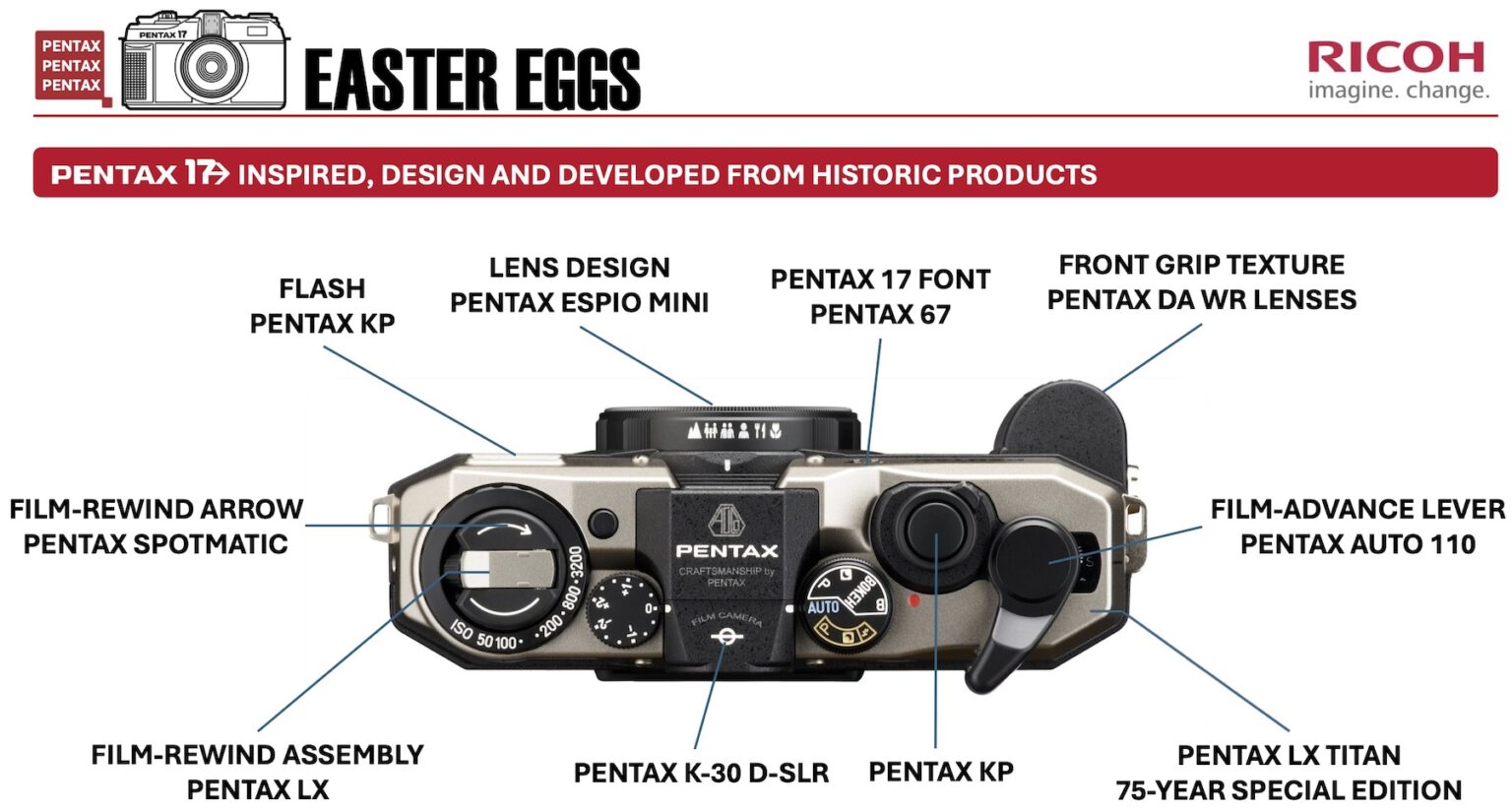
Yeah, I wouldn't have any issue owning this camera from a build quality perspective. It most likely is a plus for the camera. I think it looks awesome from the top and this was pretty cool:

Pentax-17-camera-easter-eggs-inspired-designed-developed-from-historic-products-1536x824.jpg
 
Back
Top Bottom