Collecting Leicas vs. Using Them--Excerpt from Magazine

George (copake_ham), a Leica is art, and so is worth collecting: but the artistry in it lies in its utility, so it could be argued that not using it makes it not art. One could say the same about certain revolvers, sewing machines, motorbikes....

Has anyone ever wanted to turn a work by Michelangelo or Raphael into a poncho after ripping it out of its frame and cutting a hole in it for his or her head? Not unlikely: there are, after all, people with too much money and not enough brains to know what to do with it.
 
payasam said:
George (copake_ham), a Leica is art, and so is worth collecting: but the artistry in it lies in its utility, so it could be argued that not using it makes it not art. One could say the same about certain revolvers, sewing machines, motorbikes....
.

Paysam,
😕
Since when something must be art to be worth collecting ?
And how can an industrial product, produced in a serial manufacturing process be art ? That is all new to me.

Following your statement above ( the artistry in it lies in its utility) the consequence must be that for example shooting someone down with a prefectly made gun makes this gun beeing art . Amazing !

Bertram
 
Bertram2 said:
Paysam,
😕
Since when something must be art to be worth collecting ?
And how can an industrial product, produced in a serial manufacturing process be art ? That is all new to me.

Following your statement above ( the artistry in it lies in its utility) the consequence must be that for example shooting someone down with a prefectly made gun makes this gun beeing art . Amazing !
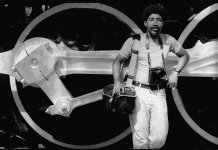
Barring the thought revolving (groan) over that other kind of shooting, I think Paysam is onto something, although a bit controversial to some. "Industrial art", of course, isn't really the oxymoron it might seem to some. The Leica M is but one clear example. Other sturdy examples exist: many of them in museums around the world, some occasionally in their natural habitat (Norfolk & Western 611, which I spent a week chasing throughout Virginia in Summer 1983). Few of these were designed with "future collectivle" status in mind. Yet, to me and more than a few others, they are beautiful, inside and out, in form and function, beyond "beauty is as beauty does".

Hmm...it is getting late here...


- Barrett
 

Attachments

  • BBva3.jpg
    BBva3.jpg
    166.9 KB · Views: 0
Barret

The N&W 611 is one heavy duty and beautiful example of industrial art that you were able to see in living/ breathing form in 1983. Even on static display she would be beautiful. Still have the Lionel O guage model of that loco that I had as a kid and still smile when I look at it. Industrial art is no oxymoron.

Nikon Bob
 
Nikon Bob said:
Barret

The N&W 611 is one heavy duty and beautiful example of industrial art that you were able to see in living/ breathing form in 1983. Even on static display she would be beautiful. Still have the Lionel O guage model of that loco that I had as a kid and still smile when I look at it. Industrial art is no oxymoron.

Nikon Bob

Bob and Barrett,

I'm more with Bertram than Paysaam on this one. I understand what you are three are saying is that certain industrial products are of such high design and engineering that the rise to a form of industrial art.

However, particularly in the case of a Leica camera - that high design and engineering is intended to create a product that can be reproduced many times with each iteration expected to perform as well as any other. Further, industrical products are the result of the mechanical assemblege of a number of separately-produced parts that than the creation of a single artist.*

So while it is true that the term "industrial arts" is often used to decribe the design processes and resulting products of manufactured goods - such forms of "art" differ substantially from what many would call "fine art".

*(Yes, I realize that large "art installations" such as Christo's "The Gates" in Central Park require many workers to "assemble it" - but then we could drag this thread furhter OT going into those nuances! 😉 )
 
One popular definition of artwork is something not serving any purpose other than aesthetic. Nothing prevents though even the most utilitarian things to have an attached aesthetic value.
 
George, some make no distinction between form and function, others say that form follows function. Among architects, Mies van der Rohe was an excellent example. Did anyone say here, by the way, that industrial art is the same as, or similar to, fine art? And should we rule that anything created by more than one person is by definition not art?

Barrett, that's some cranky shaft you have there. Groan away.

Bertram, people collect rocks too, which is fine by me. Reductio ad absurdum is a fine principle to live by. Helps in shooting oneself in the foot.

[EDIT] Just saw a pretty balanced view from Norway.
 
Last edited:
varjag said:
One popular definition of artwork is something not serving any purpose other than aesthetic. Nothing prevents though even the most utilitarian things to have an attached aesthetic value.

I think that is the point with industrial art. You can use a pig ugly tool or one that is pleasing to the eye. Both do the same job but which would you rather use. Beauty is it's own pleasure and is in the eye of the beholder.

Nikon Bob
 
Back
Top Bottom