DrTebi
Slide Lover
That link doesn't seem to go where you intended it to go...


Hi!@Jockos: Have you already started to build the film holder?
There is one thing that I just remembered, which I wanted to do different on mine.
On the top plates, the ones that mount the film, I wanted to add an edge, or recess, so that one could easily fit masks into it. It would have to be some 5mm wide or so, since the distance between the two holders is not always the same. Then just make masks that are slightly larger than the smallest width you would cover (e.g., for 120 film ca. 64mm wide).
I find it, from some tests I have done, not so important to have masks for 35mm film, since you sensor covers exactly the negative.
But when you take a single shot of a 6x7 for example, your sensor will cover some areas where no film is. This will throw off your exposure. Here a mask will make sure that the exposure reading is limited to the negative/positive itself, not the light that comes through the sides...
I hope that all makes sense...
If I had a mill, I would have put an edge into my pieces already... I don't really feel to comfortable trying it on my drill press...
As I was saying, I am just interested in how much detail exists, and how far one should take it—24MP, 36MP, 50MP? Stitching 4 or 6 shots of 35mm?
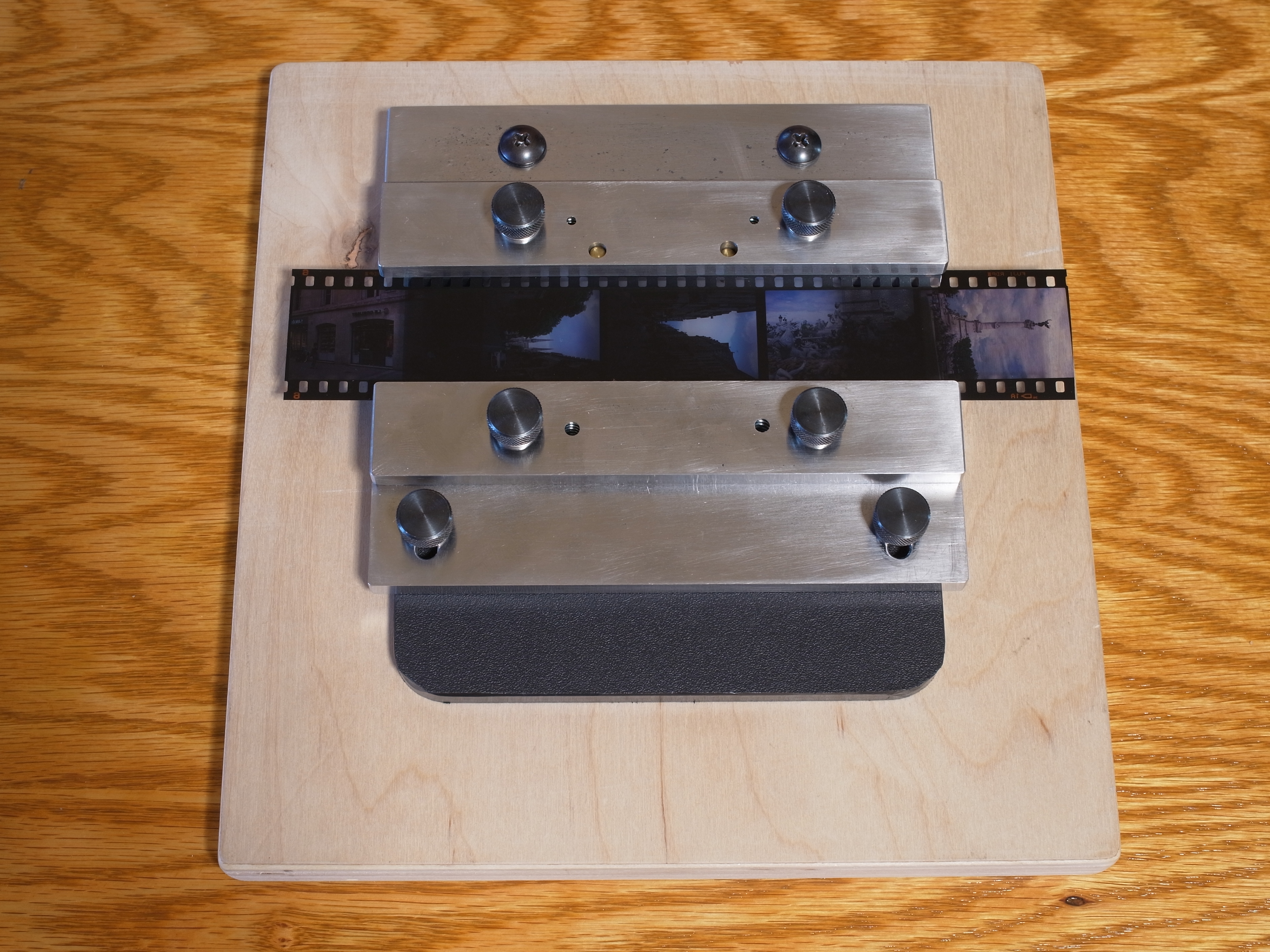
First a shot of the whole apparatus:
I tried the Sony A7 on the BEOON with:
- Micro-Nikkor 55mm f/3.5 (my old standard)
- Micro-Elmarit-R 60mm f/2.8 (one of the finest macro lenses in this focal length ever made)
- Summicron-R 50mm f/2 (superb, flat field lens: almost a reference lens)
- Schneider Kreuznach Componon S 50Mm F/2.8 enlarging lens
- Rodenstock APO-Rodagon-N 50mm f/2.8 enlarging lens
- Voigtländer Color Skopar 50mm f/2.5
- Summicron-M 50mm f/2
- Elmar 50mm f/3.5
A Foveon sensor would throw this calculation off again 🙂5000 pixels on a short side of 35mm is enough for most films. That makes one think that 5Kx7,5K=37.5Mp is enough. But... DSLR resolution is 70% vertical and 70% horizontal. 0.7x0.7=0.49 (0.5). -----> 75Mp DSLR=37.5Mp true scanner. So... 75Mp will be nice to have.
It should work with curled films... that is pretty much the purpose of the whole "jig".I like that! Great for modern films. Not sure if it will work with old curly films.
Can you elaborate?I see the culprit is a rather short focus. 75-110mm lenses can change this. But BEOON can be too small for them...
Can you elaborate?
A Foveon sensor would throw this calculation off again 🙂
I have been experimenting with a Sigma SD-1M for a few days now. It's quite impressive how there is hardly any difference in detail between the SD-1M and a 36MP Bayer sensor image (scanned slide image, that is). I like the contrast and clarity of the Foveon better. The SD-1M is a bit of a beast that needs to be tamed though... and there is always a small red hue issue, which is easily fixed in post-processing though.
That's interesting.Since introduction of Sony mirrorless we know that digital sensors covered with glass struggle with wide angle lenses in the corners.
So the better solution can be using APSC with 75-80mm on BEOON.
Sure 55mm lens is not too much wide angle, but you got the idea when we are looking for the best possible quality in the corners of the frame.
I can do that... question is, up-size the Sigma image, or down-size the Nikon one?..Can you show 100% crops of that comparison? It is interesting.
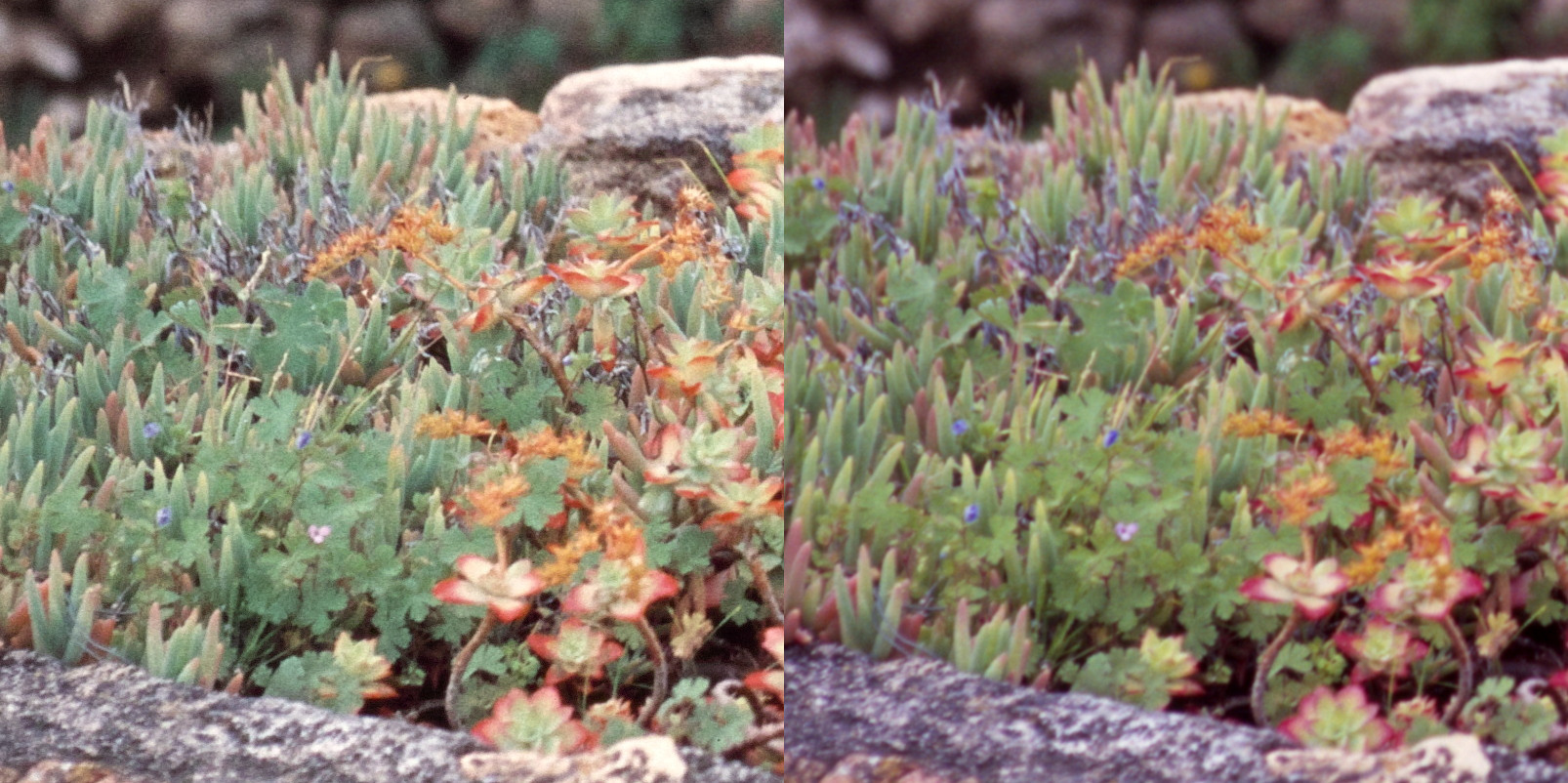
.jpg)
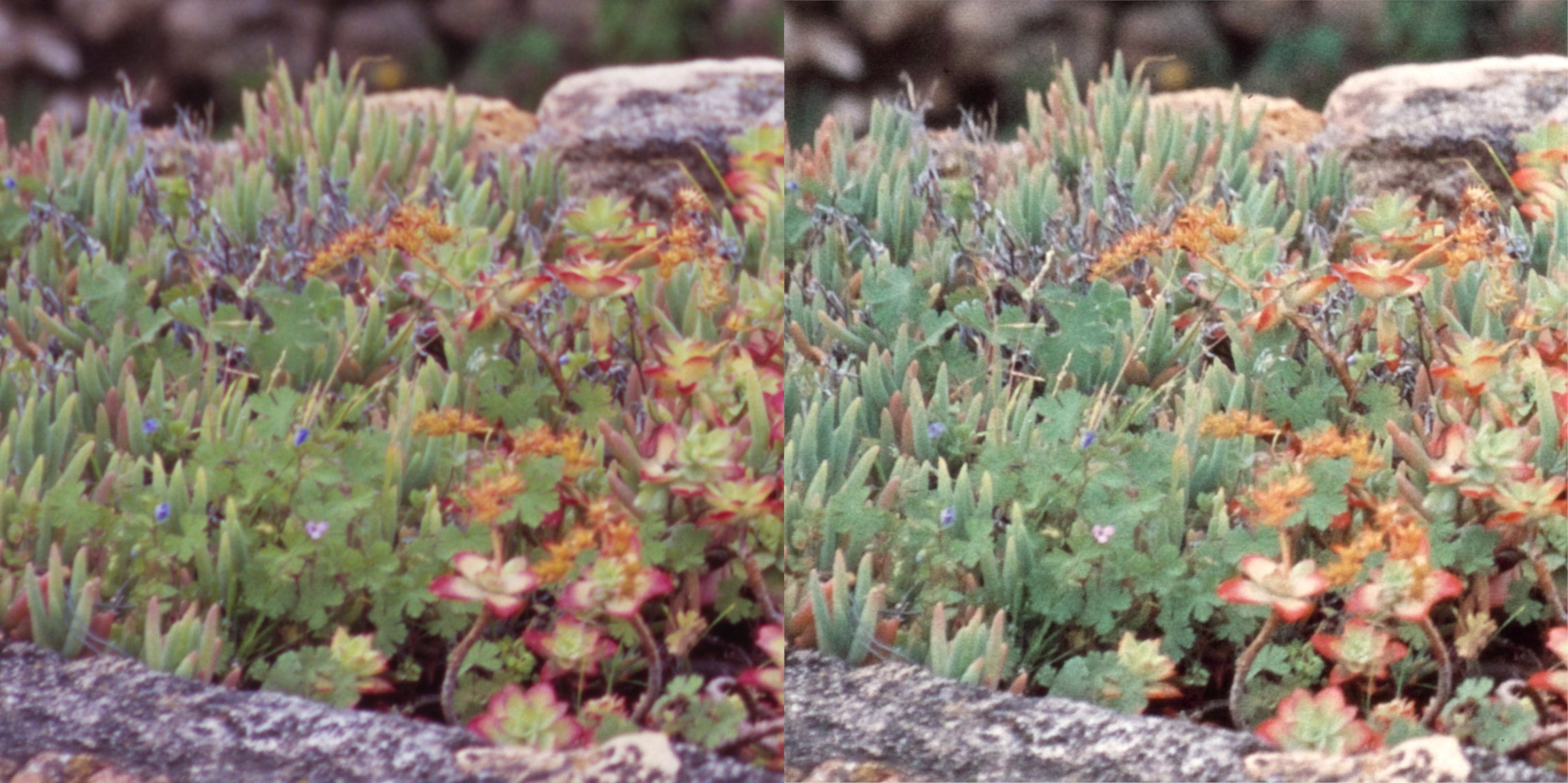
Here is a better and more delicious example.
I haven't seen any 105mm Macro DSLR-Scans of a full-frame camera yet... so you say those should turn out better? Why is that?
Hmmm... "much more", I don't see much more. Maybe a hair more. Literally.Delicious as it can be.
I see much more resolution on the left side. Do you know grain trick? I use it to compare grain on flat parts of the images.
From my experience, it appears to be an advantage to use APS-C vs. full-frame. Because you will get much less vignetting. It's easy to test—just take a picture of your light source only, properly exposed. Then open it in GIMP or PS and check the RGB or HSL values in the corner vs. the center.I play with what I have and it is APSC and a bunch of scanner lenses. I have tried lenses in 105-110mm range too. Some are not great, some are, so it more depends on the lens.
What is your problem with the stitching? What program are you using? I can recommend Image Composite Editor, a free stitching program from Microsoft. It's scary how well it works in all automatic mode...For 35mm I settled on Pentax bellows and 75mm lens. It's compact and using slide/roll adapter one can scan rolls really fast. Not the best film holder, but OK. If I want to go deeper I attach those bellows to moving carriage that can roll (manually) on a sandwich of two big scanner AN glasses. (I have some). Light table is below the glasses.
Thus it's possible to scan all kinds of film, though I'm not fully happy with stitching and prefer one shot scans.
Thanks for the samples a lot!