Skiff
Well-known
Hi,
being the OP I am quite astonished about so much reactions and replies.
Of course I cannot reply to everyone.
Therefore I will focus on the most important facts:
1. Status of the digital camera industry:
Some here said that there is no crisis. That is quite blind and naive, and ignoring the real numbers.
There is indeed a very severe crisis. The digital bubble has burst:
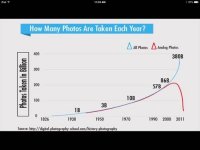
The market crashed on only half (!) of its former size in only 3 years. That is an even bigger crash than film had some years ago.
And not only the sales crashed, but also the margins for manufacturers and distributors. It is extremely difficult to earn (sufficient) money with digital cameras.
Lots of the Asian OEM manufacturers for digital compact cameras (DSC) had to quit the market and fired employees.
The manufacturers expect the market to further decrease down to only 20-30 million units p.a..
That will result in further companies leaving the market.
2. Reasons for the sales crash:
- smartphones are significantly hurting the DSC market, but the smartphone bubble will burst in 2-3 years
- the whole digital camera market (DSC, mirror-less and DSLR) is completely oversaturated, because the market was totally flooded for more than a decade with digital cameras
- because of this giant over-supply the used market is hurting sales of new cameras in a significant way
- new cameras offer only very tiny advantages compared to their forerunners; but higher quality cameras still cost a little fortune: Customers realize how extremely expensive it is to upgrade, and how little additional value they get
- Customers realize that buying a new camera in a 2-3 year time span sums up to a very big fortune, with very little benefit for them
- Customers realize that they have spend so much on digital gear in the last 10-12 years that it is more than two whole photographer lifes of film
- if you want a better sensor, you have to buy a complete new camera; with film you just change the film and keep your camera
- most serious photograpers are completely tired of the digital upgrading rat race.
3. Status of the film industry:
Some here said the film industry is in an even more problematic situation.
The facts do say otherwise:
- instant film is making a big comeback with significant increasing sales; Fuji had to increase their capacities to satisfy the demand
- Professional film sales have started to stabilise, some types are already increasing
- RA-4 silver-halide paper is making a strong comeback with increasing sales; Fuji has increased its R&D funding in this field
- InovisCoat in Germany has built a new, modern, right-sized film/paper factory and are producing colour and BW materials for different customers
- Ilford is building a new, modernised factory in the next two years; investing a double-digit million sum in Brit. Pounds
- Film Ferrania is restructuring and modernising its factory and will start film production next year
- new cameras for film were introduced this Photokina, and there were lots information there that more camera manufacturers will follow: very good news for our bartender Stephen 🙂.
Film will be the "new Vinyl".
Vinyl sales hit the bottom in 1993. Since then the sales have increased by a factor of 20 (!!).
Film is cool again.
Cheers, Jan
Very exact analysis, Jan.
I completely agree.
I see it here with all my friends, and in the local photo club, and my local, big brick-and-mortar photo shop reports the same:
The people just don't want to spend such a huge money for only tiny, negligible improvements.
1500€ to 6000€ for a camera with a real sensor (FF, 24x36mm). But do you really see improvements in the picture in comparison to the forerunner?
With 99,5% of the shots: No.
Photographers are not willing anymore to waste enormous cash in this upgrading race forced by the marketing of the manufacturers.
They do use their cameras now much longer.
And lots began to realize:
Not the camera is the bottle-neck for good pictures: They themselves are the bottleneck.
And as 99% of the digital photographers only view their pictures on the lowest quality viewing medium, the computer monitor, and don't make real prints, they realize the complete stupidity of this upgrading rat race of the last years:
LCD computer monitors cannot show real halftones.
The resolution is ridiculously low with 1-2 megapixels.
Spending so much money for a 24 or even 35 MP digital cam, but then only using the tiny fraction of 1-2 of it........
Wasted capital.
If they at least would make (bigger) prints and really "activate their megapixels" (on silver gelatin colour and BW paper, lots of labs are doing that with their laser or LED machines).