Do you change films mid roll?

Never did when I was shooting film. Now that I shoot digital I can set iso whenever I want. And in the RAW developer I can switch from colour to B&W with a mouse click. 🙂

 
Yes, I change midroll for 35mm format. But only if there's more than 1/3 of the frames left. If not, I have them processed/printed.

Main reason for changing is going from B&W to colour and back. I'm in the habit of using 400ISO exclusively, so it's not for reasons of swapping low and high ISO.
 
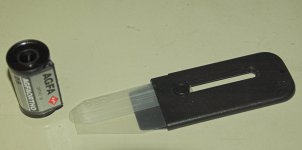
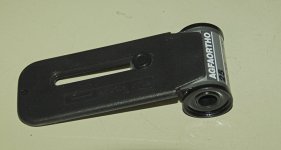
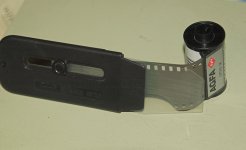
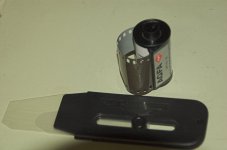
Her is a handy tool to extract film from the cassette.
It is called "film picker".
Very useful in the darkroom too.

Wim
 

Attachments

  • tool1.jpg
    tool1.jpg
    50.3 KB · Views: 0
  • tool2.jpg
    tool2.jpg
    57.2 KB · Views: 0
  • tool3.jpg
    tool3.jpg
    58.6 KB · Views: 0
  • tool4.jpg
    tool4.jpg
    58 KB · Views: 0
I've always been a bit afraid of changing film. I tend to us the 2 bodies method instead.
and I also hate wasting film. I've found that 36 films are too big for me. I seem to take on average 25 shots and I've always been very economical with film. getting as much as it's possible to get from a roll. So I can happily get that amound from a 24.
 
wdenies said:
Her is a handy tool to extract film from the cassette.
It is called "film picker".
Very useful in the darkroom too.

Wim


Perhaps I'm the exception, but every time I try one of these I find it next to useless. I've taken to developing my own now so the 'waste' issue isn't quite so acute. I stick to B&W 400 and carry a couple of 100s just in case the light is fantastic.
 
I do this a lot, too, although it's a habit I'm trying to break myself of. I write the frame # to advance to and the E.I. on the leader of the roll, and some notes either on the cassette or on some masking tape which goes on the cassette. I always carry a sharpie or two for this purpose, and there's some tape in my bag. I tend to keep a piece of white tape on the baseplate of the camera with notes about E.I. and dates/subjects shot which I then transfer to the roll when it comes out of the camera. This is especially helpful when I leave film in the camera for a while after a given shoot session, since my M3's don't have film reminder windows. I hate forgetting what emulsion and E.I. is loaded up. I'm trying to get better about always shooting out a roll- I hate having two or three different subjects and lighting situations on one roll- it makes my developing and my archiving less precise.
 
A roll of Delta 400+2 that I processed recently was, from a sheet of paper I keep with it:
removed at 5 shots in for Delta 400, placed back in later for low light.
removed at 7 shots in for the same Delta 400, placed back in later for low light.
removed at 12 shots in for TriX, placed back in later for low light.
removed at 20 shots in for the same TriX roll, placed back in later for low light.
removed at 28 for.. some other roll of film I forget, placed back in for low light.
removed at 30 shots in, placed back in later for low light.
removed at 35 and processed. Everything was and looked like a roll that was in there the whole time (including frame spacing, thank my over obsessive film loading tendencies)

I do this CONSTANTLY! I just bought another M bodied Leica just to have one camera specifically for low light situations.

Don't be afraid to switch film, although it might start to really piss you off later.

Edit: I had written Delta 1600 when I meant Delta 400+2
 
See, this is why sheet film is so much more convenient than rollfilm.

Actually I used to swap rolls with 35mm occasionally. I would mark the leader with the number of exposures, and then would advance the film an extra exposure when I put it back in, and I never had a double exposure.

Now I use 35mm for fairly limited purposes (mostly bird photography and copy slides and occasional low-light stuff), so it doesn't come up that often. I have multiple backs for my MF SLR, and I usually only shoot one film at any given time in my other MF cameras (and 120 rolls are short anyway), and for the cameras that use sheet film, it's just not an issue.
 
SolaresLarrave said:
"Advance to frame 25" (If I shot 23 frames before). That way I don't have to worry about missing or overlapping images.
how do you advance?
when i cock my lever, i need to fire off the shutter before i can advance again
firing off would mean exposing the film to light
can someone teach me?
 
Yes, sometimes, still have two rolls I begun in spring in my fridge, have to fill them soon.
 
haagen_dazs said:
how do you advance?
when i cock my lever, i need to fire off the shutter before i can advance again
firing off would mean exposing the film to light
can someone teach me?

Cover the lens with a lens cap, or as I do, set the shutter speed to the fastest and the lens to f/16 or f/22 or whatever then cover the lens with your hand.

As to not fully rewinding.. put the camera up to your ear and rewind until you hear a sort of "SNICK" sound which indicates that the film has rewound off of the film take up spool. At that point, there should be about 1 hand width of film left outside the cassette. Now just open up the camera and take it out for storage.
 
I do it a lot, too, ever since the folks over here taught me how a while back. Occasionally, I do end up over-rewinding, I'm getting a film picker to help with that. Also, had occasional overlapping pictures, and wasted a few frames advacing to make sure I don't get overlaps. But it's an economical way to test more than one camera with just one roll of film, IMO.🙂
 
Since I started this thread, I have really done this a lot. It works great and is very exact. I never roll back the film all the way inside the cassette anyway since I don't want to cut the film leader in the dark.

But now, when I am looking for some MF-camera that takes sharper pictures than my Iskra, I am wondering if I really need to exchange backs. An old Mamiya 645 is soo cheap. Maybe stopping changeing film all the time could teach me to not use 5 different films combined with 5 different developers...

/matti
 
Back
Top Bottom