Do's and Don'ts of Diafine

Hello Jin,
No agitation with Diafine,just 4 minutes for both A and B parts.
In low contrast situations rate your TriX at 1200;rate it at 1000 in high contrast situations.
For Diafine I rate Neopan 400 at 640.It works,but I LOVE the combination Neopan400 and Calbe A49.

corneliu
 

Attachments

  • Neopan400+CalbeA49.jpg
    Neopan400+CalbeA49.jpg
    141.1 KB · Views: 0
  • Neopan400+Diafine.jpg
    Neopan400+Diafine.jpg
    101 KB · Views: 0
  • TriX+Diafine.jpg
    TriX+Diafine.jpg
    143.8 KB · Views: 0
matti said:
Tom, what do you rate the efke-films at?

/matti

Hi.

Nominally 100 for the 50 and 200 for the 100. I haven't tried the 25. BUT I am pretty sloppy with my exposure technique sometimes - another reason I like diafine; you get away with quite a lot. Anyway, the 50 is really nice at 100.

About the agitation I think the fact that we have two camps with opposite views just bears out the point about what a forgiving developer this is!

Use it, abuse it, just don't pour it back in the wrong bottle.

Tom
 
Well, Plus X in Diafine does look lovely indeed.

So it doesn't matter what you rate your film at, the dev times are 3-4 mins minimum in A and B each?

Thanks for all the contributions.
 
jrong said:
So it doesn't matter what you rate your film at, the dev times are 3-4 mins minimum in A and B each?


That is as I understand it.
 
jrong said:
So it doesn't matter what you rate your film at, the dev times are 3-4 mins minimum in A and B each?

Yup, that easy....

Bill's earlier post explains the chemical action. Bath A is the developing agent, you soak the film to allow it to absorb this to saturation. After 4ish minutes it is saturated, so that action is finished. Bath B is the activating agent which reacts with the developer. The developer is local to the film (saturated in there) so the activating agent will react until the developer is exhausted. When the developer is gone in about 4ish minutes the chemical reaction is over.

In a one bath developer both the developing agent and activator are present together in abundance. The chemical reaction between the two and the film will continue long after your film is fried so timing when using these chemicals is much more important.
 
jrong said:
So it doesn't matter what you rate your film at, the dev times are 3-4 mins minimum in A and B each?

It does not seem logical, does it? After all, if you bake a cake, it is done after a certain period of time. If you continue to bake it, it burns. Bake it long enough, and the fire department comes to see you.

Standard development is like that. You don't develop enough or you develop for too long, and you get results that are not happy.

But Diafine (and most two-solution developers) don't work that way.

Most developing agents (one of the chemicals in typical developer solutions) are terribly, terribly slow. If you used them by themselves, it would take years for your film to develop. So, an accellerant is added, which makes the developer go loco on the film. In fact, it goes so loco that a buffer and sometimes a retardant have to be added - in precise proportions so that the film is fully processed - for shadows, midtones, and highlights - at about the same time for a given temperature and dilution.

In those cases, the developer has to be kept moving - agitation moves exhausted developer away from contact with the film emulsion and moves fresh developer in. That's why inversion and agitation are called for with most standard development.

Diafine instead breaks down the chemistry so that solution A has just the developer in it. This is absorbed by the film when you soak it for three minutes (you can soak it longer, but once a sponge is full, it is full, and emulsion is a very thin sponge on the surface of the film base).

When you pour solution A back out of the tank, that portion which was absorbed by the film emulsion is still there, waiting to be activated.

Solution B contains the other half of the developer - the accellerant and etc. When you pour it in, it combines with the developer that has been absorbed into the film emulsion and begins to attack like crazy, turning silver halide into metallic silver as appropriate. But when the absorbed developer is exhausted, development stops. No need to worry about the time, once it is done, it is done. There is nothing left for the accellerator to accellerate. This usually happens in 3 minutes.

That's where we get the 3 minutes plus 3 minutes thing. And that's why it is always the same no matter what speed you shot the film at, or what it was rated for. When the developer that's been absorbed into the emulsion is all exhausted, development is over. So the cake can never get overbaked.

This also means that Diafine keeps nearly forever in the bottle. You reuse it, pouring both solution A and solution B back into their respective bottles after each use. Solution A will slowly go down - some is being used by each roll of film and you don't get that back, but Solution B will stay the same level, more or less. And since the developer is not 'active' in the bottle by being mixed with accellerant, it does not break down in the presence of air nearly as much as most one-solution developers, which often have a limited shelf life.

The downsides are these:

1) Diafine gives a speed increase to everything. How much differs, but it is always there. Hard to shoot film at the rated speed, so if you intended to shoot slow film, you might not be able to with Diafine.

2) Since everything is fully developed always, there is no such thing as 'pushing' or 'pulling' film by intentionally over or underdeveloping in Diafine as you can with other developers. Some folks pull the film out of solution B earlier, but that's a bit dicey for most of us.

I hope this lengthy response helps!

Best Regards,

Bill Mattocks

 
Bill,

Thanks for the easy to understand Diafine explanation. I will be developing my first roll of B&W film with this stuff in a week or two and its good to understand what will be happening inside my tank.

The one problem I do have is what to do with my roll of Tri-X. My Yashica GS has a max film speed of 1000, my Canonet GIII QL17 goes to 800 but my Voigtlander Vito CD has a build in meter where I can adjust to ISO 3200 I believe. So into the Voigtlander it will go but the max shutter speed on that is 1/250. Maybe it will work well inside the church at my nephew's 1st communion this weekend.

I will be using the following process lifted from a earlier post from user T_om.

1. Film in tank.
2. Pour in A. Bang tank and do an inversion to break up bubbles.
3. 3 to 4 minute soak in A, no further agitation required.
4. Dump A back into the A jug.
5. Pour in B. Bang tank and do one inversion to break up bubbles.
6. 3 to 4 minute develop in B with 1 gentle inversion half way through.
7. Dump B back into the B jug. DO NOT over agitate in solution B.
8. Water rinse
9. 2 minutes in fixer
10. 15 minute wash
 
RicardoD said:
Bill,

Thanks for the easy to understand Diafine explanation. I will be developing my first roll of B&W film with this stuff in a week or two and its good to understand what will be happening inside my tank.

The one problem I do have is what to do with my roll of Tri-X. My Yashica GS has a max film speed of 1000, my Canonet GIII QL17 goes to 800 but my Voigtlander Vito CD has a build in meter where I can adjust to ISO 3200 I believe. So into the Voigtlander it will go but the max shutter speed on that is 1/250. Maybe it will work well inside the church at my nephew's 1st communion this weekend.

I will be using the following process lifted from a earlier post from user T_om.

1. Film in tank.
2. Pour in A. Bang tank and do an inversion to break up bubbles.
3. 3 to 4 minute soak in A, no further agitation required.
4. Dump A back into the A jug.
5. Pour in B. Bang tank and do one inversion to break up bubbles.
6. 3 to 4 minute develop in B with 1 gentle inversion half way through.
7. Dump B back into the B jug. DO NOT over agitate in solution B.
8. Water rinse
9. 2 minutes in fixer
10. 15 minute wash

What is the lens speed on your Vito CD? If it is a fast lens, then you should be fine. Tri-X is supposed to have a Diafine-effective speed of 1600, but I find it is not really that great at 1600 - I've been using 1250 and getting results I consider pleasing. Others say differently - so your mileage may vary. It would be good if you could try this before you need to use it for real.

As to your steps - of course I'd say don't invert or agitate at all, but as you see, others disagree. However, if you choose to invert/agitate, bang tank afterwards to dislodge bubbles, not before.

Also, you don't have to water rinse before fixing *if* you are not going to reuse your fixer. Some people reuse it, some use it as a one-shot. Rinsing before fixing can get rid of excess developer and cause your fixer to last a bit longer - there is some debate on how much longer, but in general it doesn't hurt to do it.

When you are done with the 15 minutes final rinse, I like to dunk the reel for 30 seconds in a 200:1 Photo-flo solution with water (200 parts water to 1 part Photo-flo). This is a 'wetting agent' that reminds me of liquid dish-soap. It helps prevent water spots from forming as the film dries.

Some people use a rubber squeegee to get rid of the excess water and some just use their two fingers (index and middle) to wipe off the water by pulling the film through their wetted fingers. Whichever you do, be delicate - this is where scratches happen.

Hang the film up with a weight of some kind attached to the bottom to keep it from curling up, and let it dry for an hour (minimum). Then you're ready to cut it up and scan/enlarge as the spirit moves you.

Best Regards,

Bill Mattocks
 
jrong said:
So it doesn't matter what you rate your film at, the dev times are 3-4 mins minimum in A and B each?
Yes, but don't go around thinking that you can just rate your film at any ISO and you'll get the same results. That's a whole different horse of another, er, color. 😉
 
Bill,

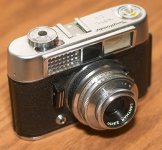
My Voigtlander Vito CD has a 50 mm. f/2.8 Lanthar lens on it. It is a simple scale focus camera so if I open it up my guesstimates on distance will have to increase in accuracy.

Anyway you have to shoot to learn! I am working on getting over my fear of "wasting" film. I just finished my second rangefinder roll in my Canonet in about half the time it took me to go through my first roll.
 

Attachments

  • vito-cd.jpg
    vito-cd.jpg
    93.4 KB · Views: 0
Last edited:
RicardoD said:
Bill,

My Voigtlander Vito CD has a 50 mm. f/2.8 Lanthar lens on it. It is a simple scale focus camera so if I open it up my guesstimates on distance will have to increase in accuracy.

Anyway you have to shoot to learn! I am working on getting over my fear of "wasting" film. I just finished my second rangefinder roll in my Canonet in about half the time it took me to go through my first roll.

You know, with your Canonet, you can shoot manual if you want to - and then you can rate your film at any ISO you wish (assuming it will process in Diafine at that ISO). What I mean is this - if you rate your Tri-X at EI 1600 (the full recommended speed for Diafine), you can use an external meter (well, you have to have an external meter) and then shoot at whatever shutter speed/aperture your external meter indicates - just set it and shoot.

The GS won't let you set the shutter speed, so you are limited to the internal meter only on that one.

But I would prefer the Canonet with the faster and very good 1.7 lens to the 2.8 Voigtlander scale or zone focus. But this is up to you. If you haven't an external meter, then your choices are a bit more limited.

Best Regards,

Bill Mattocks
 
RicardoD said:
I am working on getting over my fear of "wasting" film. I just finished my second rangefinder roll in my Canonet in about half the time it took me to go through my first roll.
The only film wasted is that which is not used.

I took out two rolls of Fuji Acros 100 which I've had in my film fridge for a while, and left it outside for two weeks now. Why that is a problem now (not that big of a problem, but the time's Poe-ticking) is because the film expired back in late 2004 (although dozens more are still in). I bought it in early 2003.

Use film. Use it! It's also the only way to learn. 😀
 
You can set the GS to 1000 and shoot the Tri-x. Tri-x in diafine wont blow the highlights easily, the highlights will just get flatter and flatter as the density increases. But with 1/3 overexposure that really wont be a problem. I rate Tri-X at 1250 in diafine, like some others on this forum. It works really well, much better than 1600 where the negative is too thin, and shadow detail is suffering. ISO1000 will be more or less like 1250. Even when I accidentally overexposed diafine by more than 1-stop, I got very good negatives. It is not like overexposing conventionally pushed film where the highlight detail would be lost.

The downside with diafine is this: When shooting low contrast scenes, you'll get dull negatives. And compared to something like HP5 pushed to 1600 in microphen (another great combination) you'll have less acute details, and less bite in pictures taken in low contrast situations. But lowlight situations usually suffer from too much contrast, not too little. Therefore, diafine works wonderfully on most occasions.

Not losing highlight detail with overexposure also allows one to be a little sloppy with exposure. It then feels a bit like shooting C41 negative, and not traditional B/W.

Berk

RicardoD said:
The one problem I do have is what to do with my roll of Tri-X. My Yashica GS has a max film speed of 1000, my Canonet GIII QL17 goes to 800 but my Voigtlander Vito CD has a build in meter where I can adjust to ISO 3200 I believe. So into the Voigtlander it will go but the max shutter speed on that is 1/250. Maybe it will work well inside the church at my nephew's 1st communion this weekend.
 
1. No need to agitate at all in B
2. Re film speed, you'll be fine, Diafine produces low enough contrast to handle 800-3200 in TriX
You'll have to print through some density but the highlights will not bloom.
 
Thanks for all the informative posts (again). Definitely food for thought.
I have a roll of expired Tri-X that I shot at about ISO 1000, should be good for a first experiment, I think. 😀

Cheers!
Jin
 
I like Diafine and have favored it for decades. My greatest mistake early-on was in agitating just as with other developers. I'm sure that's what produced thin negs with low max densities, though it seems counter-intuitive. Over-agitate leads to thin negs? Naw.... But with Diafine it does... I theorize because the agitation washes the developing agent out of the emulsion.

We discuss this unusual and interesting developer periodically. In the past it seems to me there was more sentiment for at least near-normal agitation in Diafine, while this current discussion is biased toward little or no agititation, and I think Bill said the instructions said not to agitate. Here are the instructions from a recent 1-gallon kit Diafine box:

INSTRUCTIONS FOR USE
Diafine may be used within a temperature range of 70° to 85°F with a mininum time of 3 minutes in each solution. Increased developing times will have no practical effect on the results.

DEVELOPING PROCEDURE
Any type of tray or tank may be used.
Do not pre-soak films.
1. Immerse film in Diafine Solution A for at least 3 minutes, agitating very gently for the first 5 seconds and for 5 seconds at 1 minute intervals.
2. Drain, but do not rinse.
3. Immerse film in Diafine Solution B for at least 3 minutes, agitating very gently for the first 5 seconds and for 5 seconds at 1 minute intervals.
4. Drain and rinse in plain water for about 30 seconds. The use of an acid stop bath is NOT recommended.
5. Fix, wash, and dry in the usual manner.

Optimum results are obtained if all solutions, including the wash, are maintained at the same temperature. CARE MUST BE EXERCISED TO PREVENT ANY AMOUNT OF DIAFINE SOLUTION B FROM ENTERING DIAFINE SOLUTION A.

Me again... I usual dunk 'em for 4-5 minutes just for the heck of it, and I interpret the suggestion of agitating "very gently" as no more than a nudge or two after the initial bang on the counter to dislodge any bubbles from the pouring-in. No inverting or twirling. While the box suggests higher exposure indices for almost all films, Delta 100 comes in lower at 80. That's the same as PanF, though I use PanF at 50. The speeds are just good (maybe a little optimistic) starting points, of course, and your own experience will lead you to adjust the ratings to your own taste.
 
Dougg said:
I usual dunk 'em for 4-5 minutes just for the heck of it, and I interpret the suggestion of agitating "very gently" as no more than a nudge or two after the initial bang on the counter to dislodge any bubbles from the pouring-in. No inverting or twirling.
That's what's so confusing about the "agitating" part. I still invert. I should stop doing that. Sounds like I should be even more gentle than I was. I guess the instructions should say "nudge, don't agitate".
 
Back
Top Bottom