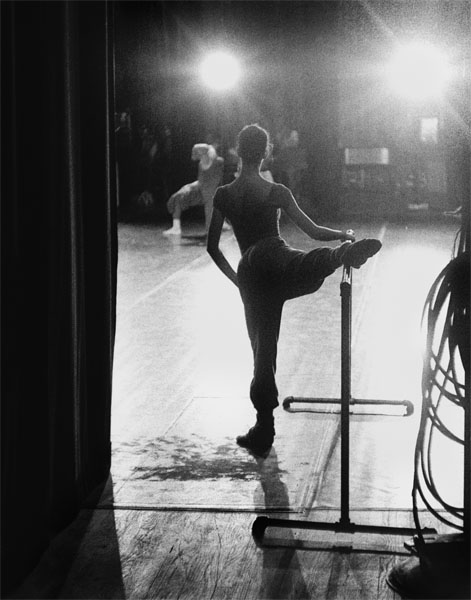
Bertram2 said:
I like this photo, it does have strong atmospheric effects indeed ! it is well exposed, i think you got the maximum out of the film.
But on the other hand it's a well suited example for a discussion about low light photography too ( I really don't like this "available darkness " nonsense) and I ask myself if not Tri-X and a very discrete and unobtrousive (fill in) flash (small soft box) would have made a better result ?
Well, let's look at that in a strictly practical sense. In this particular example, firing off ANY flash (no matter how diffused or unobtrusive) would have gotten me kicked out of the theater! It's usually an assumed but unspoken rule, and in this case (because there was a lot of press interest in this performance) I was warned explicitly.
And as it happens, this was the last picture on the roll -- so if I had decided to ignore the rule and chance the use of flash for the
first picture on the roll, I wouldn't have been around to have a chance to get this one.
There are a lot of other situations in which the use of flash, even if tolerated, changes the dynamics of the picture-taking situation in a way that may make it impossible to get the kind of result you want.
Now, I do agree with what you're getting at: If you know
in advance the kind of picture you want to make, and have the opportunity to control the situation, the best way to get a result of
high technical quality is to create the kind of lighting and environment that will let you use the equipment that will yield that quality. If you can fully control the environment and lighting, you can use whatever camera, film/sensor, lens, etc. will give you the best image.
That's exactly why I own a car-trunk-load of studio flash equipment, and am willing to haul it around and set it up whenever the opportunity presents itself to use it.
BUT... my problem with this scenario is that the pictures I can previsualize inside my head usually aren't as good as the ones that walk up and hit me in the face by accident! And given that the range of my creativity is limited, I can't afford NOT to take advantage of those accidents.
That means I have to work with equipment that's portable, flexible, responsive, and usable in a wide range of conditions. That's why I shoot with a rangefinder camera, and it's also why I find it invaluable to have a high-speed lens or two at the ready.
The
image quality may not be as good, but the
picture quality is better.
To put it another way: For me, photography is like golf, not like pool. In pool (at least where I play) we use a house rule called "gentleman's call." You're not allowed to win on a slop shot; if you luck into a shot that was NOT what you had intended, you're supposed to fess up and award the match to the other guy.
In golf, on the other hand, the rule is always "rub o' the green." That means that luck (good or bad) counts just as much as intention. If you're just trying to blunder out of the greenside bunker, and the ball happens to get caught by a gust of wind, bounce off a passing vulture, and fall into the cup -- hey, it still counts, no matter what it does to your opponent's blood pressure. It's just rub o' the green.
Photographers differ widely in skill level, which may be one reason there are such strongly-held diverse opinions on this subject. Personally, my skill level isn't high enough to play "gentleman's call" in my photography -- I have to take the rub o' the green every chance I get. Packing a high-speed lens is one way to help me get away with it.